AI Automation Agency UAE: What to Buy and What to Avoid
How UAE companies should choose an AI automation agency, compare build routes, and require logs, approvals, data controls, and measurable value.

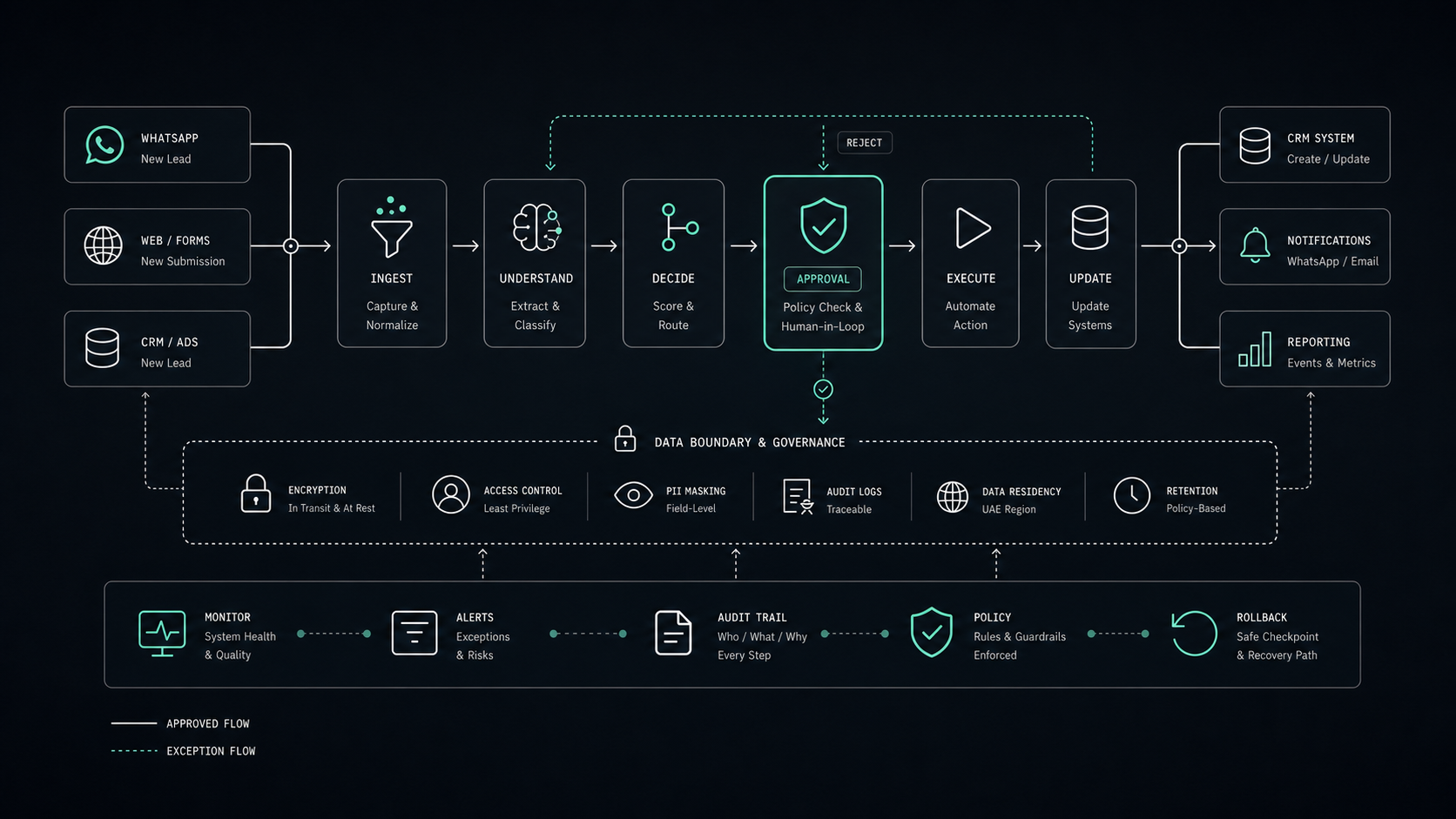
Do not buy an AI automation agency for "AI." Buy one for a named workflow with data boundaries, approvals, logs, and a measurable handoff. In the UAE, the right provider is the one that can show how the system survives PDPL-aware review, board scrutiny, WhatsApp/CRM reality, and a rollback day.
The Verdict: Buy The Workflow, Not The Agency Label
An AI automation agency is worth hiring only when it can turn one costly manual workflow into a governed operating system. If the pitch starts with vague agents, generic chatbots, or a long menu of tools, slow the deal down. The first buying question is not "which model do you use?" It is "which workflow will change, who approves the output, what gets logged, and what happens when the system is wrong?"
That distinction matters because the market is noisy. Gartner predicts that over 40% of agentic AI projects will be canceled by the end of 2027, citing escalating costs, unclear business value, and inadequate risk controls. The same Gartner note also warns about "agent washing," with only about 130 of thousands of vendors estimated to be real agentic AI vendors. The practical lesson for a UAE operator is simple: do not buy vocabulary. Buy the workflow proof.
For a UAE company, the proof has local shape. A clinic intake workflow handles patient identity and appointment context. A real-estate lead workflow handles WhatsApp messages, phone numbers, preferences, and sometimes budget signals. A fund or family-office workflow may touch investor communications, research notes, or deal documents. Those are not abstract automation tasks. They are business records with privacy, access, audit, and handoff implications.
The strongest agency is not always the one with the flashiest demo. It is the one that can say, before build starts:
- Here is the workflow boundary.
- Here is the data we touch and the data we do not touch.
- Here is where a human approves.
- Here is the log record for every AI-assisted decision.
- Here is the monitoring view after launch.
- Here is how the workflow is paused, rolled back, or handed over.
That is the buying rule: choose the provider that can make the workflow safer and faster at the same time.
The Route Comparison For A UAE Operator
Most UAE companies do not need to choose between "AI" and "no AI." They need to choose the right delivery route for one operational problem. The route determines how much control you keep, how fast you move, and whether the system survives procurement, PDPL-aware review, and post-launch ownership.
The agency route wins when the workflow is valuable but messy. A Dubai brokerage that receives property leads through WhatsApp, qualifies them manually, updates a CRM late, and loses visibility on follow-up is a fit. A clinic that needs intake routing, appointment reminders, and admin handoff is a fit. A logistics operator that wants every shipment exception summarized, routed, approved, and logged is a fit.
The tool-first route wins when the process is already standard. If you only need form submissions to create CRM tasks and send a templated email, buy the tool and configure it. If you are still comparing platforms, read the tool route in AI Workflow Automation Tools for UAE Companies before you hire a services provider.
The internal route wins when the workflow is strategically sensitive and permanent. If it touches proprietary underwriting logic, regulated investor communications, or deep ERP data, an agency can still help with scoping and architecture, but your own team should own the long-term system.
The wrong route is the one that hides the real operating cost. A low implementation fee can become expensive if no one owns monitoring. A large agency retainer can waste months if the first workflow is not measurable. A SaaS tool can look cheap until usage, seats, message fees, and manual workarounds pile up.
The Controls That Must Be In Scope
The minimum scope for a UAE AI automation build is not the prompt. It is the control layer around the prompt. That layer is what keeps a helpful workflow from becoming a shadow system no one can audit.
The UAE legislation portal lists Federal Decree by Law No. (45) of 2021 Concerning the Protection of Personal Data as active, issued on 20 Sep 2021 and effective on 02 Jan 2022. The same official page notes that, for interpretation, the original Arabic text prevails if there is a conflict. For an operator, the implementation takeaway is not to turn an automation discussion into a legal memo. It is to make the data handling explicit enough that counsel, compliance, or a board can review it.
Every agency scope should include these controls:
Data map. List the exact systems and fields touched by the workflow. For a WhatsApp-to-CRM workflow, that may include name, phone number, message text, budget range, property preference, lead source, assigned broker, and follow-up status. If the provider cannot name the fields, they cannot govern the workflow.
Access model. Define who can view, edit, export, and approve each step. A broker may see their own leads. A sales manager may see team performance. An admin may manage routing rules. The AI layer should not receive broader access than the workflow needs.
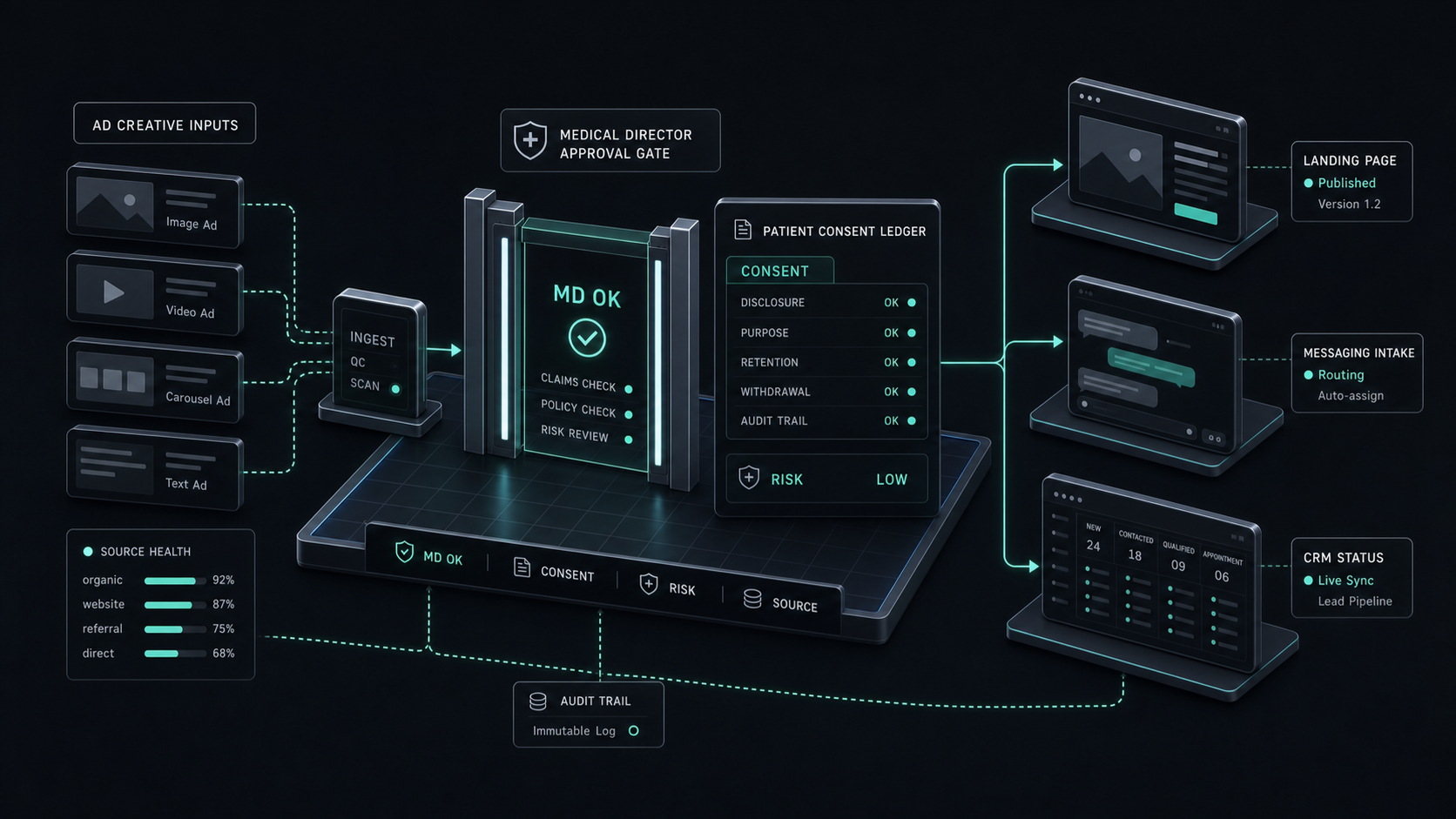
Human approval. Decide what the system can draft and what it can send. Low-risk internal summaries may go straight to a task queue. External messages, price commitments, refund decisions, medical guidance, legal statements, or investor-facing language should require human approval.
Log record. Store enough context to reconstruct what happened. A practical log includes timestamp, user, source system, input reference, prompt or rule version, retrieved knowledge source, generated output, action taken, approval status, and error state. This is what makes the workflow reviewable after a complaint, wrong response, or audit question.
Data residency and transfer decision. Ask where the data is processed, where logs live, which subprocessors are involved, and how exports work. Do not accept "cloud" as the answer. The provider should name the systems and explain the tradeoff clearly.
Monitoring. Track throughput, exception rate, approval rate, cost per completed task, user overrides, and failure reasons. If the dashboard only shows model calls, it is not an operations dashboard.
Rollback and handover. The old manual route should remain available until the new system proves itself. The agency should also hand over credentials, architecture notes, integration diagrams, monitoring rules, and a maintenance plan.
These controls are also useful if your provider claims Dubai AI Seal readiness. The official Dubai AI Seal page describes a DCAI verification system for Dubai's AI industry, with serial-number verification for approved suppliers. It also states that the service is free of charge. The buyer takeaway is direct: if an agency claims the Seal, ask for the serial number and verify it. If they do not have it, the absence is not automatically fatal, but the control evidence still matters.
A Worked Example: WhatsApp Lead To CRM With Approval
A useful agency proposal should make one workflow concrete enough that your team can argue with it. Here is a reference workflow for a Dubai real-estate brokerage. It is illustrative, not a client result.
Define the trigger
A new WhatsApp inquiry arrives from a portal lead, referral, signboard, or repeat buyer. The system captures the channel, message text, phone number, timestamp, and broker assignment. It does not pull unrelated chat history unless the brokerage has a documented reason and permission model.
Classify the lead
The AI layer classifies intent: buying, renting, selling, valuation, viewing request, financing question, or unknown. For low-risk routing, an example confidence threshold is 0.80. Below that, the lead goes to a human queue instead of being routed automatically.
Draft, do not overcommit
The system drafts the first response using approved brokerage language and available listing data. It should not invent availability, quote unapproved discounts, promise returns, or make legal claims. If the message includes a price change, discount, refund, or commercial commitment above AED 5,000, it requires human approval before sending.
Update the CRM
After approval, the workflow creates or updates the CRM record with source, intent, property preference, budget signal, next step, broker owner, and follow-up due date. The broker should not need to copy details manually from WhatsApp into a separate form.
Log the decision path
The log stores the source message reference, classification, confidence, response draft, approval status, approver, CRM action, and error state. If a customer complains, the sales manager can see what the system suggested and who approved it.
Monitor exceptions
The monitoring view shows unresolved leads, messages awaiting approval, routing errors, duplicate CRM records, high-value approvals, and broker overrides. The goal is not to remove judgment. The goal is to make judgment faster and visible.
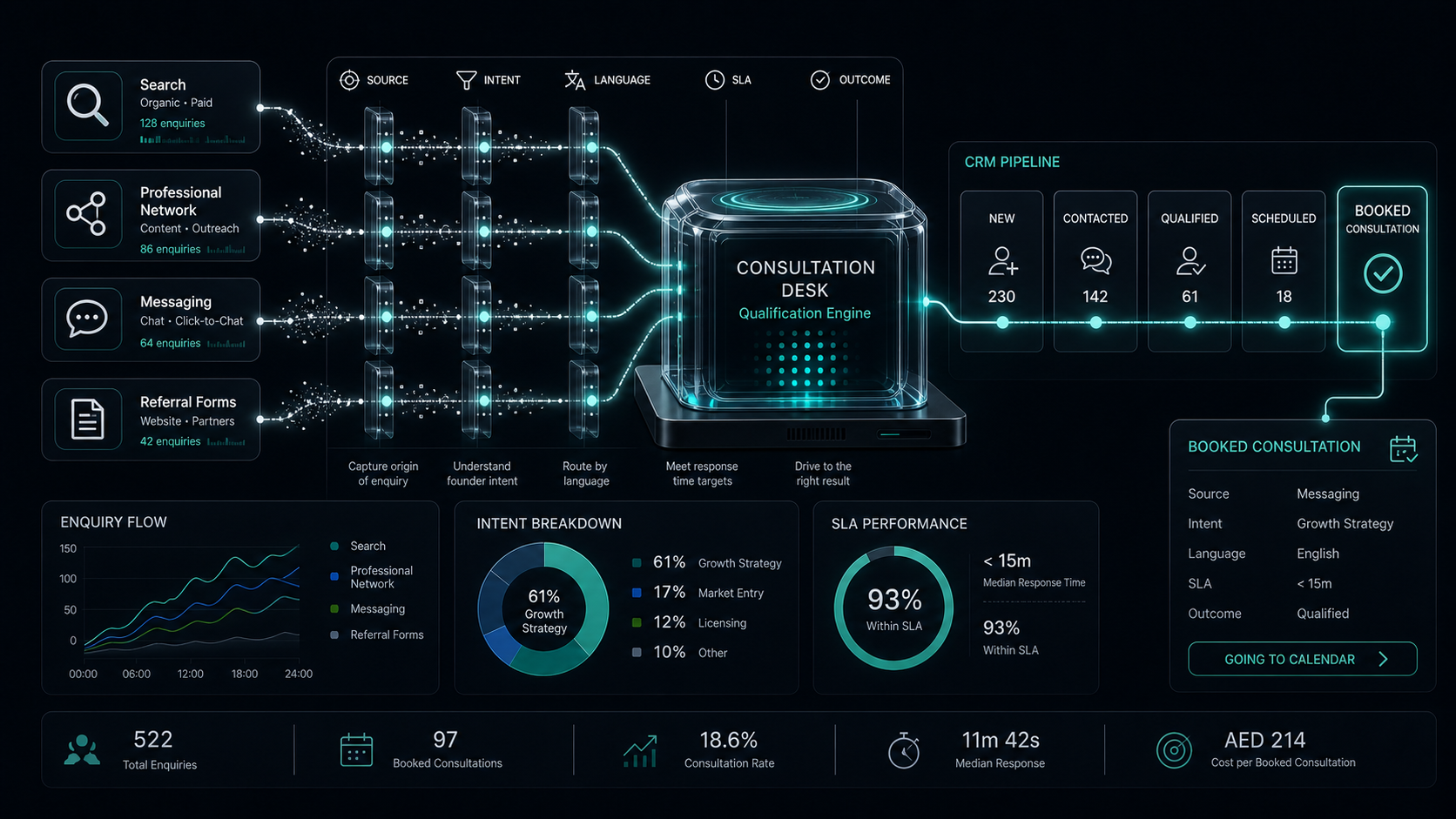
This example is small enough to ship and important enough to matter. It touches revenue, customer experience, broker productivity, and data handling. It also exposes whether the provider understands UAE operating reality: WhatsApp is central, CRM hygiene is uneven, English and Arabic messages both appear, and managers need follow-up visibility without reading every chat.
If an agency cannot turn your equivalent workflow into triggers, fields, approvals, logs, and monitoring, it is not ready to build production automation for you. Start with AI Automation Services in the UAE if you still need to decide which workflow should come first.
How To Read The Quote
A serious AI automation quote is itemized. A weak quote hides the hard parts in a single package price and leaves you guessing what happens after the demo.
Ask the provider to separate the scope into these commercial lines:
- Discovery and workflow design.
- Implementation and integrations.
- AI model, API, messaging, and software pass-through costs.
- Testing, training, and change management.
- Monitoring and support after launch.
- Documentation and handover.
There is no useful public standard price for UAE implementation work that applies across clinics, brokerages, funds, logistics operators, and service firms. The price depends on system access, integration complexity, data sensitivity, approval requirements, user count, and support expectations. A quote before workflow discovery is a guess.
The better commercial test is whether the quote makes the operating burden visible. Who pays for WhatsApp message fees? Who owns model usage? Who handles failed automations at midnight? Who changes a prompt or rule after a policy update? Who reviews logs? Who can export the workflow if you leave the provider?
The quote should also define acceptance criteria. For example: the workflow is accepted when the CRM update works, the approval queue works, the log record is complete, the rollback path is tested, and the business owner can read the monitoring view without the agency in the room.
Provider Red Flags In The UAE
The fastest way to filter providers is to ask operational questions and watch whether the answers become clearer or vaguer.
Red flags:
- They pitch generic agents before naming the workflow.
- They cannot explain where customer data is processed or stored.
- They say human approval is optional for external commitments.
- They have no log schema.
- They show a demo but no monitoring plan.
- They do not test Arabic and English inputs.
- They cannot explain who owns credentials, prompts, workflow rules, and documentation after handover.
- They claim Dubai AI Seal status but will not provide a serial number for verification.
- They promise broad autonomy where a controlled workflow would be safer.
- They cannot say what happens when the AI output is wrong.
The strongest providers are usually more specific and less dramatic. They will narrow the first release, ask uncomfortable data questions, define the approval boundary, and tell you which parts should stay manual. That restraint is a positive signal.
The Durable Buying Rule
Buy the smallest governed workflow that creates measurable throughput without weakening control. For a UAE company, that usually means starting with admin, sales, intake, routing, reporting, or knowledge-work handoff before touching regulated advice, medical judgment, credit decisions, or investor-facing recommendations.
The right agency should leave you with a working system and an operating model: what changed, what gets logged, who approves, how performance is monitored, where the data lives, and how the workflow can be paused. If those answers are not in the scope, you are not buying automation. You are buying a demo.
How much does an AI automation agency cost?
There is no useful public standard for UAE implementation work. Ask for an itemized quote that separates discovery, implementation, software and API usage, monitoring, support, and handover, then compare the cost against one measurable workflow outcome.
How do I choose an AI automation agency?
Ask each provider to design one workflow before they demo tools. The strongest answer names the data fields, systems, approval gates, log record, monitoring view, rollback path, and business owner.
What does an AI automation agency do?
A serious agency connects existing systems, automates repeatable steps, adds AI where language or judgment support is useful, and wraps the workflow with approvals, logs, monitoring, and handover. It should not replace your operating model with an opaque black box.
Should a UAE company hire an agency or buy automation tools directly?
Buy tools directly when the workflow is simple and already supported by the platform. Hire an agency when the workflow crosses systems, needs local exceptions, requires approval controls, or must be documented for management, counsel, or procurement.
Scope Your Workflow Automation
DVNC.ae maps one UAE workflow, designs the governance layer, and scopes the automation path before you buy or build.
Jun 4, 2026