WhatsApp for Dubai Clinics: Build the Patient Enquiry System Before You Automate
A Dubai clinic playbook for turning WhatsApp enquiries into booked appointments while protecting consent, health information and CRM attribution.

WhatsApp should be the front door to a Dubai clinic, not the patient record. Automate booking logistics, give every enquiry a named owner, and move clinical detail into the clinic-approved care system before speed creates a data problem.
The verdict: use WhatsApp as the front door, not the record
The right WhatsApp workflow ends at a confirmed appointment or a controlled human handoff. It does not ask a patient to build a clinical history inside a reception inbox.
That distinction matters because a booking enquiry can turn into health information in one reply. “Do you have a dentist available in Jumeirah on Thursday?” is appointment logistics. “Here is an X-ray, my medication list, and the pain I have had since last week” is a different class of conversation. Your system must recognise the boundary even when the patient does not.
Federal Law No. (2) of 2019 requires patient information to remain confidential and limits access to authorised people and necessary work. It also sets a minimum retention period of 25 years from the last health procedure for health data and information kept through information and communications technology. That does not mean every booking message is automatically a medical record. It means a clinic should decide, with its compliance owner, what becomes part of the record before an informal inbox accumulates clinical detail with no approved retention path.
Consider an aesthetic clinic receiving a message about laser treatment. Reception can collect the preferred branch, appointment window, language, and service of interest. If the patient then sends a photograph and asks whether the treatment is suitable, the automation should stop, acknowledge the handoff, and route the question to the clinic's approved clinical pathway. The goal is not to block the patient. It is to put the question in the system where the right person can answer it and the clinic can govern it.

Define the minimum reception data contract
Collect only what reception needs to route and book the enquiry. A data contract is the agreed set of fields, purposes, owners, and destinations for the workflow. It prevents a well-meaning receptionist, form, or bot from asking for information simply because the channel makes it easy.
Use this as a reference configuration for a Dubai dental or aesthetic clinic:
The DHA Health Data and Information Sharing Policy says consent should be specific, clear, and unambiguous. It also says consent should be sought for collecting health data and before sharing it outside direct care unless another legal condition applies. The practical move is to keep the first interaction operational: understand the request, book or route it, and do not solicit clinical detail in a marketing-owned flow.
Build one enquiry-to-booking workflow
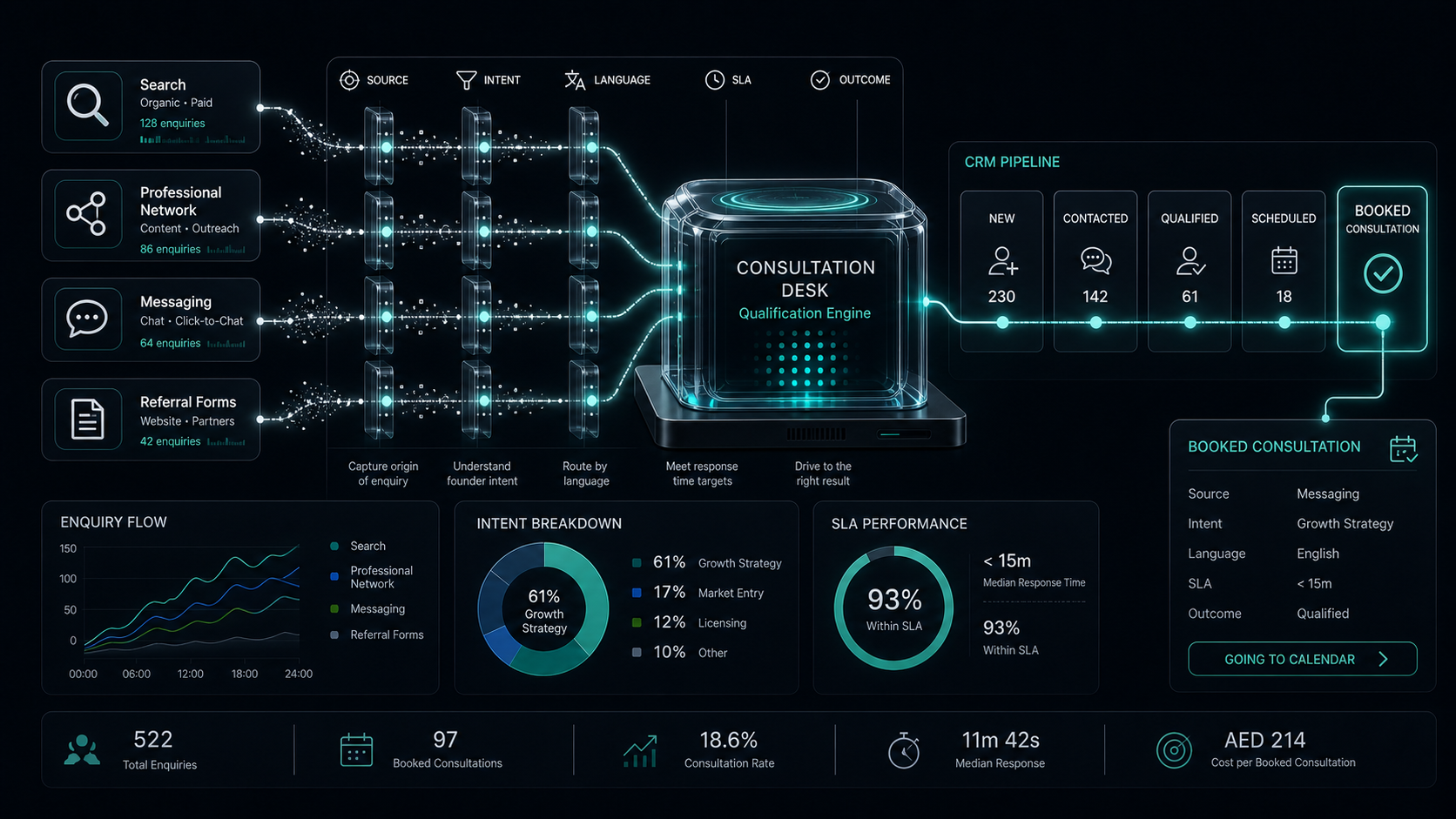
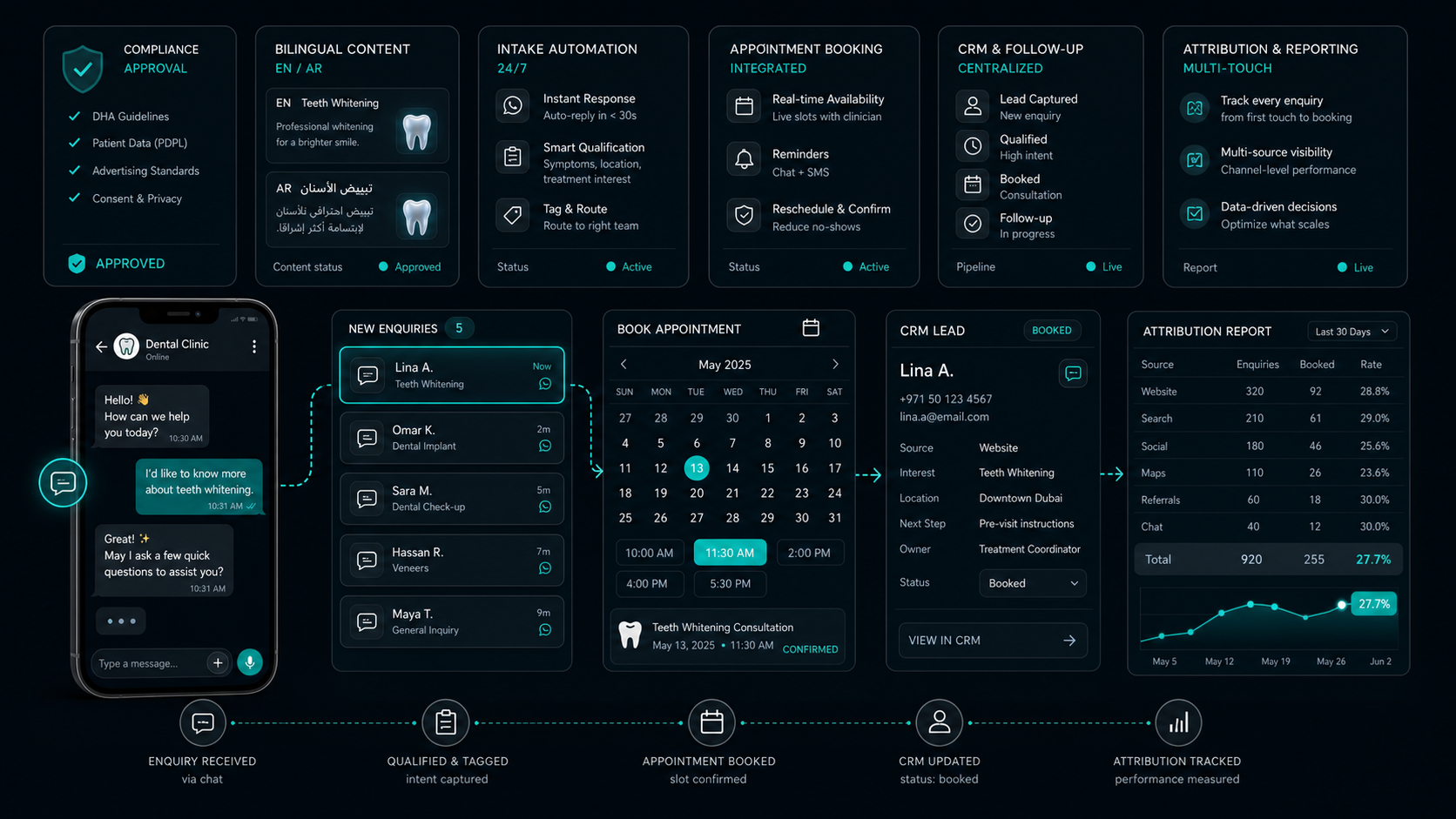
Every enquiry needs a source, a language, a named owner, a visible status, and a final outcome. Without those fields, the clinic has a busy inbox but no reliable patient-acquisition system.
Capture the source before chat opens
Pass the campaign, content, landing page, directory, or Google Business Profile source into the first CRM activity. Keep the values controlled, such as
instagram,google_business_profile,website, orreferral, so the monthly report can group them without manual cleanup.Acknowledge in the preferred language
Confirm that the enquiry has arrived, state reception hours, and ask only for the next booking detail. Arabic and English should be written as service copy, reviewed by the clinic, and tied to the same operational intent rather than treated as two unrelated campaigns.
Assign a named owner
Move the conversation out of an unowned queue. The owner can change by branch, service, or shift, but the lead record should always show who is responsible for the next action.
Book or hand off
Offer appointment logistics when the request stays operational. When the conversation crosses into clinical judgment, change the status to
handoff, preserve the booking context, and route the clinical question through the clinic-approved care path.Write the outcome back to CRM
Use clear statuses such as
new,assigned,waiting,booked,handoff, andclosed. Store the appointment outcome, source, language, owner, and consent purpose as structured fields, not as a sentence buried in chat history.
Here is an illustrative walkthrough. An Arabic Instagram post about cosmetic dentistry opens WhatsApp with source=instagram, campaign=smile_ar, and language=ar. Reception asks for the preferred branch and availability. The patient then asks whether sensitivity makes the procedure unsuitable. The workflow stops the booking script, assigns the clinical handoff, and keeps the source attached. If an appointment is later confirmed, the CRM records both the marketing source and the booked outcome without copying the clinical exchange into a marketing note.
The system preserves context without letting everyone see everything. That is the difference between routing and duplication.

Treat consent as a field, not a disclaimer
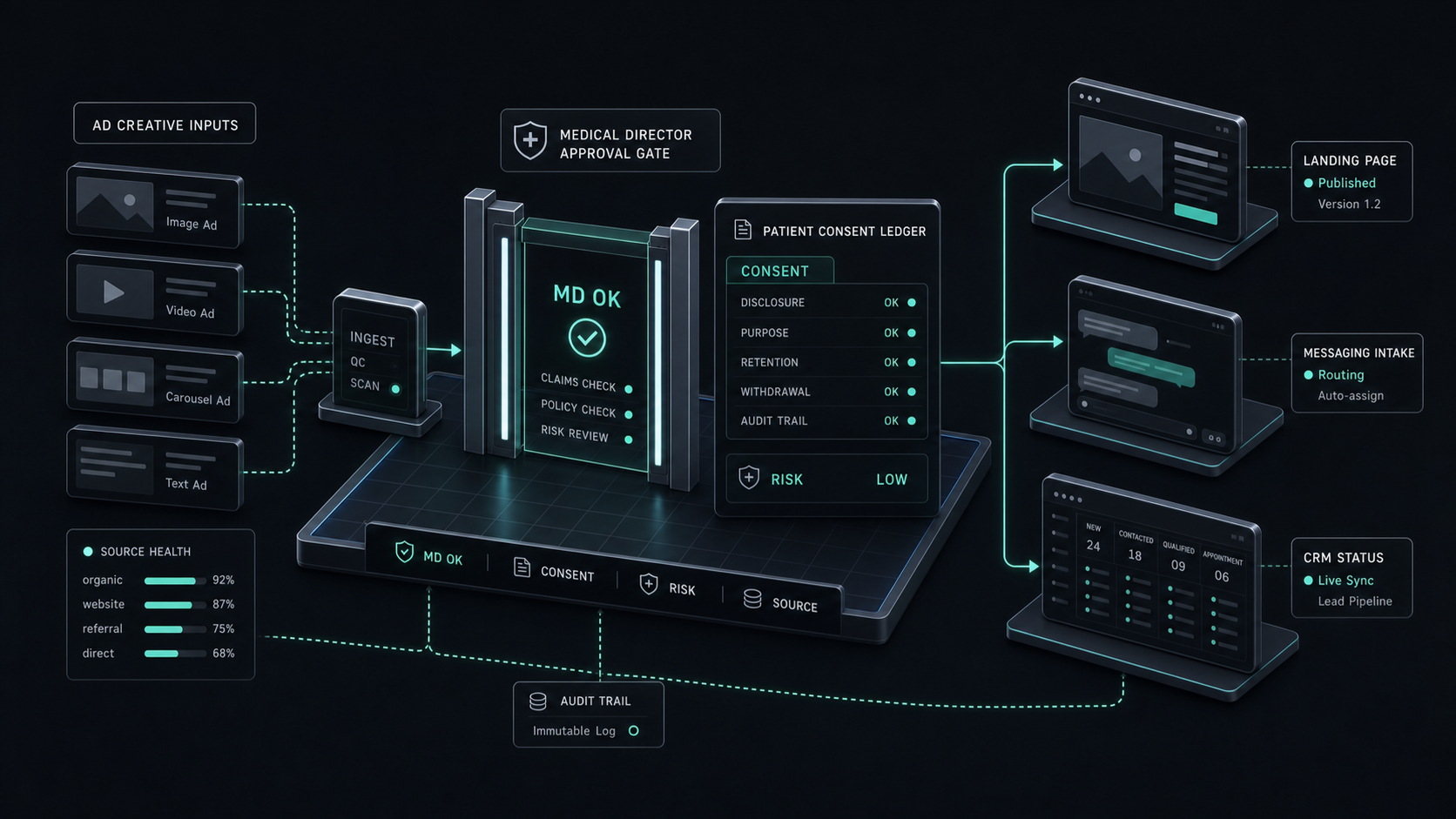
A requested booking reply is not blanket permission for recurring promotions. Record what the person agreed to, why, where the wording appeared, and which communication path it covers.
This matters because the DHA sharing policy identifies marketing as a secondary use of health information. DHA's current consent standard also says an entity should first ask whether identifiable patient information is actually needed for a secondary use. If anonymous data is not practical, consent is normally required for access beyond individual care.
For the operating record, capture:
- Purpose: booking response, appointment reminder, service update, or marketing.
- Wording: the approved consent language shown to the person.
- Capture point: website form, click-to-message page, reception conversation, or another controlled source.
- Evidence: time, source, and preference attached to the lead or patient record.
- Change: withdrawal or preference updates that stop the relevant branch of communication.
An appointment reminder and a promotion should not share a vague consent=yes field. They serve different purposes and should remain distinguishable in the record. If the clinic plans promotional messages, the content and approval workflow also need to follow the clinic's DHA advertising checklist. Do not make the booking automation responsible for deciding whether a medical claim can run.
Make access control visible at reception
Shared credentials are the wrong foundation for patient enquiries. DHA's 2025 Standards for Health Information Consent and Access Control, effective 2 April 2025, say users should receive unique credentials, should not share them, and should work under need-to-know and least-privilege access.
The DHA sharing policy also says access to protected health information must be role-based and regularly monitored and audited. Translate that into an access matrix the clinic owner can inspect:
For a multi-branch dental clinic, reception access can follow branch and shift. A marketing manager can see that google_business_profile produced booked consultations without seeing why a patient needed care. A senior clinic owner can review access exceptions without reading every conversation. Least privilege is not an IT-only setting; it is an operating design that keeps growth reporting useful while reducing unnecessary exposure.
Automate logistics and keep clinical judgment human
Automation should remove reception friction, not imitate a clinician. The boundary should be approved by the clinic before any prompt, template, or integration goes live.
The most important implementation detail is the fallback. If the integration cannot read availability, the language is unclear, or the patient asks a clinical question, the system should create a visible handoff with an owner and the operational context already attached. It should not keep asking questions to protect its completion rate.
For an aesthetic clinic, “Which branch and appointment window suit you?” can remain automated. “Am I eligible after taking this medication?” cannot. The clinic may choose a nurse-led callback, secure patient portal, or another approved path. The automation's job is to make that transfer fast and traceable, not to choose the clinical answer.
Measure booked appointments, not message volume
The core growth report should connect source to a booked outcome. Message counts, reply counts, and inbox activity can diagnose workload, but they do not prove that marketing produced a qualified appointment.
Track these operational measures:
Booking rate is calculated as booked appointments divided by eligible enquiries for the same source and period. Keep the numerator and denominator definitions stable. If reception marks every message as an enquiry one month and only consultation requests the next, the trend is unusable.
For a dental clinic, compare an Arabic Instagram content path and a Google Business Profile path using the same definitions. If one source creates more chats but fewer eligible booking requests, the fix may be the offer or landing copy. If both sources create good enquiries but appointments stall at waiting, the fix is ownership or availability. This source-to-outcome view is one part of the wider Dubai dental lead system.
Buy only after the vendor proves the data path
Do not accept “compliant” as a product feature. Ask the vendor to show where data moves, who can access it, what is logged, and how the clinic controls the record.
Federal Law No. (2) of 2019 restricts storing, processing, generating, or transforming UAE health-service data outside the UAE unless the required health-authority resolution exists. DHA's 2022 confidentiality policy also says electronic transfers of protected health information should use privacy, security, and confidentiality access controls, with protected portals and encrypted connections given as examples. It says third parties should not keep protected health information longer than needed for their processing purpose.
Put these questions into procurement and make the written evidence part of approval:
- Where is every message, attachment, transcript, backup, and analytics event stored or processed?
- Which subprocessors receive data, in which countries, and for what purpose?
- How are data encrypted in transit, protected in storage, and separated between customers?
- Can the clinic enforce unique accounts, role-based access, least privilege, and regular access review?
- What audit log records viewing, export, change, deletion, and administrative action?
- How does the system prevent or redirect clinical detail in the marketing and reception layer?
- What are the retention, export, deletion, backup, and contract-exit controls?
- What happens when automation fails, confidence is low, or a patient raises an urgent or clinical issue?
- Which structured fields return to the CRM or scheduler, and which content is deliberately excluded?
- How are consent purpose, wording, capture evidence, withdrawal, and communication preference recorded?
Run a reference scenario before signing. Start with an Arabic booking enquiry, add an unsolicited clinical image, change the assigned receptionist, withdraw promotional consent, and request an audit trace. A vendor that can only demonstrate the happy path has not proved the operating system your clinic needs.
Is WhatsApp chat allowed in Dubai?
For a clinic, there is no useful blanket answer based only on the app. The workflow must still protect patient information, limit access, capture consent for the relevant purpose, govern any cross-border processing, and move clinical detail into approved systems.
Do hospitals use WhatsApp?
The important decision is not whether another provider displays a WhatsApp number. A contact channel can handle appointment logistics, but another organisation's use does not prove that your vendor, data path, access model, or follow-up campaign meets your obligations.
Can WhatsApp be used for telemedicine?
This playbook does not treat a booking chat as telemedicine. Clinical assessment, treatment advice, medication questions, and urgent issues should move to the clinic's approved care pathway and trained staff rather than being answered by a reception automation.
Book the Growth Sprint
Map the clinic's website, bilingual content, WhatsApp routing, consent boundary, CRM attribution, and operating ownership into one buildable growth system.
Jul 14, 2026