DHA Clinic Advertising Rules in Dubai: What To Check Before Ads Run
A practical Dubai clinic ad checklist: DHA social-media standards, medical-director approval, patient consent, risk statements, and lead routing.
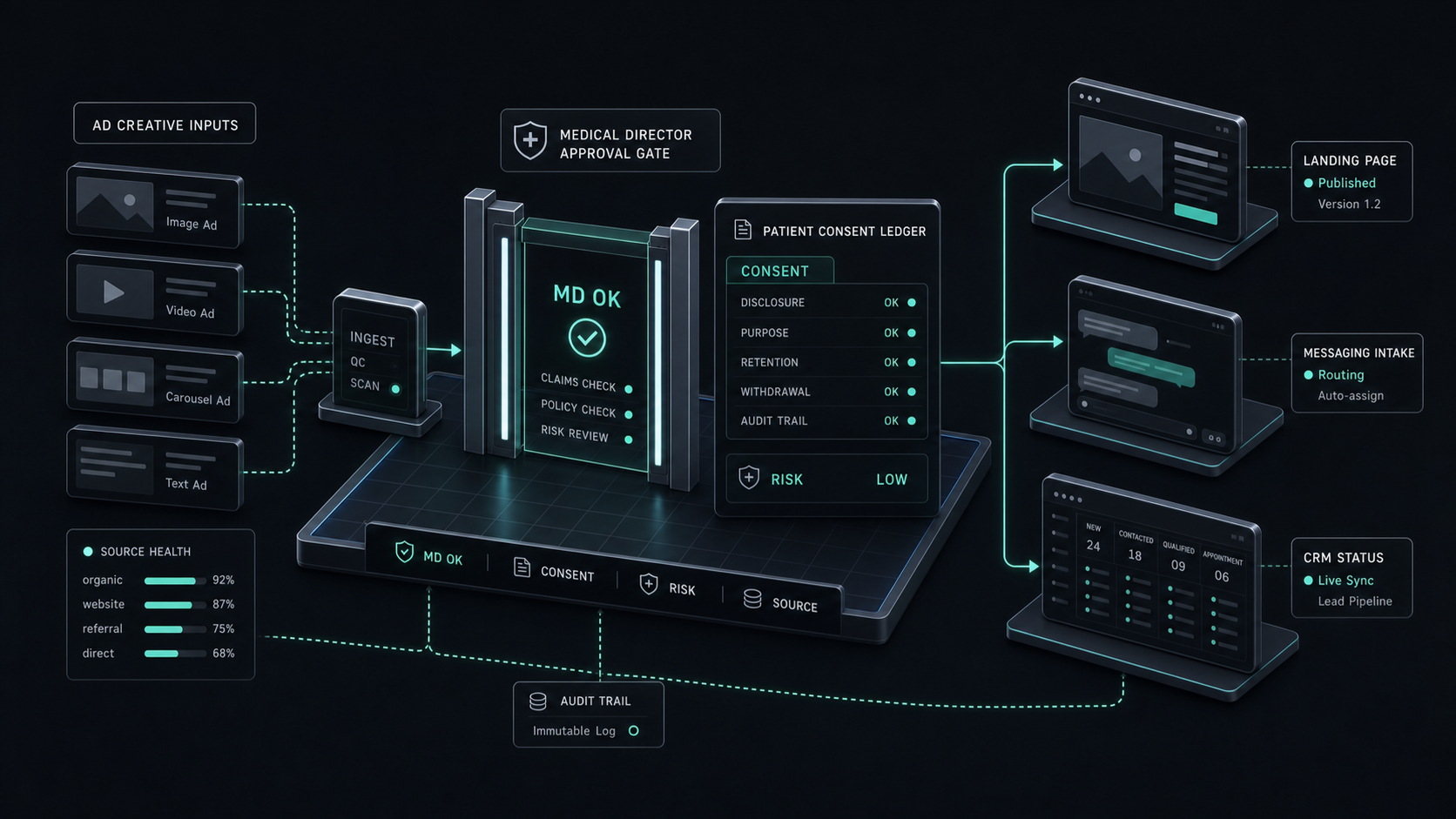
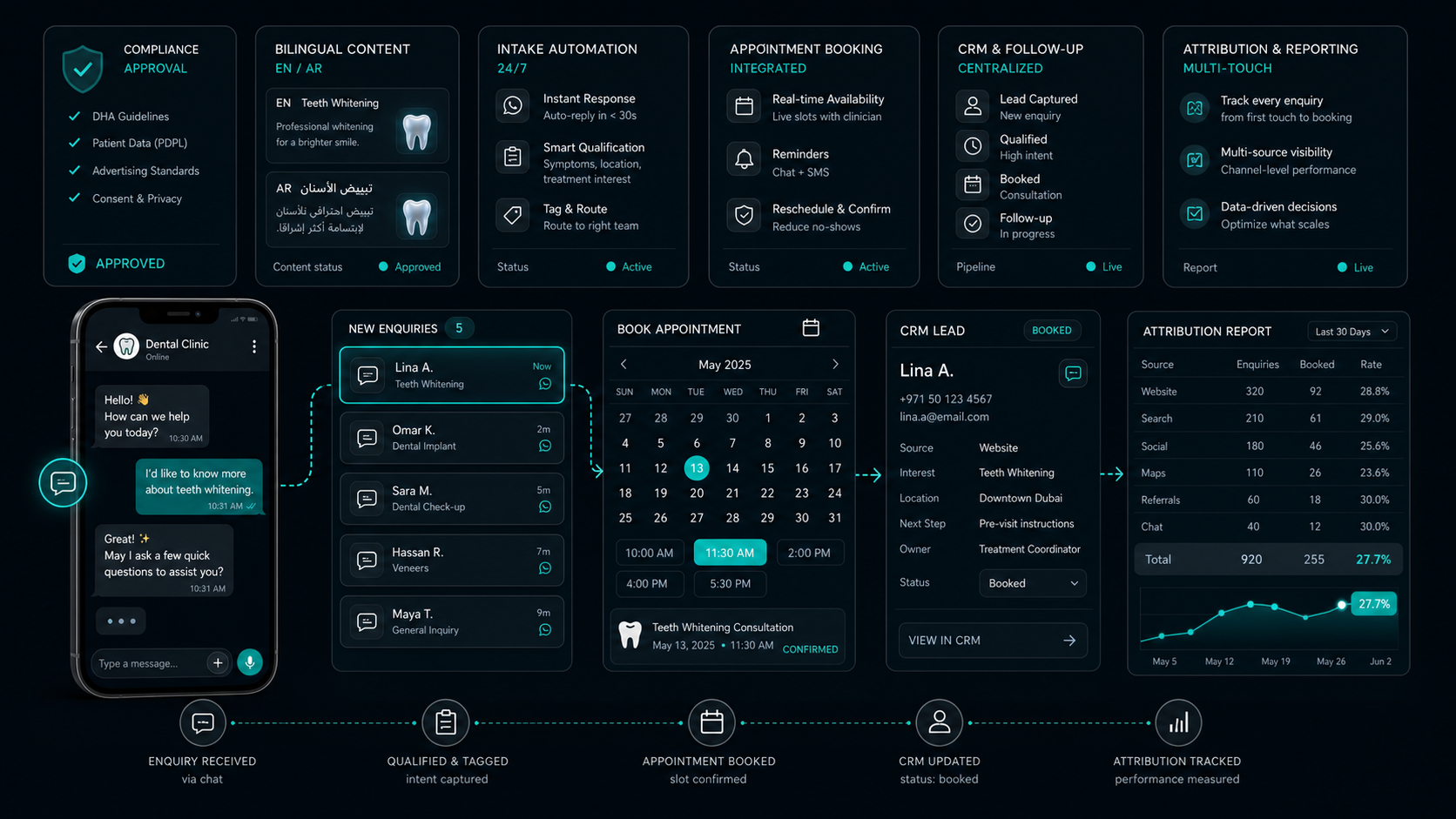
A Dubai clinic should not brief ads as creative first. Brief them as a compliant lead system: medical-director signoff, DHA social-media rules, patient consent, risk language, and WhatsApp follow-up all decided before the first campaign goes live.
The Safe Decision: Approve The System Before The Ad
The safest clinic ad is the one your Medical Director, front desk, and marketing team can all explain the same way. For a dental, aesthetic, dermatology, fertility, or specialty clinic in Dubai, the campaign is not just a Meta or Google asset. It is a healthcare claim, a patient-facing promise, a consent record, a lead-capture path, and a follow-up process.
That is the practical mistake we see in clinic marketing briefs. The team writes a sharp offer, sends it to design, adds a WhatsApp button, and only then asks whether the claim, image, or landing page fits the health-advertising standard. By then the ad is already pulling in the wrong direction.
Scope it in this order instead:
Lock the clinical claim
Write the exact service claim in plain language. If it promises an outcome, implies a result, or compares the clinic with another provider, stop and ask what evidence, risk language, and approval route support it.
Get Medical Director signoff
Any social-media ad that uses the clinic name, location, service, activity, or outcome should be reviewed through the Medical Director before launch.
Build the compliant asset set
Create the ad, landing page, WhatsApp script, call-centre note, consent record, and CRM fields as one package. Do not let the ad say one thing and the receptionist say another.
Route the permit question early
If the campaign is a health-awareness activation, dental screening, school health awareness activity, sport event, or similar temporary campaign, check the Sheryan temporary campaign permit route before media buying.
What The DHA Social-Media Standard Actually Controls
DHA's social-media advertising standard controls the clinic's public medical content, not just the design file. The current scraped document is DHA/HRS/HPSD/ST-21, issue 1.1, issued on 03/08/2022, effective from 03/10/2022, and marked with a revision date of 03/08/2027. DHA circular CIR-2022-00000158 attaches the updated version for health professionals and facilities under DHA jurisdiction in Dubai.
The standard applies to DHA licensed health facilities and healthcare professionals engaged in social media advertisements. DHA defines a social media advertisement as information about a health product, service, facility, professional, treatment, or therapy through social media. The standard names platforms including Facebook, LinkedIn, Google, WhatsApp, YouTube, Facebook Live, Periscope, and Vimeo.
For a clinic owner, that means the ad system includes more than paid social:
The practical interpretation is simple: if a Dubai clinic uses social, search, WhatsApp, a doctor profile, or an influencer to promote a healthcare service, the content needs a controlled approval trail. That trail should live beside the campaign plan, not in a separate compliance folder nobody opens.
For the wider patient acquisition layer, pair this with a broader compliant clinic lead system. The ad standard protects the promise. The lead system makes sure the promise turns into qualified appointments instead of loose WhatsApp messages.
The Clinic Ad Approval Checklist
The useful checklist is not "is the ad nice?" It is "can we prove the claim, identify the accountable person, protect the patient, and measure the enquiry?"
Use this as the internal pre-launch gate for a dental implant offer, aesthetic consultation campaign, skin clinic treatment page, IVF awareness campaign, or specialist screening event.
Two points deserve special discipline.
First, do not let title inflation creep into copy. DHA says staff and healthcare professionals should not use names or specialty titles different from the DHA license. The title Dr. or Doctor is not a styling choice. DHA says it can be used only by physicians, dentists, and other healthcare professionals with a recognized Doctor of Philosophy qualification.
Second, do not let design hide the risk statement. DHA says the content should be factually accurate, reliable, substantiated, and contain risks and benefits. It also says fine print must be prominent and legible to the unaided eye. If the landing page has a clean hero section but the treatment risk language is tiny, buried, or missing from the ad path, the system is not ready.
Where Sheryan Fits Into Campaign Permits
The Sheryan temporary campaign permit is not a blanket answer for every clinic ad, but it matters for the right campaign types. DHA's scraped Sheryan service page says active licensed healthcare facilities can request temporary permits for activities such as health awareness, dental screening, school health awareness, and sport events.
For that specific service, DHA lists:
- Average processing time: 2 working days.
- Applicant: delegated healthcare facility representatives.
- Service channel: Sheryan portal.
- Required documents: landlord or concerned authority NOC letter, plus additional supporting documents.
- Process: fill and submit the online application, DHA review, temporary permit issued if approved.
- Service limitation: only facilities with active licenses can apply.
- Approximate cost: AED 0.
- Draft cleanup: inactive draft applications over 3 months are cleared after a 15 day reminder to the registered email.
That gives you a clean planning rule. If the campaign is a normal always-on service promotion, start with the DHA social-media ad standard and the health-advertisement licensing route named by the regulator. If the campaign is a temporary activation or screening event, ask whether the Sheryan temporary campaign permit applies before the venue, school, partner, influencer, or media spend is locked.
Do not brief this as a last-minute operations task. The NOC and supporting documents can affect the launch date, and the landing page should match what was submitted. A clinic that changes the offer, location, doctor, image, or service wording after approval has created a new control problem.
Build The Lead System Around Compliant Claims
The growth layer should make the compliant claim easier to convert, not louder. The best clinic campaigns usually win because the patient journey is clear: what service is available, who it is for, what the next step is, what the clinic can and cannot promise, and how quickly a real person responds.
Build the lead path like this:
Use one campaign source field
Every enquiry needs a source field that names the exact campaign, channel, language, creative version, and landing page.
implant-meta-en-v3is useful.Instagram leadis not.Use a clinical-safe WhatsApp opener
Start with identity, service interest, preferred appointment time, and whether the patient wants a call-back. Do not ask for sensitive medical history inside an ad chat unless the clinic has a controlled intake flow for that data.
Separate enquiry from suitability
The ad and WhatsApp flow can qualify interest and book assessment. Suitability belongs with the clinician or approved clinical process.
Track dropped leads by reason
Use statuses such as
no response,asked price only,needs doctor review,booked consultation,not suitable, andattended. This tells you whether the campaign has a demand problem, a trust problem, or a follow-up problem.
This is where many Dubai clinic campaigns lose money quietly. The ad may be compliant, but leads still die because the clinic has no bilingual EN/AR response system, no appointment owner, no response-time target, and no reason codes in the CRM. A compliant ad without a lead process is just a safe way to waste media spend.
The practical build is small:
If your clinic is already collecting patient intake data online, connect this ad workflow to the patient intake governance layer. The promise made in the ad, the data collected after the click, and the follow-up script should be one controlled patient journey.
What To Avoid Before Launch
The quickest way to weaken a clinic campaign is to make the copy sound more certain than medicine allows. DHA's appendix gives enough direction to remove risky language before the ad leaves the brief.
Avoid these patterns:
- Guaranteed recovery or language that implies the treatment is certain, magical, miraculous, infallible, unfailing, or always effective.
- Unrealistic or absolute effectiveness claims.
- Patient identifiable information.
- Patient testimonials without written patient consent.
- Comparisons with other treatments, services, devices, medicines, professionals, or facilities unless they are scientifically proven and supported by credible references.
- Fear, panic, or distress wording that pushes people to believe their health may suffer if they do not act.
- Superior-service claims against another healthcare professional or facility.
- Price claims that hide conditions, variables, or time-limited inducements the clinic cannot meet.
- Before-and-after visuals without the required results-vary disclaimer and risk wording.
- Video filming or live streaming for social-media ads while a patient is undergoing surgery under general anaesthesia or in procedure rooms for promotion.
- DHA, UAE government, or public authority logos or names without explicit written approval.
The same rule applies to aesthetic clinics. Replace "look ten years younger today" with an assessment-led offer: consultation, treatment options, risks, recovery expectations, and clinician review. The ad can still convert. It just converts the right enquiry, not a patient who was promised certainty.
The Operator Rule
Treat DHA clinic advertising as a controlled operating system: approved claim, compliant asset, measurable enquiry, documented follow-up. If any one part is missing, the campaign is not ready.
A serious Dubai clinic does not need louder advertising. It needs a repeatable way to ship campaigns that the Medical Director can sign, the front desk can handle, the CRM can measure, and patients can trust. That is the difference between "we ran ads" and "we built a clinic growth channel."
For a small campaign, one person can own the checklist. For an always-on clinic growth program, the ownership should be explicit:
That last role matters because compliance and conversion should not fight each other. The job is to make the clinic easier to trust and easier to contact while staying inside the standards that protect patients.
What is DHA approval?
For clinic marketing, separate the approval types. DHA's social-media standards govern the content and accountability layer for DHA licensed facilities and professionals, while Sheryan temporary campaign permits apply to listed temporary campaign activities for active licensed facilities.
How long does it take to get DHA certified?
For the Sheryan temporary campaign permit service specifically, DHA lists an average processing time of 2 working days. Do not treat that as a general promise for every advertisement, professional license, or health-advertisement matter.
Who can apply for a DHA temporary campaign permit?
DHA's Sheryan page says delegated healthcare facility representatives can apply, and the service limitation says only facilities with active licenses can use it.
Can a Dubai clinic use before-and-after photos in ads?
DHA's social-media standard allows before-and-after pictures, images, and videos only under strict controls: same individual, same lens, no Photoshop or equivalent enhancement, a results-vary disclaimer, and risk wording in the same font size as the rest of the ad.
Book the Growth Sprint
Map the clinic's compliant content, lead capture, WhatsApp follow-up, and reporting system before the next campaign goes live.
Jun 30, 2026