Invoice Automation Software UAE: Build This Before E-Invoicing
Choose UAE invoice automation software around e-invoicing readiness: ASP path, approval logs, data controls, exceptions, and audit evidence.

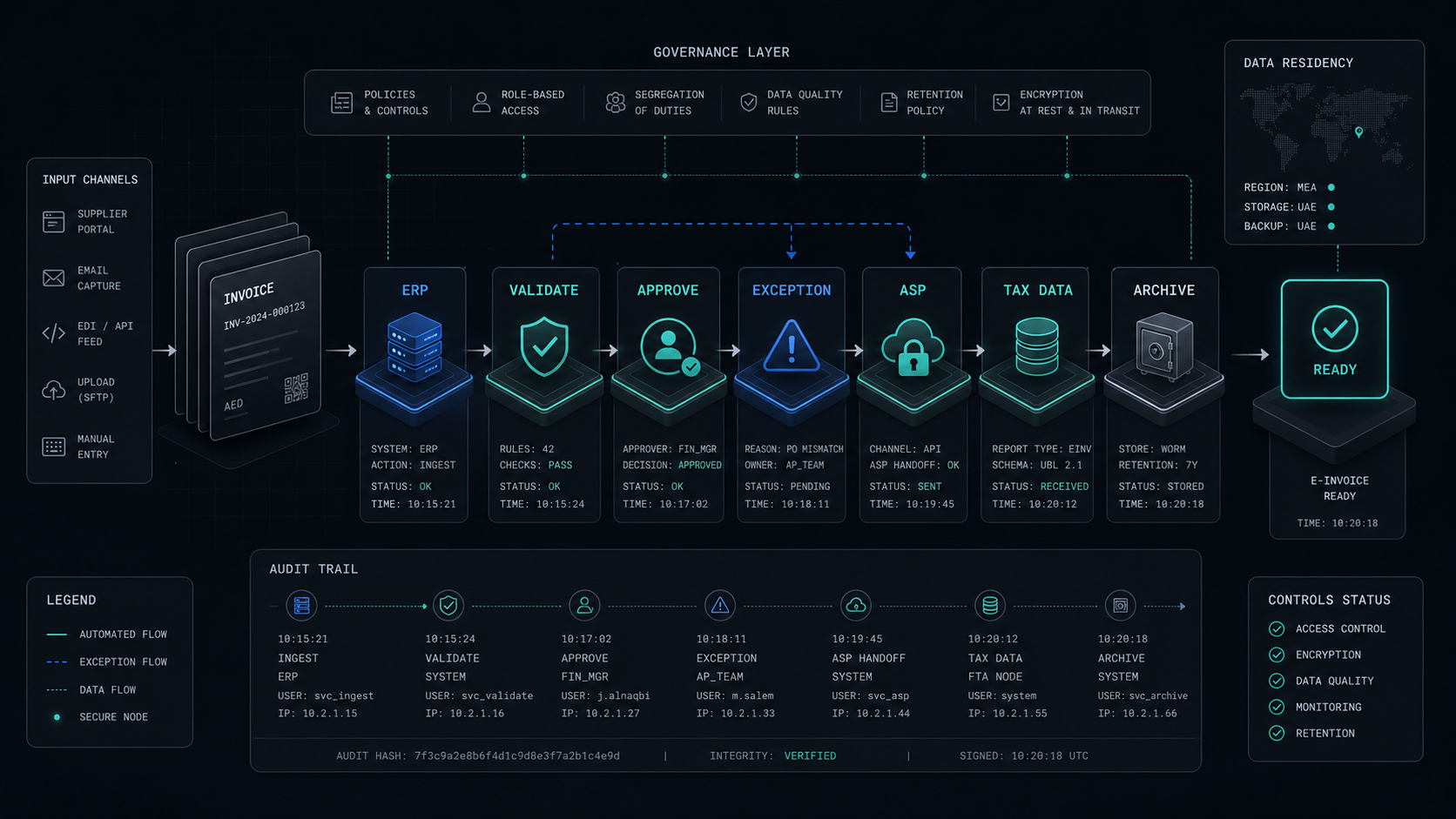
Invoice automation for a UAE company should not start with another invoice app. Start with a governed invoice spine: clean supplier and customer data, approval thresholds, exception queues, document retention, and a clear Accredited Service Provider path for the UAE eInvoicing rollout.
The verdict: automate the invoice spine before the invoice app
The best invoice automation software for a UAE company is the system that keeps invoice data clean, approvals traceable, exceptions owned, and e-invoicing handoff ready. A free invoice generator, a beautiful PDF template, or a chatbot that drafts invoice text is not enough once finance has to prove who approved the invoice, what VAT logic was applied, what changed, and which system sent tax data onward.
The buying rule is simple: if your company will be in scope for UAE eInvoicing, or expects to be pulled in later, do not choose software only by invoice creation. Choose the workflow that can connect your accounting or ERP system, supplier and customer master data, approval rules, archive, and Ministry-accredited Accredited Service Provider, or ASP, path.
That makes invoice automation a workflow project, not a finance-app purchase. The durable build has five layers:
For a broader tool-buying frame, pair this with the UAE workflow stack rules in AI Workflow Automation Tools for UAE Companies. The invoice project is narrower, but the control logic is the same: logs before speed, approval before release, data quality before AI.
What the UAE eInvoicing rollout changes
The UAE eInvoicing rollout turns invoice automation from a back-office efficiency project into a compliance and operating-system decision. The Ministry of Finance announced on 10 May 2026 that the deadline for appointing an Accredited Service Provider was extended from 31 July 2026 to 30 October 2026 for persons subject to the eInvoicing system whose annual revenues exceed AED 50 million. The same announcement says the mandatory implementation timeline remains unchanged: those entities must fully implement the system by no later than 1 January 2027.
That date changes the software decision. If your revenue is above the AED 50 million threshold, the question is not "which invoice tool is cheapest?" It is "which invoice workflow can be cleaned, tested, connected to an ASP, and governed before 1 January 2027?"
MoF also announced the launch of the UAE eInvoicing 4-Corner model on 21 April 2026. Businesses can use the Federal Tax Authority's EmaraTax system to select their preferred Ministry-accredited ASP, enter into a commercial agreement, complete onboarding, and start exchanging eInvoices. MoF describes the exchange as Corner 1, Supplier, to Corner 4, Customer, with Corner 5 tax reporting scheduled to go live ahead of the July pilot phase.
The official UAE Electronic Invoicing Guidelines, issued by MoF on 23 February 2026, matter because they frame readiness as more than technical file exchange. MoF says the guide covers scope, objectives, the national framework, compliance requirements, operational expectations, phased implementation, system readiness, process alignment, governance requirements, penalties, templates, a readiness checklist, and stakeholder roles. That is a direct signal to finance teams: the government expects an operating model, not just a plug-in.
MoF's eInvoicing page describes the UAE model as Decentralized Continuous Transaction Control and Exchange, or DCTCE. It also says invoice tax data must be reported to the FTA through UAE Accredited Service Providers, and that adopting a standard such as OpenPeppol can support exchange beyond the UAE. Those facts should drive your stack. Your invoice automation software must not trap you in a dead-end workflow that cannot pass clean tax data to the accredited route.
The software stack: five layers, not one tool
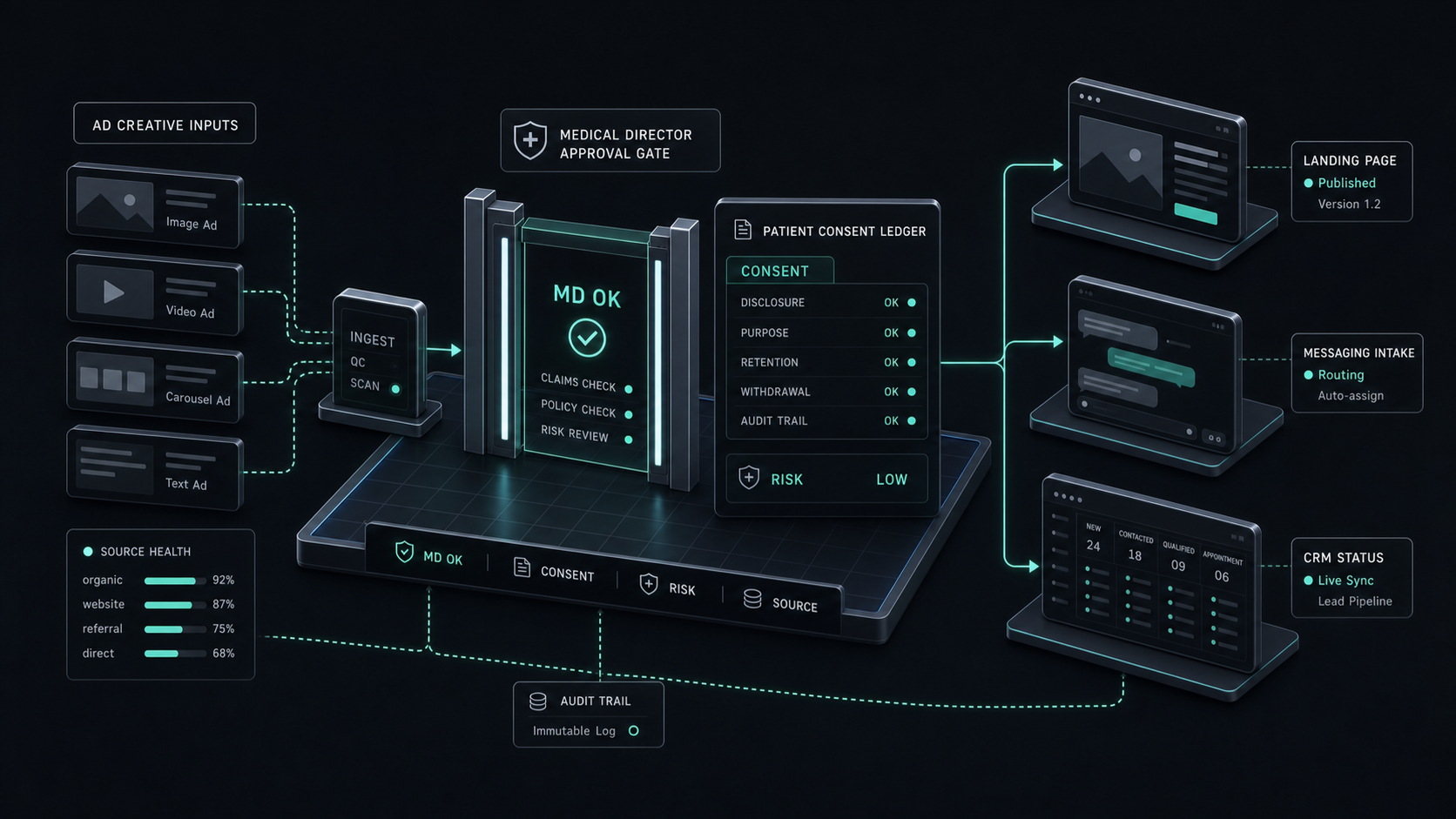
The right UAE invoice automation stack has one system of record, one approval spine, one exception queue, one ASP path, and one audit trail. If you buy five apps that each claim to "automate invoices," finance still owns the reconciliation pain when totals, statuses, attachments, and approvals disagree.
Use this stack map before speaking to vendors:
The Ministry's pre-approved service-provider list is updated periodically and says final accreditation is granted under Article 16 of Ministerial Decision No. 64 of 2025. The list includes providers such as Comarch Middle East FZ LLC, Defmacro Software DMCC (ClearTax), Deloitte & Touche - M E, Flick Network L.L.C, Pagero Gulf FZ-LLC, and SAP Middle East & North Africa LLC. Do not treat that list as a generic software marketplace. Treat it as the accredited channel question your invoice automation stack must be able to answer.
The trap is buying invoice capture software and assuming the ASP issue can be solved later. Capture is useful, but it is only one layer. A UAE finance team needs the path from incoming invoice to approved record to eInvoice exchange to tax-data reporting. If one layer is missing, the work falls back to spreadsheets, email approvals, and manual reconciliation at the worst possible time.
The build sequence for a UAE finance team
Build the invoice spine in this order. It is slower than buying a tool in week one, but it prevents rework when the ASP path and e-invoicing fields become non-negotiable.
1. Clean customer and supplier master data
Start with the fields every invoice depends on: legal entity name, trade license where relevant, TRN, billing address, payment terms, bank details, currency, contract owner, and preferred invoice channel. Flag duplicates and inactive records. If supplier names differ across ERP, email, and PDFs, fix that before automating routing.
2. Define approval thresholds
Set approval rules by amount, department, entity, project, and exception. A normal AED 3,000 subscription renewal should not follow the same path as a new AED 180,000 supplier invoice. For each rule, define who can approve, who can delegate, who can override, and what evidence is required.
3. Create exception queues
Most invoice projects fail in the exceptions, not the happy path. Build queues for missing TRN, duplicate invoice number, mismatched purchase order, wrong VAT treatment, missing attachment, contract overrun, and supplier bank-detail changes. Each queue needs an owner, SLA, and resolution log.
4. Map the ASP handoff
Before final vendor selection, map how your invoice data will reach the ASP route. Identify the fields your ERP can export, where validation happens, who owns failed submissions, and how the system records exchange status. If the vendor cannot explain its UAE ASP path clearly, keep it out of the critical workflow.
5. Lock the audit trail
Every create, edit, approval, rejection, override, export, and status change should be timestamped and tied to a user or system role. The audit trail should be searchable by invoice number, supplier, customer, amount, date, entity, approver, and exception type.
This is also where PDPL-aware design belongs. UAE Federal Decree by Law No. 45 of 2021 Concerning the Protection of Personal Data defines Personal Data broadly, including data linked to an identifiable natural person. Invoice workflows can contain names, email addresses, phone numbers, bank details, IDs, and business-contact data. Article 5 requires specific purpose, data minimization, accuracy, and secure processing. Article 7 requires controller records covering categories of personal data, authorized access, processing times, purpose, cross-border movement, and security measures. Article 20 requires appropriate security measures, including encryption and pseudonymisation where suitable to the processing risk.
For invoice automation, that becomes a practical design rule:
- Give finance, procurement, and operations role-based access, not blanket inbox access.
- Keep supplier bank-detail changes in a high-risk queue with human approval.
- Record who corrected extracted data, not only the final value.
- Limit invoice-data exports to the purpose and team that needs them.
- Ask cloud and ASP vendors where data is processed, who can access it, and how logs are retained.
The goal is not to make finance slower. It is to make the fast path trustworthy enough that exceptions are visible instead of hidden in email.
What to ask vendors before signing
The right vendor conversation is not "do you support invoice automation?" Every vendor says yes. Ask questions that force the vendor to explain the operating model.
For many UAE companies, the right answer is not a single vendor. It is an integration pattern: keep ERP or accounting as the record, use capture only where it saves real manual entry, run approvals through a controlled workflow, select the ASP path deliberately, and archive the evidence. If you need to scope that before procurement, the process in AI Automation Services in the UAE is the safer starting point than a feature checklist.
A practical walkthrough for a UAE operator
Take a Dubai distributor with AED 80 million in annual revenue, two legal entities, 40 recurring suppliers, 600 customer invoices a month, and approvals split across finance, operations, and the managing director. This company should not spend the next quarter debating invoice template tools.
The first month should be data cleanup and workflow mapping. Finance exports customer and supplier records, flags duplicate names, fixes TRNs, maps invoice types, and identifies the 10 exceptions that cause most delays. Operations defines who approves warehouse, logistics, marketing, and professional-services invoices. Management signs off on amount thresholds.
The second month should be controlled automation. Incoming supplier invoices are captured from a dedicated mailbox or portal. Low-risk invoices that match supplier, PO, amount, and VAT logic move to the right approver. High-risk items enter exception queues. Every correction is logged.
The third month should be ASP and e-invoicing readiness. The company selects the ASP path in EmaraTax, completes the commercial agreement and onboarding route, tests export fields, and confirms how exchange status and errors flow back into the invoice record. By then, the invoice workflow is already clean enough to connect.
That sequence is less dramatic than a full tool rollout. It is also how a finance team avoids discovering in December 2026 that the approved invoices, PDF archive, ERP data, and ASP integration do not agree.
What not to automate yet
Do not automate final submission, payment release, or supplier bank-detail changes until the control points are proven. Those are authority decisions, not just workflow steps.
Delay automation when:
- Supplier and customer records are duplicated or incomplete.
- VAT treatment depends on manual judgment that has not been documented.
- Approvals happen in WhatsApp or email with no durable record.
- The invoice capture tool cannot preserve the original document and correction history.
- The ASP path is unclear or treated as a future integration.
- Finance cannot export a complete event log for one invoice.
Use AI carefully inside the workflow. AI can classify invoice types, suggest GL codes, detect duplicate-looking invoices, summarize exception reasons, and draft supplier follow-ups. It should not become the authority that approves tax treatment, releases payment, changes bank details, or decides that an invoice is ready for e-invoicing submission. Keep the human approval where the risk sits, and log the AI suggestion as a suggestion.
Is there a way to automate invoices?
Yes. Automate the workflow, not only the invoice document: capture, validation, approval, exception handling, ASP handoff, archive, and audit trail. The document is only one object inside the process.
What is the best software for invoices in the UAE?
The best software is the one that fits your ERP, approval model, ASP path, data controls, and audit needs. For companies in scope for UAE eInvoicing, a simple invoice app is not enough if it cannot support clean data exchange and traceable approvals.
Is there free invoice software?
Free invoice software can be useful for simple invoice creation in a small business. It is not a substitute for governed invoice automation if you need approval routing, exception queues, ERP sync, ASP onboarding, and audit evidence.
Can ChatGPT generate an invoice?
Do not make a chatbot the invoice system of record. It can help draft supplier emails, classify an exception, or explain a variance, but invoice creation, approval, tax treatment, and payment release need controlled systems and human accountability.
When should a UAE company start preparing for e-invoicing?
If your company is above AED 50 million annual revenue and subject to the eInvoicing system, treat 2026 as the readiness year. The ASP appointment deadline moved to 30 October 2026, but full implementation is still required by no later than 1 January 2027.
Scope Your Workflow Automation
Map the invoice workflow, approval controls, ASP path, data movement, and audit evidence before you buy or build invoice automation for a UAE team.
Jun 8, 2026