Where the AI Stops: The Dubai Brokerage WhatsApp Handoff Rule
A practical Dubai brokerage workflow for qualifying WhatsApp property leads, handing buyer intent to brokers, and keeping CRM and listing controls intact.

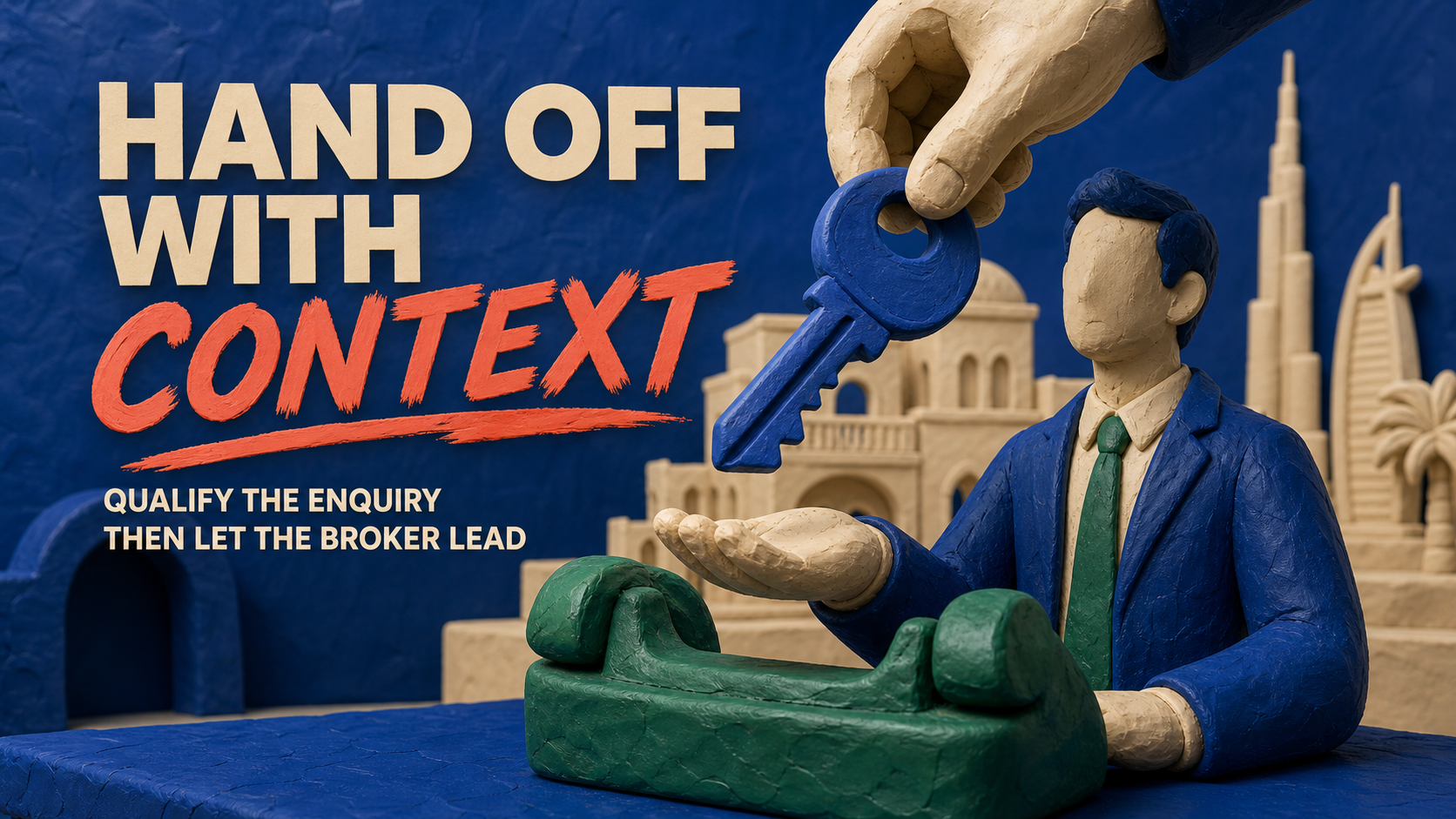
Your AI WhatsApp agent should qualify a Dubai property enquiry, preserve its source and hand the buyer to a named broker. It should not negotiate, improvise listing facts or keep talking after human judgment becomes more valuable.
The operating boundary is simple: automation owns the structured first exchange, while the broker owns advice, commitment and the next commercial decision. A handoff means the conversation, captured requirement and responsibility move together to a human, not that a notification lands in another inbox.
The agent should qualify, not close
The agent's job is to make the broker's first human response better. It can remove repetitive intake work without pretending that a property transaction is a scripted support ticket.
For a Dubai brokerage, the safe automated scope is:
- identify whether the buyer prefers English or Arabic;
- preserve the portal, campaign and listing reference that produced the enquiry;
- clarify whether the person wants to buy, rent or invest;
- capture property type, preferred area, budget, timing and financing status;
- retrieve facts only from a current, brokerage-approved listing source;
- summarise the requirement and invite a named broker to take over.
The broker should take over when the buyer asks to negotiate, requests a viewing, needs investment or financing judgment, disputes a listing fact, becomes frustrated, asks a legal question, or moves outside the approved conversation scope. The agent can capture the question. It should not manufacture an answer to keep the chat moving.
Consider an illustrative portal enquiry in Arabic for an apartment in Dubai Hills. The assistant confirms the listing reference, continues in Arabic, captures the buyer's purpose, budget and timing, and checks the approved listing record. When the buyer asks whether the owner will accept a lower offer and requests a viewing, the assistant stops qualifying. It transfers the original source, requirement, open questions and conversation summary to the assigned broker. The broker confirms availability, handles the negotiation context and owns the viewing.
That is a productive boundary. The AI creates context. The human creates confidence.
The handoff record is the product
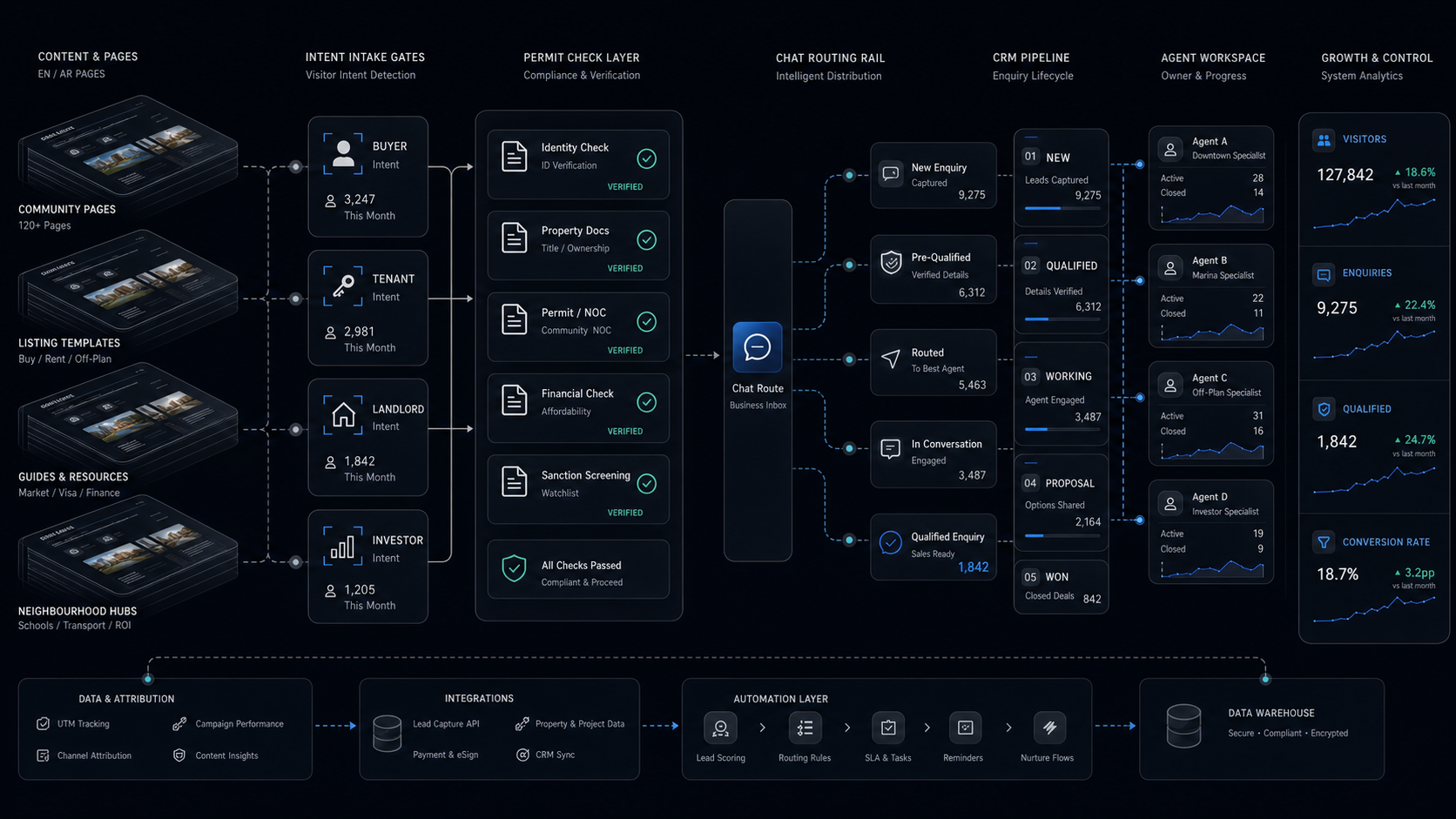
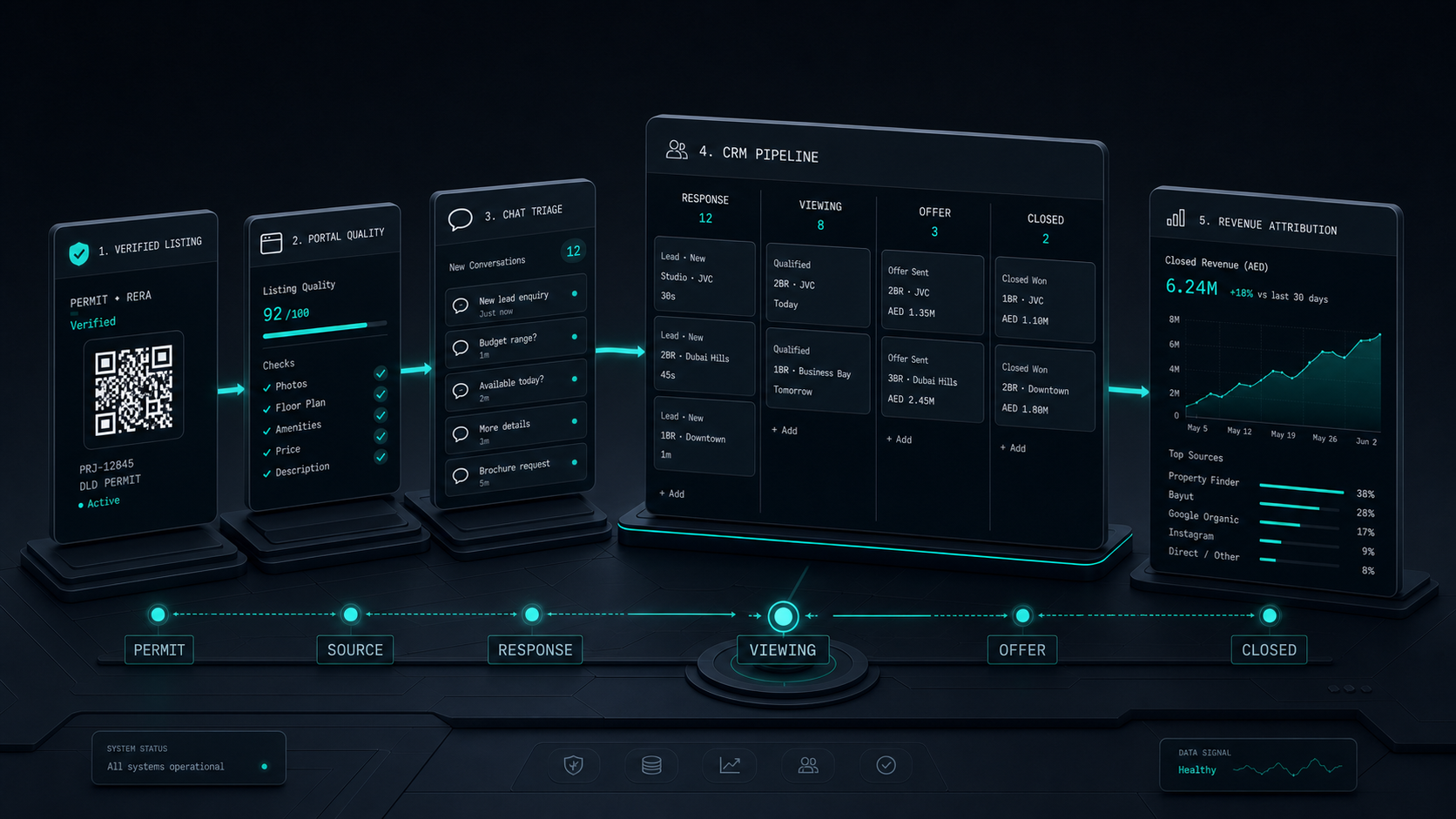
The CRM must become the system of record, the place where the brokerage can see who owns the enquiry, what happens next and what outcome followed. WhatsApp remains the conversation channel. Treating the chat thread itself as the pipeline leaves management unable to distinguish an active buyer from an unanswered message.
A broker-ready handoff record should carry:
- original source, campaign and listing reference;
- contact identity and preferred language;
- buy, rent or investment intent;
- property type, area and budget;
- timing and financing status;
- the buyer's unresolved question or objection;
- consent source, opt-out state and relevant timestamps;
- assigned broker, next action and ownership status;
- the original transcript or an access-controlled link to it.
If the brokerage is still choosing where those fields live, settle that decision with the Dubai brokerage CRM buying guide before adding an AI layer. An agent cannot repair a pipeline that has no accepted owner.
Capture the source
Create the CRM record from the portal or campaign event before the conversation branches. Keep the listing reference and attribution fields attached to the contact.
Qualify the requirement
Ask only for information that changes routing or the broker's next action. Use the buyer's language and allow corrections without restarting the chat.
Transfer the context
When a handoff trigger appears, pause automation and send the broker the requirement, approved listing match, open question and transcript context together.
Close the loop
Require the broker to accept ownership and set the next action. Return the eventual viewing, nurture or disqualification outcome to the same record.
An illustrative handoff can be this compact:
Property Finder enquiry. Arabic preferred. Family apartment in Dubai Hills. Budget not yet confirmed. Moving this quarter. Approved listing reference matched. Buyer requests a viewing and asks about offer flexibility. Consent source recorded. Assigned broker must confirm availability and call.
The handoff is complete only when a broker accepts it. "Sent to sales" is not an operational state.
Put an approved-listing boundary around every reply
The AI should retrieve listing facts, never invent them. Price, availability, unit status, permit details and promised returns are all capable of changing or being misunderstood, so the assistant needs a controlled knowledge boundary around what it may send.
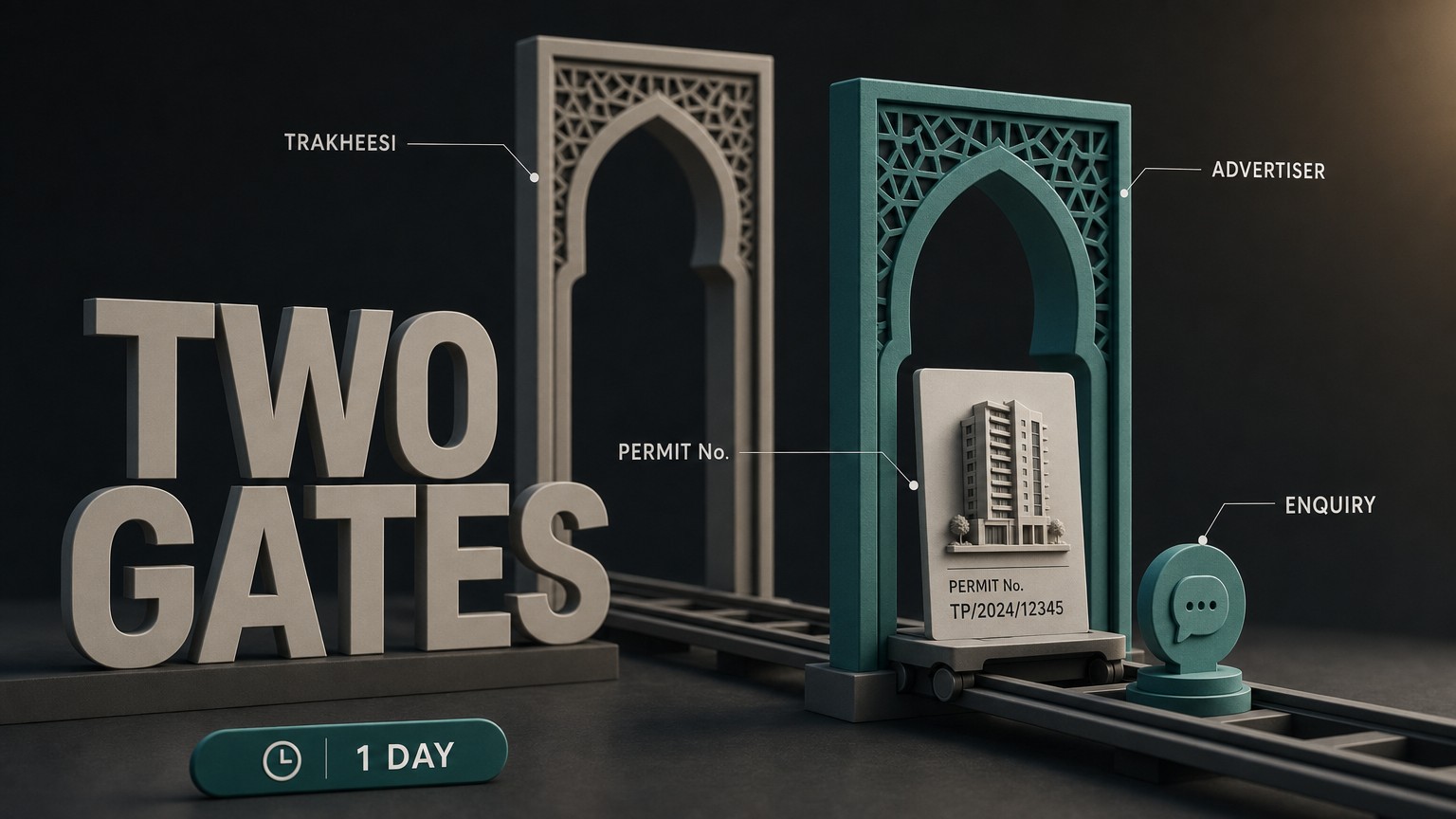
Dubai Land Department makes the advertising context unusually concrete. In its 24 April 2025 advertising-governance update, DLD said its platform had monitored over 279,000 real-estate advertisements across Property Finder, Dubizzle and Bayut, and that 29% of the monitored listings were automatically modified using artificial intelligence. The same update says Madmoun, the verification service inside the Trakheesi permit system, issues a QR code for every real-estate advertising permit. DLD requires real-estate companies to display that QR code on visual and written advertisements.
DLD's current Real Estate Ad Permit service expressly includes online and classified advertisements. That does not mean these pages classify every private WhatsApp reply as an advertisement. It means the safer implementation rule is to prevent automation from turning an enquiry into uncontrolled promotional publishing.
Use an approved listing library with a named internal owner. Each record should expose only the facts the agent may use and the current promotional asset the brokerage has cleared. If the record is stale, incomplete or missing its compliance reference, the assistant says that a broker will confirm. It does not fill the gap from model memory.

This boundary also protects the brand. The English and Arabic answers come from the same approved property record, so translation does not become a second, uncontrolled version of the listing.
Consent and human escalation belong in the state machine
WhatsApp policy and UAE privacy controls must decide what the agent may do next. A state machine is a set of named statuses that controls the next permitted action. It is more reliable than asking the model to remember policy inside a prompt.
Meta's current WhatsApp Business Messaging Policy says a business may contact a person only after receiving the mobile number and opt-in permission for subsequent messages or calls. It also requires the business to respect requests to block, discontinue or otherwise opt out.
For the Business Platform, a business may reply without a message template within 24 hours of the user's last message. Outside that customer-service window, it may send only approved message templates. Meta permits automation during the 24-hour window only when prompt, clear and direct escalation paths are available, including an in-chat human transfer, phone, email, web support, an in-store visit or a support form.
Build those rules into the record:
- Inbound active: record the source, consent evidence and latest inbound message time.
- Automated service: allow only approved qualification and listing retrieval, with a visible human-transfer path.
- Human pending: pause the assistant while a broker accepts the handoff.
- Template required: block free-form business-initiated follow-up outside the 24-hour window.
- Suppressed: stop subsequent WhatsApp sends when the person opts out.

The privacy layer goes beyond messaging mechanics. The UAE government's PDPL summary says Federal Decree Law No. 45 of 2021 covers personal data processed electronically inside or outside the country. It describes company duties to secure personal data and maintain confidentiality and privacy, and it gives data owners rights to request correction of inaccurate data and restriction or cessation of processing. The same summary states the consent rule and its specified exceptions.
For the brokerage, that means a portal enquiry is not a blank cheque for unrelated campaigns. Record what the person expected, keep the privacy notice accessible, restrict transcript access by role, support corrections, and make suppression effective across WhatsApp and the CRM. Have UAE counsel confirm the brokerage's lawful bases, notices, retention and cross-border setup before production.
Test the handoff before you route live portal traffic
Test broker acceptance and follow-through, not conversation length or reply speed. A fast assistant can hide a slow human operation if nobody accepts the transfer.
Use de-identified or synthetic scenarios that reflect the brokerage's actual mix:
- an Arabic enquiry that switches between Arabic and English;
- a buyer who changes area and budget during the conversation;
- a listing reference that is missing or marked stale;
- a viewing request during a broker's active appointment;
- a request for investment, legal or financing advice;
- an explicit request to stop messages;
- a returning contact whose record already has another owner;
- a buyer who disputes the assistant's summary.
For each scenario, inspect the approved fact used, the extracted requirement, the reason for handoff, the broker alerted, the consent state, the next action and the final CRM outcome. The assistant fails the test if it invents a listing fact, continues after a stop request, loses the original source, or transfers without a named owner.
Teams considering Meta's newer agent route can reuse the evaluation gates in the Meta Business Agent pricing test. The product decision matters less than the evidence: bilingual accuracy, approved retrieval, clean escalation, consent enforcement and accepted ownership.
The useful scorecard is operational:
- handoff acceptance rate;
- time from transfer to broker acceptance;
- requirement-field completeness;
- incorrect or unapproved listing responses;
- opt-out suppression pass rate;
- viewings and qualified nurture outcomes after human contact;
- outcomes attributed to portal, campaign and listing.
Reply volume is a diagnostic, not the commercial result.
Use a hard go or no-go rule
Launch only when the brokerage can support the human side of the system. The AI is ready when approved listing data, consent state, bilingual qualification, CRM ownership and broker coverage work as one operation.
The decisive question is not whether an AI can answer a property lead. It is whether the brokerage can accept, govern and convert the handoff it creates.
Questions Dubai brokerage leaders ask
Do AI WhatsApp agents help convert more leads or just create more noise?
They help when qualification ends in an accepted human handoff and a measurable next action. Without CRM ownership, approved listing facts and broker follow-through, they create faster noise.
Should WhatsApp be the brokerage CRM?
No. WhatsApp should carry the conversation, while the CRM stores source, consent state, requirement, human owner, next action and outcome.
When should a human broker take over?
Transfer at viewing intent, negotiation, listing uncertainty, legal or finance questions, frustration, opt-out requests, or any request outside the approved scope.
How do you stop good leads getting lost on WhatsApp?
Make transfer acceptance and next-action ownership required states. Alert management when a handoff has no owner, and return every outcome to the original source record.
Apply for a Build
Scope an owned Dubai brokerage agent around approved listing data, bilingual qualification, consent, CRM ownership and human handoff.
Jul 25, 2026