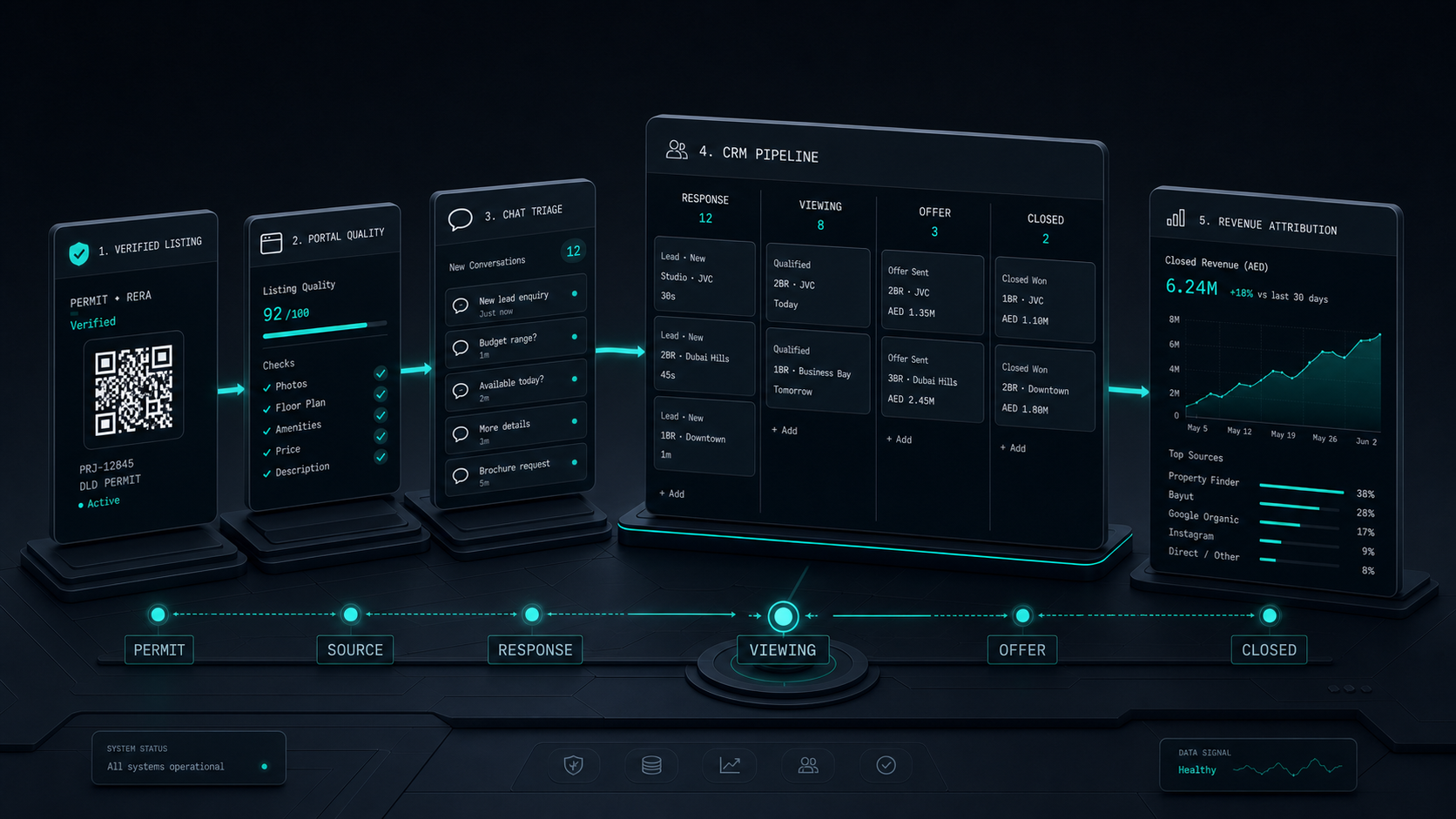
Real Estate Web Design Dubai: Build the Brokerage Website Around Enquiries
A Dubai brokerage website should capture owned demand, preserve permit hygiene, route WhatsApp enquiries, and prove qualified pipeline.

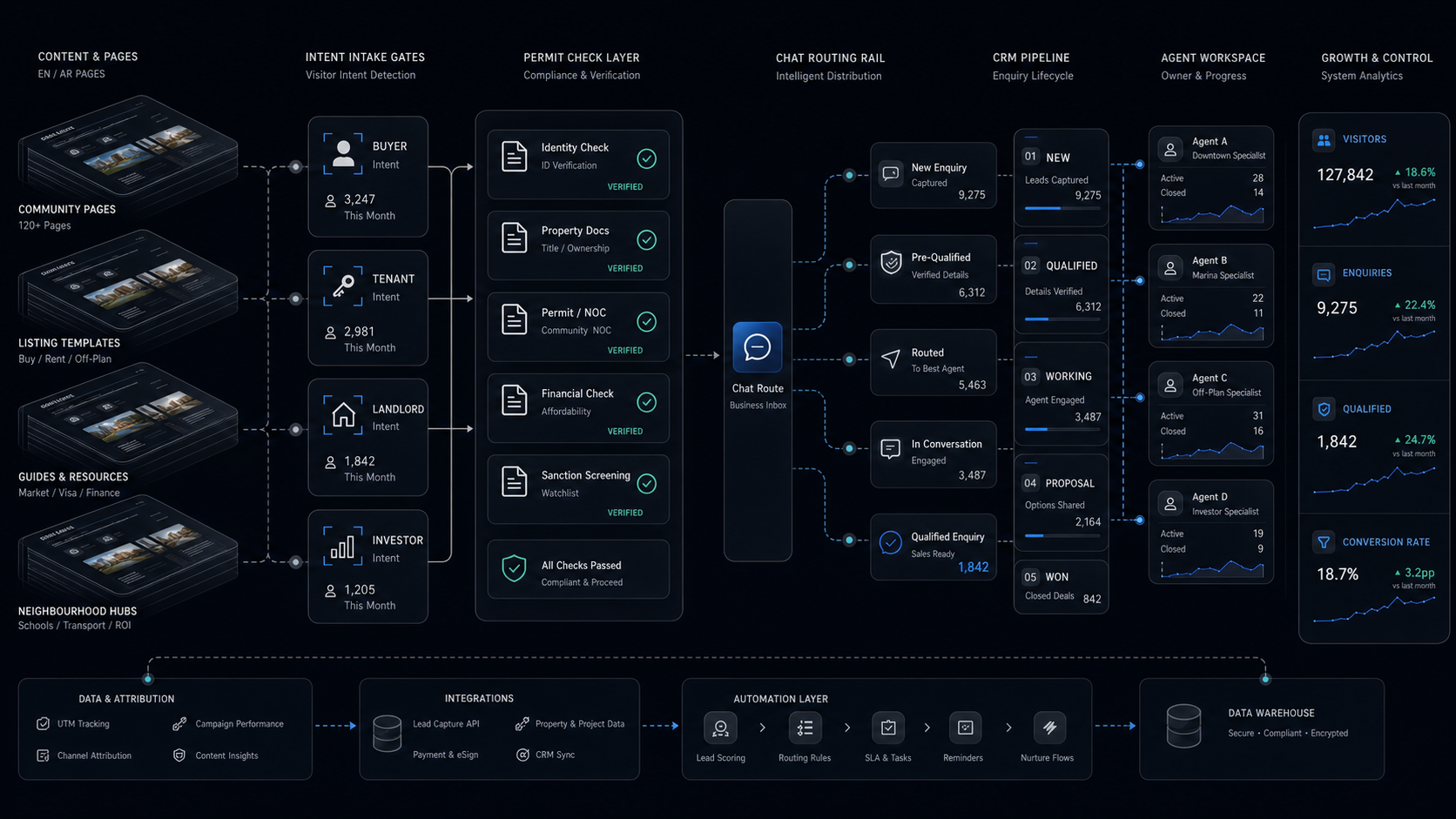
A Dubai brokerage website should be bought as an enquiry system, not a prettier brochure. If it cannot turn Google, portal, community-page, and WhatsApp traffic into qualified owner, buyer, tenant, and investor conversations your team can track, it is not a growth asset.
The verdict: buy the enquiry system, not the homepage
The right real estate website for a Dubai brokerage gives you more control over enquiries you already influence. Portals still matter. Paid campaigns still matter. WhatsApp still matters. The mistake is treating the website as a brand brochure that sits beside those channels instead of the place where owned demand is captured, qualified, routed, and measured.
For a brokerage owner, the buying rule is simple: do not approve the design until the enquiry path is approved. A visitor on a Downtown Dubai investor page, a landlord valuation page, and a Palm Jumeirah rental listing should not all land in the same generic form or the same floating WhatsApp chat. Each one should carry context into the conversation: page, language, property type, budget band, intent, source, campaign, and assigned owner.
That is the difference between a website that looks premium and a website that helps the business. A polished homepage might improve trust for a few seconds. A properly scoped brokerage website improves the whole pipeline: search visibility, listing confidence, lead quality, agent response, CRM hygiene, and reporting.
If you are comparing agencies, ask for the site map, lead-routing logic, CRM fields, WhatsApp message structure, analytics plan, and Arabic/English content model before you look at moodboards. The visual direction matters, but it should serve the pipeline.
What a Dubai brokerage website must include
A serious brokerage site needs page architecture before decoration. The core build is not complicated, but each layer has to do a job.
The minimum viable version can be lean. It does not need to out-portal Bayut or Property Finder. It needs to do what the portals cannot do for your brand: explain your niche, make your agents credible, own community demand, and route direct enquiries without losing context.
For example, a Dubai Marina page should not be a thin paragraph under a stock photo. It should answer the buyer or tenant question quickly: who the area suits, which building types matter, what budget and lifestyle filters shape the search, what documents or permit references the team needs before advertising a unit, and what happens after the visitor asks for options. The page then routes into a specific WhatsApp prompt and CRM stage, not a generic "contact us" inbox.
That page also gives the brokerage a repeatable content system. The same structure can become an English page, an Arabic page, a short LinkedIn post, a Reel script, a WhatsApp follow-up, and a landing page for paid traffic. This is where the website becomes part of the managed digital department, not a temporary build.
The compliance layer belongs in the website scope
Dubai property advertising needs permit-aware infrastructure, not last-minute admin. The Dubai Land Department Real Estate Ad Permit service covers newspaper, SMS, outdoor, vehicle, printed, electronic, billboard, promotional campaign, open-house, classified, exhibition, project launch, promotion-platform, and seminar advertisements. A brokerage website touches several of those channels because it publishes electronic property content and often supports campaigns, landing pages, open houses, and project launches.
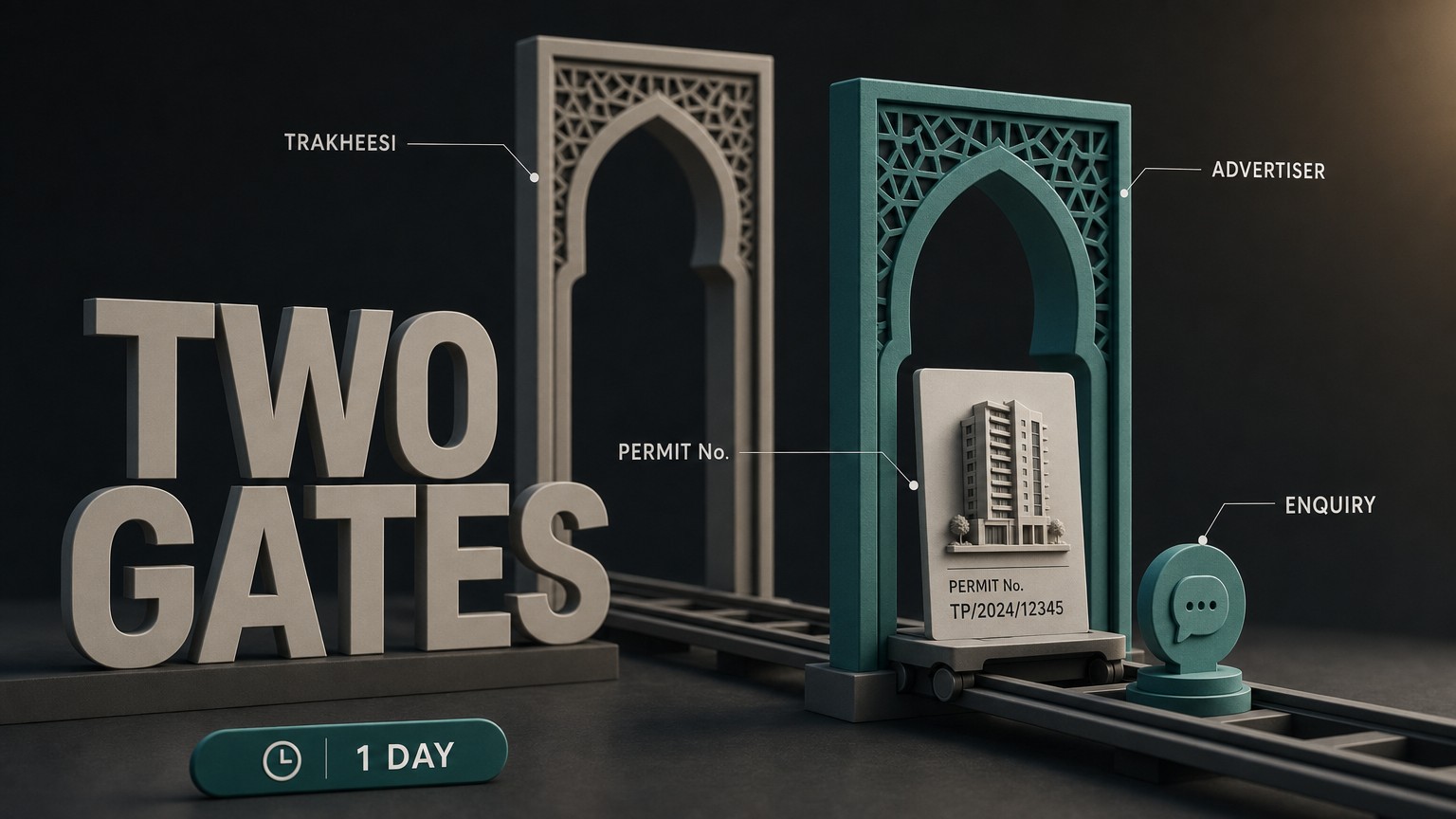
The DLD process is not mysterious. The same service page lists the flow: login to Tarakhesi, choose the service, fill the required information, upload documents, wait for employee review and approval, select the payment method, and receive the e-permit certificate. It also lists a copy of the advertisement form as a required document for advertisement, billboard, and promotion-campaign permits.
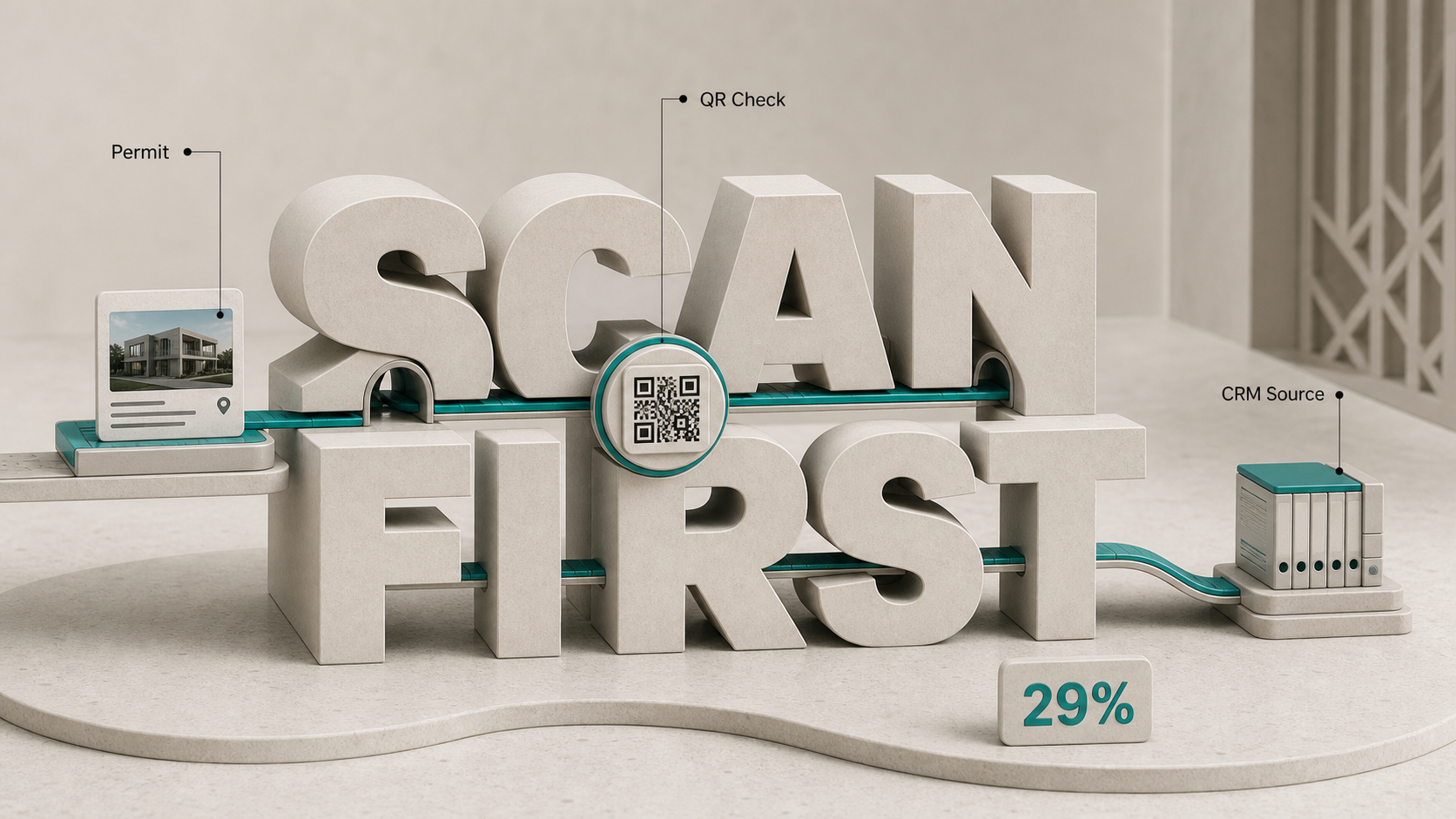
The site build should therefore include a permit check in the content workflow. A listing page, campaign page, or project page should not go live because the designer finished a layout. It should go live when the content owner has checked the permit reference, listing facts, owner authority, media, price, and agent assignment.
DLD also provides a Verify License and Permits service that allows customers to verify e-copies of licenses and permits issued by the Land Department for Dubai real estate activities practitioners via Trakheesi. Trakheesi is the DLD system used for real estate licenses and advertising permits. Your website should make permit hygiene easy to maintain because trust breaks fast when a buyer sees outdated, duplicated, or unsupported property content.
The permit cost is not the main budget issue, but it is useful context. DLD lists Project Launch Event Permit at AED 5,000, Other Permits at AED 1,000, and AED 20 Knowledge and Innovation Fee. The real cost of a weak website is not the permit fee. It is the operating mess when agents publish, pause, edit, and reuse property pages without a clear approval path.
Put the permit field into the CMS
Every listing or campaign template should have a field for the permit reference, status, source document, expiry or review note, and the staff member who checked it. If the page type does not need a permit, the field should still force a clear "not applicable" reason.
Separate listing copy from brand copy
Property facts belong in the listing area. Brokerage positioning belongs in service, community, and agent-profile sections. Mixing the two creates portal-quality problems and makes review harder.
Route exceptions to a senior owner
Open houses, project launches, promotional campaigns, and high-value listings should have a named internal reviewer. The website workflow should show who cleared the page before traffic is sent to it.
Keep an audit trail
The CRM or task system should record when the page was published, changed, paused, or replaced. This protects both marketing performance and operational trust.
Portal traffic should feed the website, not replace it
Portals are demand channels. Your website is the place where the brokerage turns that demand into a stronger owned relationship.
Bayut's Trakheesi guide says it is mandatory to have a marketing permit to publish property advertisements in Dubai, and that the Trakheesi permit is required for property listings to go live on Bayut and dubizzle. The same guide says the permit helps curb false and duplicate real estate advertisements and helps ensure advertised properties are sold or leased with the legal owner's permission.
Property Finder's terms are equally clear about listing quality. They require advertiser content to be true, complete, and accurate to the advertiser's knowledge, promptly updated or corrected when errors are found, and limited to listing details for a particular property unless written approval is received. Property Finder also says each listing must be a bona fide listing of real property for sale or lease, not a place to advertise unrelated business services.
That means your website should not scrape portal thinking into your own brand. It should improve on it. Use portal leads to learn what buyers and tenants ask. Then build owned pages that answer those questions with better context: community intent, building fit, investor logic, agent credibility, next step, and availability route.
There is also a verification signal to respect. Property Finder's verification guide says verified listings get a ranking boost, a verified badge, up to 4x more impressions, help showcase property quality, and help eligibility for the SuperAgent badge. It says Dubai listings eligible for verification include Ready Secondary, Off-Plan Secondary, and Yearly rental listings across all locations. If verified listing quality can affect portal performance, your website should not be the weaker version of the same content.
This is also where internal linking matters. If the brokerage already has a lead system problem, the website must connect to the wider brokerage lead-generation system. If the CRM is weak, a new website will only push cleaner-looking leads into the same messy process, so the CRM buying rule for Dubai brokerages should be handled before or during the rebuild.
What should real estate web design cost in Dubai?
Website prices in Dubai vary because people sell very different things under the same label. A cheap site, a custom brand site, and a conversion-focused brokerage platform are not comparable purchases.
Public price ranges show the spread. Browser says real estate website prices generally range from AED 4,000-6,000 for a basic real estate property website to AED 12,000-25,000 or more for fully custom designs with advanced functionality. Propphy says a basic real estate website in Dubai usually costs AED 6,000-18,000, while a premium conversion-focused real estate website usually starts around AED 25,000 and often lands between AED 35,000 and AED 90,000 depending on scope.
Those are not DVNC.ae price promises. They are useful market references for understanding what is usually missing at each tier.
The buying question is not "what is the cheapest acceptable website?" It is "what must the website do for our pipeline?" If you already spend on portals, paid search, social content, and agents, the website has to preserve context from that spend. If it cannot show which page, language, campaign, community, agent, and source produced the enquiry, the build is under-scoped.
Propphy's cost page also says serious quotes should separate design, development, content structure, integrations, and post-launch support, and that integrations may include CRM syncing, WhatsApp actions, analytics, Meta Pixel, Google Tag Manager, and lead-routing rules. That is the right way to read proposals. A price without scope separation is not a quote. It is a design estimate.
WhatsApp needs routing, not just a floating icon
WhatsApp is useful because Dubai property conversations move fast, but a floating icon is not a strategy. Meta says the WhatsApp Business Platform enables businesses to communicate with customers at scale, and Cloud API can programmatically send text messages, rich media, and interactive messages. It can also share appointment availability and reminders. That makes WhatsApp a real operating layer when it is connected to source, context, and ownership.
On a brokerage website, each WhatsApp entry point should pass useful context:
- Visitor language: English or Arabic.
- Page type: community, listing, developer, valuation, campaign, agent profile.
- Intent: rent, buy, sell, invest, off-plan, viewing, valuation.
- Source: Google organic, Google Ads, Meta ad, portal profile, LinkedIn, Instagram, direct.
- Owner: agent, team, rotation, or senior reviewer.
- CRM stage: new enquiry, qualified, viewing requested, valuation requested, not ready, duplicate.
The practical prompt matters. "Hi, I want more information" creates work for the agent. "I am asking about an apartment in Dubai Marina, budget range [ ], preferred language [ ], viewing timing [ ]" gives the team a head start. The visitor does not need to see the tracking logic, but the business needs it.
Meta also says WhatsApp Manager is used for managing WhatsApp Business Accounts, messaging accounts, phone numbers, templates, and analytics. That matters because a brokerage that wants scale should not depend on a personal mobile phone as the commercial system. WhatsApp should be part of the website and CRM design from launch.
The build scorecard
A good website proposal should survive an operator scorecard. If the agency cannot answer these points clearly, the project is probably still a design job.
This is where a managed partner should earn the fee. The work is not only design and development. It is deciding what the business should measure, how the sales team receives leads, what pages deserve content, which channels deserve spend, and how the site keeps improving after launch.
What to avoid when buying the site
Avoid a brochure rebuild if the brokerage already has traffic. A prettier homepage will not fix unqualified leads, slow response, duplicate listings, or missing CRM attribution.
Avoid stale listing feeds. If inventory is not current, searchable, and owned by a staff process, it creates more trust damage than value. For many brokerages, strong community pages, developer pages, valuation pages, and campaign pages should come before a complex listing engine.
Avoid English-only growth architecture. Arabic should not be a footer toggle with thin content. It should have real page intent, human review, and routing logic.
Avoid WhatsApp shortcuts with no ownership. If all enquiries go to a shared phone, the website is hiding the leak, not solving it.
Avoid unowned analytics. Google Analytics, call tracking, CRM stages, WhatsApp templates, and campaign tags need a monthly owner. Without that, no one can tell whether the new site improved qualified enquiries or just changed the brand surface.
The better decision is to buy a website as part of the brokerage operating system: brand, content, listing hygiene, WhatsApp, CRM, reporting, and post-launch growth rhythm.
How much does a real estate website cost in Dubai?
Public ranges vary widely. Browser lists AED 4,000-6,000 for a basic real estate property website and AED 12,000-25,000 or more for fully custom designs, while Propphy lists AED 6,000-18,000 for basic sites and AED 35,000-90,000 for premium conversion-focused builds. Scope matters more than the headline price.
How do you build a website for a real estate agent in Dubai?
Start with the enquiry journey: target area, visitor intent, proof, language, WhatsApp route, form fields, CRM stage, and reporting. Then design the pages around that journey.
Does a Dubai brokerage website need property listings?
Often yes, but listings only help when they are accurate, permit-aware, current, searchable, and routed. A brokerage can usually get more value by pairing listings with community, developer, valuation, and campaign pages.
Is WhatsApp integration enough for real estate leads?
No. WhatsApp needs page context, source tracking, language preference, intent, and assigned ownership. Without that, the website creates faster messages but not better pipeline control.
Should the website replace portals?
No. Portals remain important demand channels. The website should turn portal, search, social, and referral attention into owned, traceable brokerage enquiries.
Apply for a Partnership
Build the brokerage website, WhatsApp routing, bilingual content, CRM attribution, and monthly growth system with a senior DVNC.ae partner.
Jul 3, 2026