Cold Calling Rules UAE: The Dubai Real Estate Broker Playbook
Dubai brokerages need interested-owner capture, DNCR suppression, registered numbers, call records, and a compliant WhatsApp-to-CRM handoff.


Dubai brokerages should stop treating owner cold calling as a list-and-dial target. The compliant growth system starts with an interested owner, blocks prohibited contact before an agent can call, and preserves the evidence from source to CRM outcome.
The verdict: replace list-and-dial with permission and proof
Do not build a Dubai brokerage's owner pipeline around bought, scraped, or untraceable phone lists. A large database is not a growth asset when the brokerage cannot prove why each owner is contactable, where the number came from, whether the owner is suppressed, and what happened after contact.
The better operating model begins with an owner who asks for useful information: a valuation, a landlord brief, a seller consultation, or an update about a specific community. The CRM then checks the record before an agent can act. If the required evidence is missing, the call does not enter the queue.
This is more than a compliance position. It improves the commercial signal. A managing director can see which bilingual page, social campaign, search query, referral, or event generated an interested owner. The marketing team can improve that source. The sales director can coach from real outcomes. The brokerage can stop rewarding agents for dial volume that creates no attributable instruction.
What the UAE rule covers for a Dubai brokerage
The UAE telemarketing regime covers more than voice calls. Cabinet Resolution No. 56 of 2024 defines telemarketing to include phone calls, marketing text messages, and marketing messages through social media applications. Moving an unqualified owner list from the dialler to WhatsApp is not a workaround.
The resolution became effective on 27 August 2024 and is listed as active. It applies to all companies licensed in the UAE, including companies in free zones, when they market through telemarketing. For a Dubai brokerage, the federal baseline includes prior approval for phone marketing activity, an interest-based communication channel, DNCR suppression, company-registered numbers, call records, recording notice, identity disclosure, and contact controls.
DLD has kept property-owner contact in sector focus. Its official rules and circulars register lists a real-estate circular dated 27 February 2026 whose Arabic title translates as "Controls for communicating with property owners and prohibiting annoying communication."
The enforcement risk is not theoretical. In an official RERA enforcement announcement, DLD reported an AED 50,000 fine against a brokerage office and the suspension of nine brokers for three months for cold calling and direct telemarketing. DLD also told owners and the public to report unsolicited promotional calls through Report Malicious Calls in the Dubai REST application.
The owner-contact gates every record must pass
Compliance belongs in the workflow, not in an agent handbook. The federal resolution gives enough detail to turn the core obligations into hard CRM gates.

The DNCR, or Do Not Call Registry, is the national suppression register supervised by TDRA. The resolution says companies must not call consumers whose numbers are listed on it. Your own suppression list must sit beside that check because an owner who rejects the service on the first call must not be called back.
The federal rules also require the company to disclose the source of consumer numbers and data if the competent authority asks. That makes lead_source an evidence field, not a marketing label. "Database," "manual upload," and "agent list" are not acceptable source explanations. The record should point to the form, campaign, event, referral evidence, or prior request that created the contactable relationship.
Build the owner-enquiry workflow in the CRM
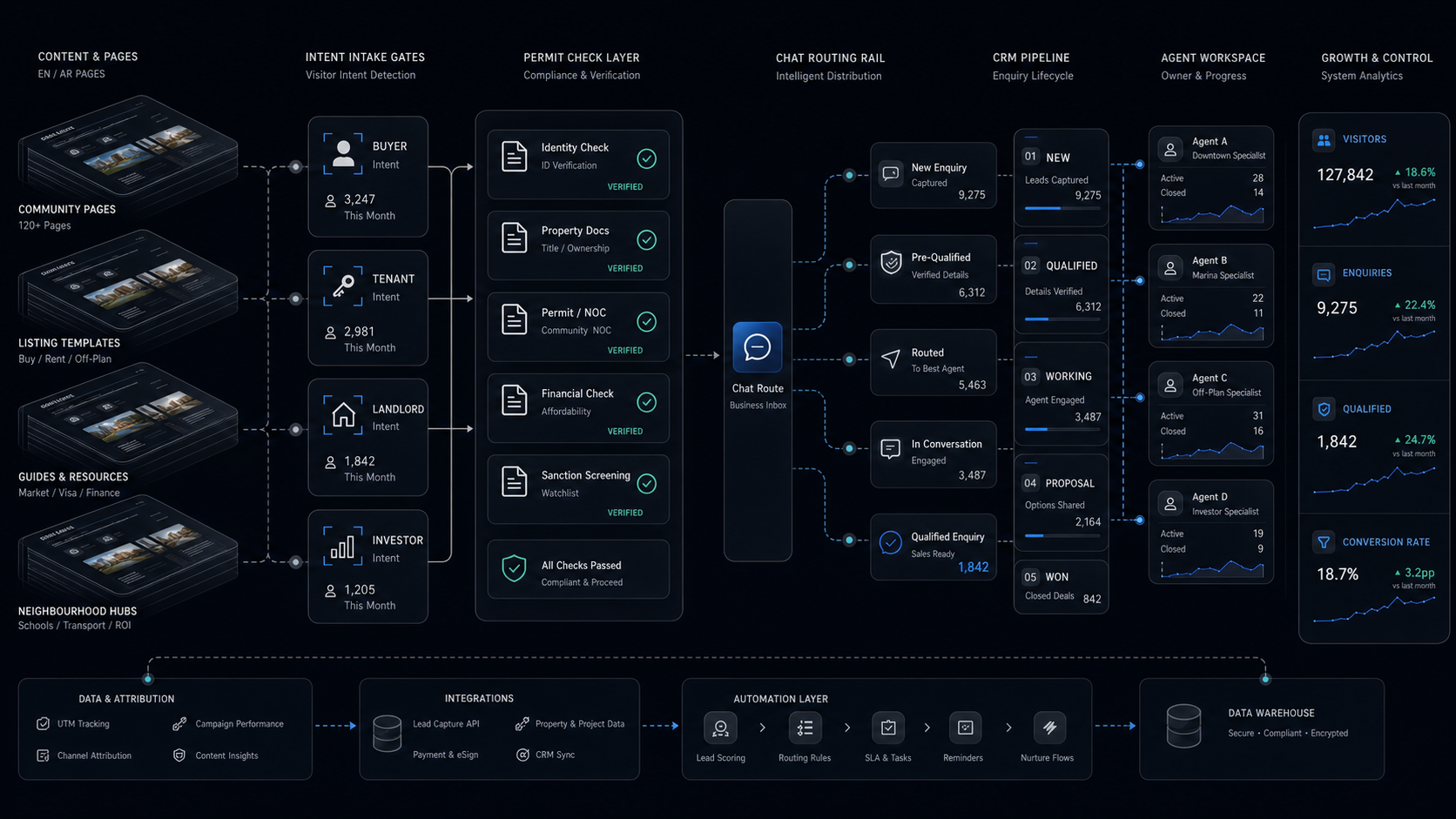
The CRM should make the compliant action the easiest action. Build the journey around a single owner record with evidence, suppression, contact, and outcome fields that travel together.
Start with these record groups:
- Interest evidence:
source_url,source_campaign,request_type,consent_text,consent_timestamp,preferred_language, andpreferred_channel. - Contact authority:
phone_owner,calling_number,approval_status,assigned_agent, andcall_purpose. - Suppression:
dncr_status,dncr_checked_at,internal_opt_out,refusal_status, andsuppression_reason. - Contact history:
last_attempt_at,attempt_outcome,recording_reference, andnext_eligible_action. - Commercial outcome:
owner_need,community,property_status,valuation_requested,consultation_status, andinstruction_source.
The field names can change to match your CRM. The evidence cannot disappear when a lead is reassigned, exported, merged, or passed from marketing to an agent.
Capture an explicit owner request
Use a bilingual English and Arabic page for a clear owner job, such as requesting a Dubai Hills valuation or a landlord consultation. Store the exact request, channel choice, source, consent wording, and timestamp with the record.
Preserve the source
Keep the original source URL or campaign reference through every handoff. Do not overwrite it with a broad label such as social or website when the owner moves into the sales pipeline.
Run the suppression checks
Check the DNCR and the brokerage's internal refusal and opt-out records before creating a contact task. A suppressed record remains visible for audit but cannot enter an agent queue.
Release only an eligible task
Allow a marketing call only from a local number registered under the brokerage's commercial licence, during 9:00 am to 6:00 pm, with the assigned agent and call purpose already attached.
Open transparently and record
Identify the brokerage and purpose at the beginning, inform the owner that the call is being recorded, and ask whether the owner wants to continue before promotion starts.
Route the outcome immediately
Refusal creates suppression. No answer or an ended call uses the statutory retry controls of no more than once a day and a maximum of twice a week. Interest creates the agreed next action and preserves the original attribution.
Use a call opening that earns permission
The opening should prove identity and context before it tries to sell. A short, consistent script also makes coaching and audit review far easier than allowing every agent to improvise.
"Hello, this is [agent] from [brokerage]. You requested [valuation or information] through [source]. This call is being recorded. I am calling about [specific purpose]. Would you like to continue?"
That sequence maps directly to the federal controls: identify the company, state the purpose, notify the consumer of recording, and ask whether the consumer wants to continue before marketing begins.
If the owner says no, the agent closes politely and selects the refusal outcome. The CRM must then suppress future marketing contact. If the owner says the timing is inconvenient but requests a later call, record the owner-requested next action rather than treating it as another cold attempt.
Do not add pressure language, fake buyer urgency, or vague claims that the brokerage "has clients waiting" unless there is a truthful, specific basis. The resolution requires marketing without unjustified pressure, deception, or misleading statements. A clean purpose wins more trust than a rehearsed pretext.
Build inbound owner demand instead of buying another list
The durable alternative is to create reasons for owners to identify themselves. This is where compliance and growth reinforce each other: the brokerage gains a clearer signal, the owner receives something useful, and the source can be measured.
A practical owner-acquisition system can include:
- Community valuation pages that answer the owner's actual decision, not just display listings.
- English and Arabic landlord briefs that explain leasing, sales preparation, or marketing options in a named Dubai community.
- Search and social campaigns linked to one owner request, using official marketing channels after obtaining the official RERA permit for the offering.
- A form that separates the requested service, preferred language, preferred channel, and clear marketing interest.
- A WhatsApp handoff only when that is the owner's selected or requested channel, with the original source and suppression status preserved.
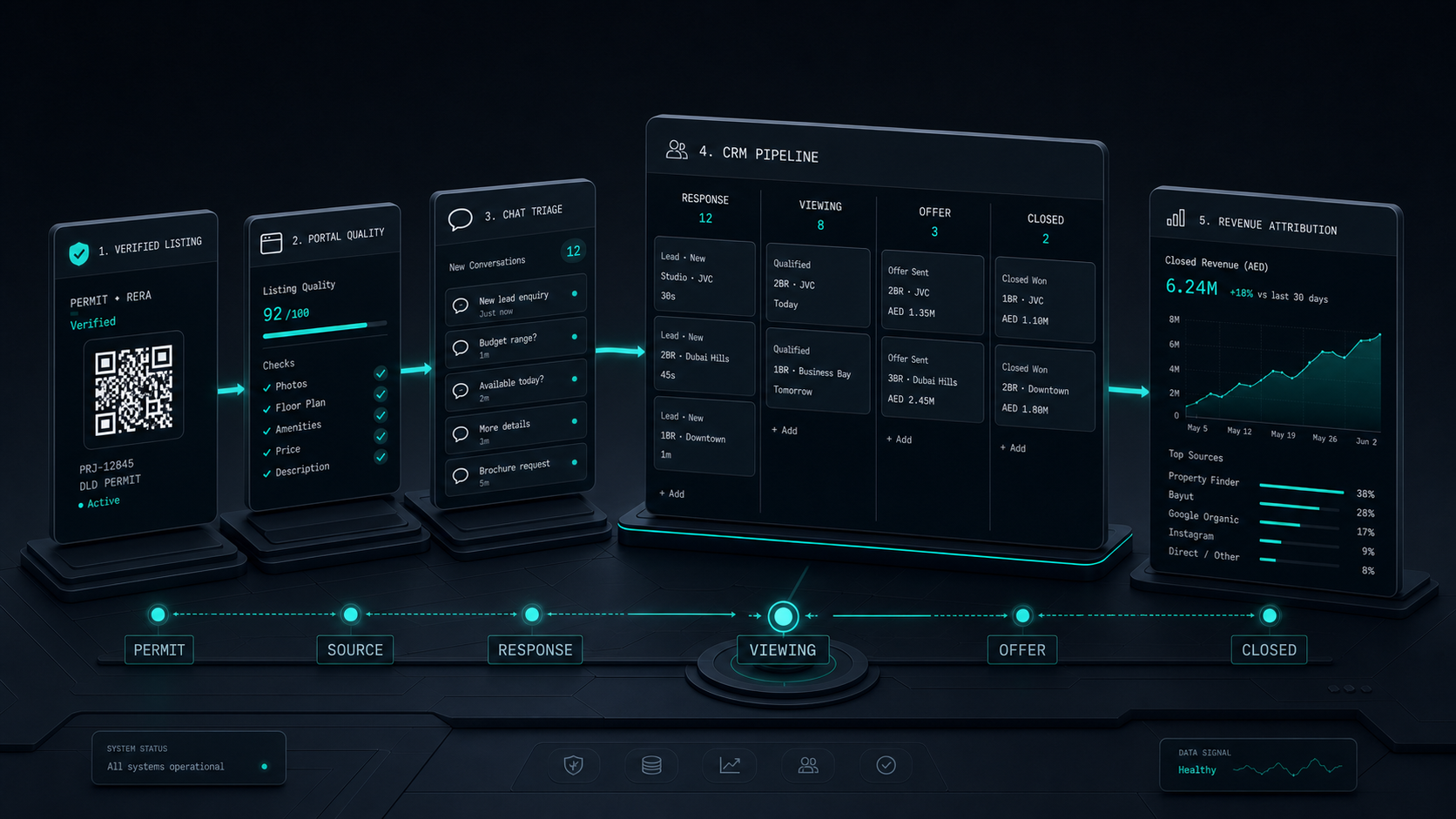
- A CRM journey that connects the first request to the conversation, valuation, consultation, and eventual instruction.
Consider a Business Bay landlord who is comparing whether to lease or sell. A useful bilingual decision page can invite a specific consultation instead of hiding the request behind "contact us." The record arrives with context: community, decision, language, and requested channel. The agent can prepare for a qualified conversation rather than opening with a blind question about whether the property is available.
This owner-demand layer should connect to the wider brokerage lead-generation system, so portal demand, owned website demand, WhatsApp, and agent activity reach the same attribution model.
What fails in practice and how to fix it
The weak points are predictable. Fix them in the system before adding more agents or media spend.
If the current CRM cannot enforce these states, that limitation belongs in the buying decision. The Dubai brokerage CRM comparison explains why portal capture alone is not enough; governance, WhatsApp handoff, ownership, and audit history matter just as much.
The federal penalties make this operationally material. Cabinet Resolution No. 57 of 2024 allows graduated company penalties including a warning, administrative fine, total or partial activity suspension from seven to 90 days, or licence cancellation and deletion from the commercial register with communications services cut and the phone number removed. For the same violation repeated within six months, the competent authority may skip the graduated path and impose the most severe administrative penalty.
Measure qualified owner instructions, not dial volume
The primary growth metric is an attributable owner instruction, not the number of attempts. Dial volume can rise while brand trust, contact quality, and compliance all fall.
Use a compact operating view:
- Contactable owner rate: records that pass every gate compared with owner records received.
- Qualified owner conversation rate: eligible contacts that produce a real valuation, leasing, sales, or portfolio discussion.
- Valuation progression: qualified conversations that move to a valuation or consultation.
- Instruction attribution: signed instructions traced back to the original page, campaign, referral, event, or owner request.
- Suppression health: DNCR blocks, refusals, opt-outs, blocked personal-number attempts, and tasks stopped outside the permitted window.
- Evidence completeness: eligible calls with source, suppression result, recording reference, outcome, and owner attached.
Review these by source, language, community, campaign, and assigned team. That tells the senior partner where better EN/AR content, landing pages, routing, or agent preparation will produce a stronger pipeline. It also exposes the sources that create records but no legitimate reason to contact an owner.
Frequently asked questions
Is cold calling illegal in Dubai real estate?
Do not reduce the answer to a blanket yes or no. Regulated company telemarketing exists, but the UAE rules require prior approval, an interest-based communication channel, DNCR suppression, company-registered numbers, recording, transparency, and contact controls. DLD also asks the public to report unsolicited promotional calls from real estate companies. A cold list with no evidence of owner interest is not a defensible acquisition system.
What hours can telemarketing calls be made in the UAE?
Companies may make marketing phone calls only from 9:00 am to 6:00 pm. Put the window into the queue logic so a task cannot be released outside it.
Do the UAE telemarketing rules cover WhatsApp messages?
A brokerage should treat them as covered. The resolution's definition includes marketing text messages and marketing messages through social media applications, so WhatsApp marketing should use the same interest, source, suppression, and record discipline.
Can a Dubai broker call from a personal mobile number?
No. Company telemarketing must use local phone numbers issued by licensed UAE telecommunications companies and registered under the licensed company's commercial licence. The resolution also says companies must not use numbers that are not registered or owned by the licensed company.
What happens after an owner refuses the offer?
Do not call the owner back after rejection on the first call. Record the outcome and move the record into the brokerage's marketing suppression state.
How can an owner report an unwanted real estate call in Dubai?
DLD says property owners, investors, and the public can log into the Dubai REST application and choose Report Malicious Calls for unsolicited promotional calls from real estate companies.
Book the Growth Sprint
Map the owner-enquiry journey, compliance gates, CRM routing, bilingual capture, and attribution before more outreach spend.
Jul 11, 2026