Dubai Clinic Local Search: The DHA-Compliant Patient Discovery System
A Dubai clinic playbook for winning Google Maps and AI-search discovery inside DHA rules: profile setup, compliant reviews, and enquiry routing.

Patients in Dubai find a clinic the way they find a restaurant: they open Google Maps, ask a friend, or now ask ChatGPT. The clinics that show up are not the ones with the biggest ad budget. They are the ones with a complete, consistent profile, genuine reviews earned without breaking the rules, and someone who answers the enquiry within minutes. The catch is that the Dubai Health Authority regulates almost every shortcut a marketing agency would reach for.
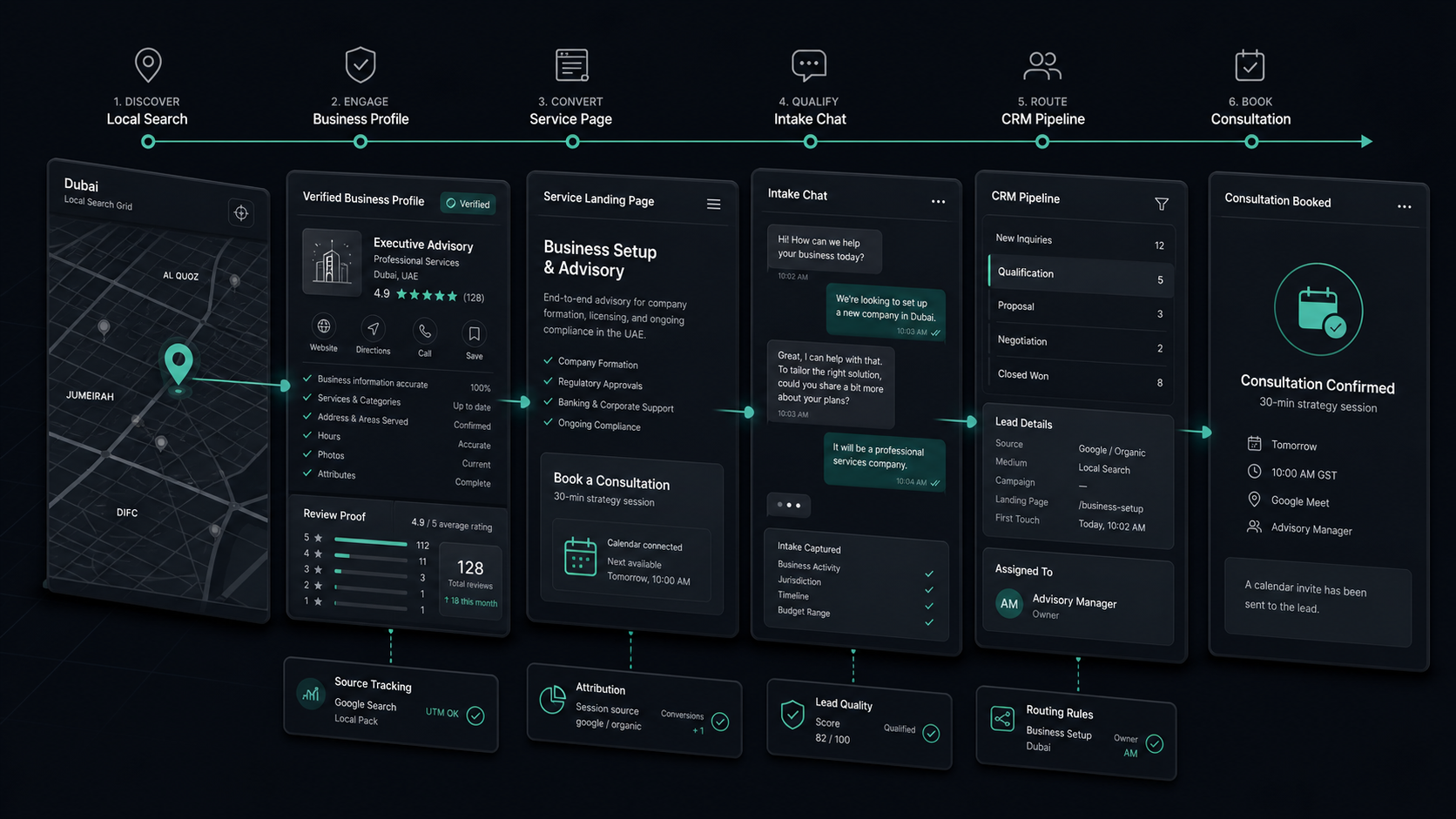
So build for the surfaces patients actually use, and build inside the rules from the start. This is the patient-discovery system we set up for a Dubai clinic: a Google Business Profile that matches the licence, a review approach that survives both DHA and Google policy, content that teaches instead of oversells, and an enquiry route that turns a map view into a booked consultation.
How patients actually find a Dubai clinic now
Three surfaces decide whether a new patient ever reaches your front desk, and they all feed each other.
The first is the Google Maps local pack, the small cluster of pins and profiles that appears when someone searches "aesthetic clinic near me" or "dentist Jumeirah." Most local intent still lands here. The second is AI answers: Google's AI Overview (which appears for these clinic queries in the UAE) and assistants like ChatGPT, which increasingly pre-filter the shortlist before a patient ever opens a map. The third is the profile and website they land on to make the final call.
You do not win these separately. A complete, consistent Google Business Profile is what the map pack ranks, what an AI answer quotes, and what a cautious patient checks. Get that one asset right and it works across all three. The rest of this playbook is how to build it without tripping a DHA rule.

Build the Google Business Profile the DHA way
Start with the profile, because it is the highest-impact asset a clinic owns and the one most agencies fill in carelessly.
Match the name to your DHA licence exactly
Use the clinic's licensed trading name, not a marketing variant stuffed with keywords like "Best Dubai Dermatology." Name-stuffing is a Google violation and it creates a mismatch with your DHA licence that a patient (or a regulator) will notice. Consistency across your profile, website, and licence is the trust signal that actually moves ranking.
Set one accurate primary category
The primary category ("Dental clinic," "Medical clinic," "Skin care clinic") carries the most weight in what you rank for. Pick the one that matches your core service, then add secondary categories for the rest. Do not pick a broader category to "catch more searches"; it dilutes relevance and can misrepresent a licensed scope of practice.
Complete every field, in English and Arabic
Hours, services, booking link, phone, and a written description. A bilingual audience searches in both languages, so a profile that reads naturally in Arabic and English reaches more of the actual market. Half-filled profiles lose to complete ones on the same street.
Use real facility photos, and mind patient images
Photograph the reception, the treatment rooms, the facade, and your practitioners. Patient images are different: the DHA standard requires that written consent "shall be obtained and documented from any individual or patient whose Pictures, Images and Videos (PIV) and statements are used." No patient photo goes up without that documented consent on file.
That last point is the theme of this whole playbook. The compliant version of each tactic is usually also the durable version, because it is built on genuine signals rather than shortcuts a platform will later strip out.
The review problem every Dubai clinic hits
Reviews are the single strongest lever on the map pack and a major trust signal for AI answers, and they are also where clinics get themselves into the most trouble. Two separate rulebooks apply at once.
On the DHA side, the Standards for Medical Advertisement Content on Social Media prohibit "patient testimonials without written patient consent." A testimonial is not automatically banned, but using one as marketing without documented consent is. This is narrower than the "clinics can never use testimonials" advice you will hear repeated; the actual rule is about consent, and it is worth getting right. The same standard governs everything from before-and-after images to comparative claims, which we break down in our guide to the DHA advertising rules for clinic ads.
On the Google side, the review policy is blunt about how you may ask. Merchants may not offer incentives "such as payment, discounts, free goods and/or services, in exchange for posting any review." They may not "discourage or prohibit negative reviews, or selectively solicit positive reviews," which rules out review gating, the common trick of only sending happy patients to Google. And when asking, a clinic "should not require or pressure users to leave ratings or write reviews while on the premises, nor should they request that specific content be included." Reviews from staff or anyone with a conflict of interest get removed.
Put those together and the compliant ask is simple, which is the point.
The clinics that win reviews in Dubai are not gaming anything. They ask everyone, they ask well, and they respond to every review, positive or negative, without ever discussing a patient's medical details in a public reply.
Content and before-after images that stay inside the rules
Content is how you rank for the conditions and treatments patients search, and how an AI engine decides you are a credible source. Write to teach, and the compliance mostly takes care of itself.
Lead with educational pages: what a treatment involves, what recovery looks like, how to choose between options, what a first consultation covers. Attach real authority by naming your practitioners with their credentials. The DHA standard also requires that the official account "state the corresponding medical advertisement license number provided by Ministry of Health and Prevention (MOHAP)," so the licence number belongs on your profiles, not hidden.
Then avoid the three claims that get clinics penalised:
- Plain explanations of conditions, treatments, and recovery, in EN and AR
- Practitioner names, qualifications, and licence details
- Before-and-after images only of the actual patient, same individual and same lens, with no retouching, carrying the required disclaimer that "there is no guarantee that the result will be the same, as it might vary from one individual to another," plus documented written consent
- FAQ pages that answer the real questions patients ask
- Testimonials or patient statements without documented written consent
- Comparisons claiming you are better or safer than another provider, unless scientifically proven and peer-reviewed with credible references
- Copy engineered to cause "fear, anxiety, panic or distress," a category the DHA standard prohibits outright
- Video of a patient undergoing surgery under general anaesthesia used for marketing, which the standard bans in all forms
None of this weakens the content. It forces you to compete on genuine expertise and clarity, which is exactly what both a cautious patient and an AI engine are trying to find.
Win the AI-search recommendation
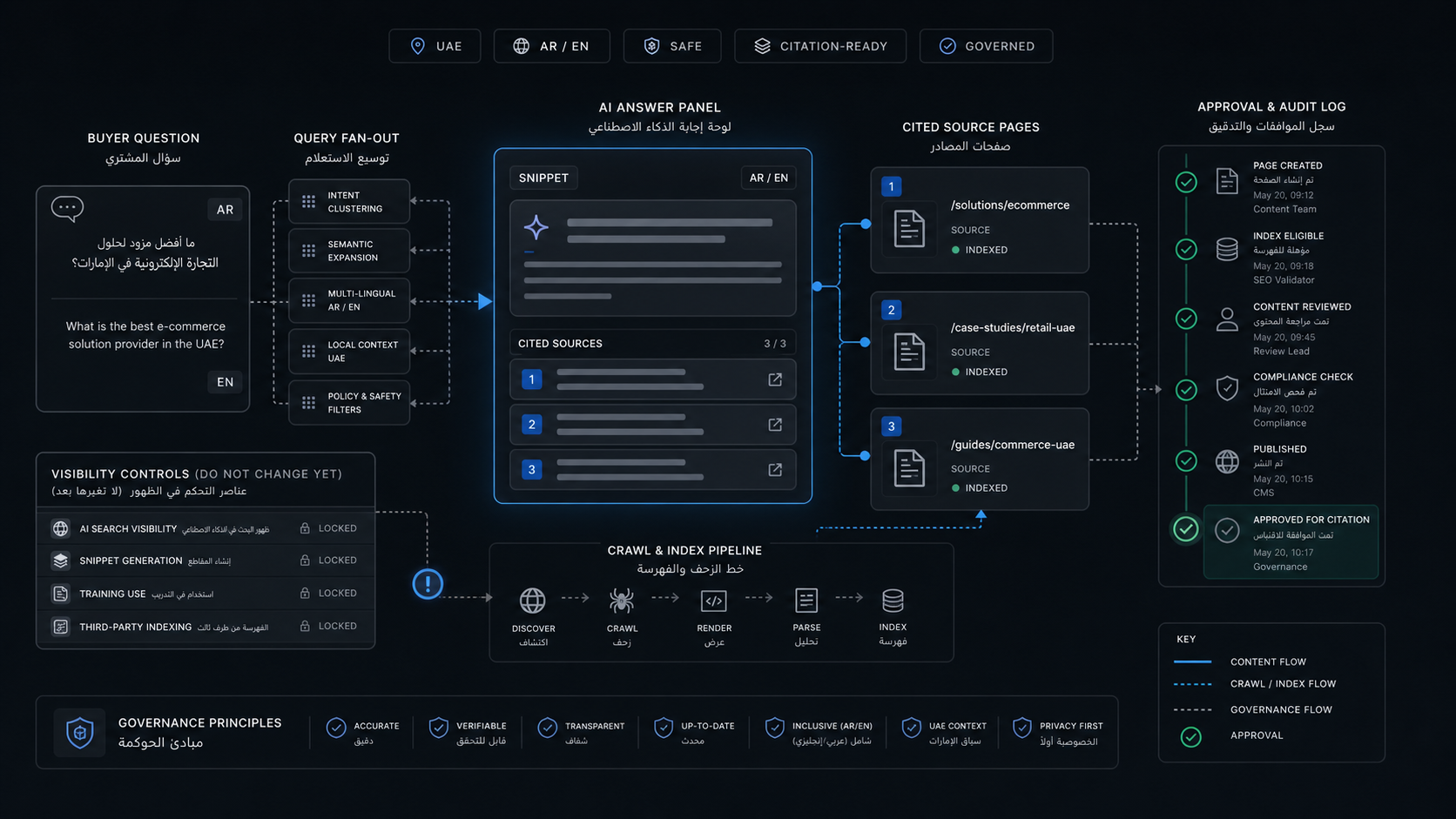
Getting quoted in an AI answer is an extension of the same profile discipline, with one addition: structure your pages so a machine can lift a clean answer.
Open each page with the direct answer to the question in its title, then support it. Keep your name, address, and phone identical everywhere, because inconsistency is what makes an engine distrust a local business. Publish FAQ pages that match how patients phrase questions ("how much does teeth whitening cost in Dubai," "is laser hair removal safe"), and answer them plainly. Reinforce credibility with your practitioners' licence and qualification details, the same signals a patient uses. This is the citation-page discipline that gets a brand quoted rather than skipped; we cover the mechanics in our guide to building citation pages AI engines can quote.
The clinics that get recommended by ChatGPT are, again, the ones with a consistent, complete, credible footprint. There is no trick layer underneath.
Route the enquiry before it goes cold
Visibility is worthless if the enquiry dies in a WhatsApp inbox, and for most Dubai clinics that is exactly where it dies. A patient who found you on Maps at 9pm and messaged will book with whoever replies first.
Wire the last mile so the enquiry is captured and answered:
- Put a WhatsApp click-to-chat and an online booking link on the profile and every landing page, so the patient reaches you in one tap.
- Route new enquiries into a shared CRM, not a personal phone, so nothing is lost when a receptionist is off shift and every message has an owner and a follow-up.
- Handle patient contact details as regulated personal data: capture consent and keep the record, in line with the UAE's data-protection expectations and the DHA's own patient-information rules.
- Measure the number that matters: cost per booked consultation, not profile views or follower counts. Views feel good; bookings pay the lease.
This is where a lot of clinic marketing quietly fails. The ads work, the map ranking climbs, and the enquiries still leak away between a portal, a WhatsApp, and a spreadsheet nobody owns.
Getting found is a system, not a campaign, and for a licensed clinic the compliant version is also the one that lasts. If you want that system built and measured for your clinic, this is exactly what a Growth Sprint scopes.
Book the Growth Sprint
A two-week paid diagnostic that maps your clinic's Google, AI-search, and enquiry-routing gaps into a build plan with a cost-per-consultation target.
Can a Dubai clinic ask patients for Google reviews?
Yes. You can ask every patient with a direct link to your Google profile. What you cannot do, under Google's policy, is offer an incentive for a review, discourage or filter out negative ones, or pressure patients on the premises to write specific content. Ask everyone, keep it neutral, and respond to all reviews without discussing any medical detail.
Can we post before-and-after photos of treatments?
Only within the DHA rules. The image must be of the actual patient who received the treatment, the same individual using the same lens, with no photoshop, and it must carry the disclaimer that "there is no guarantee that the result will be the same, as it might vary from one individual to another." You also need documented written consent for any patient images or statements.
Do we need a licence number on our clinic's social accounts?
Yes. The DHA social-media advertisement standard requires the official account to state the medical advertisement licence number provided through MOHAP. Keep it visible rather than buried.
Does Google Maps or AI search matter more for a clinic?
Both feed the same profile. Google Maps still drives most local "near me" intent, while AI answers increasingly build the shortlist a patient considers first. A complete, consistent, credible Business Profile and website is what ranks in the map pack and what an AI answer quotes, so you invest once and win on both.
Jul 13, 2026