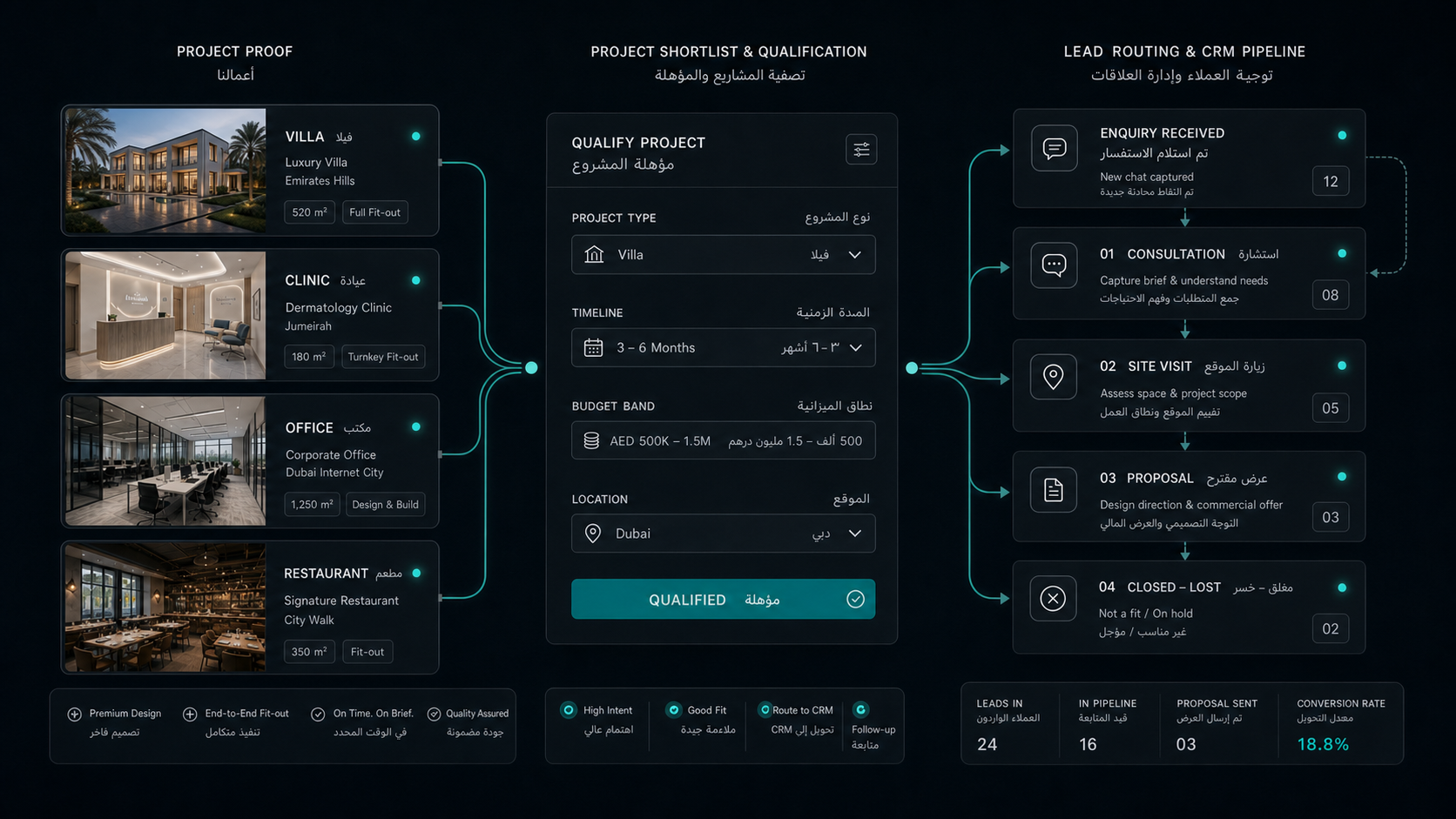
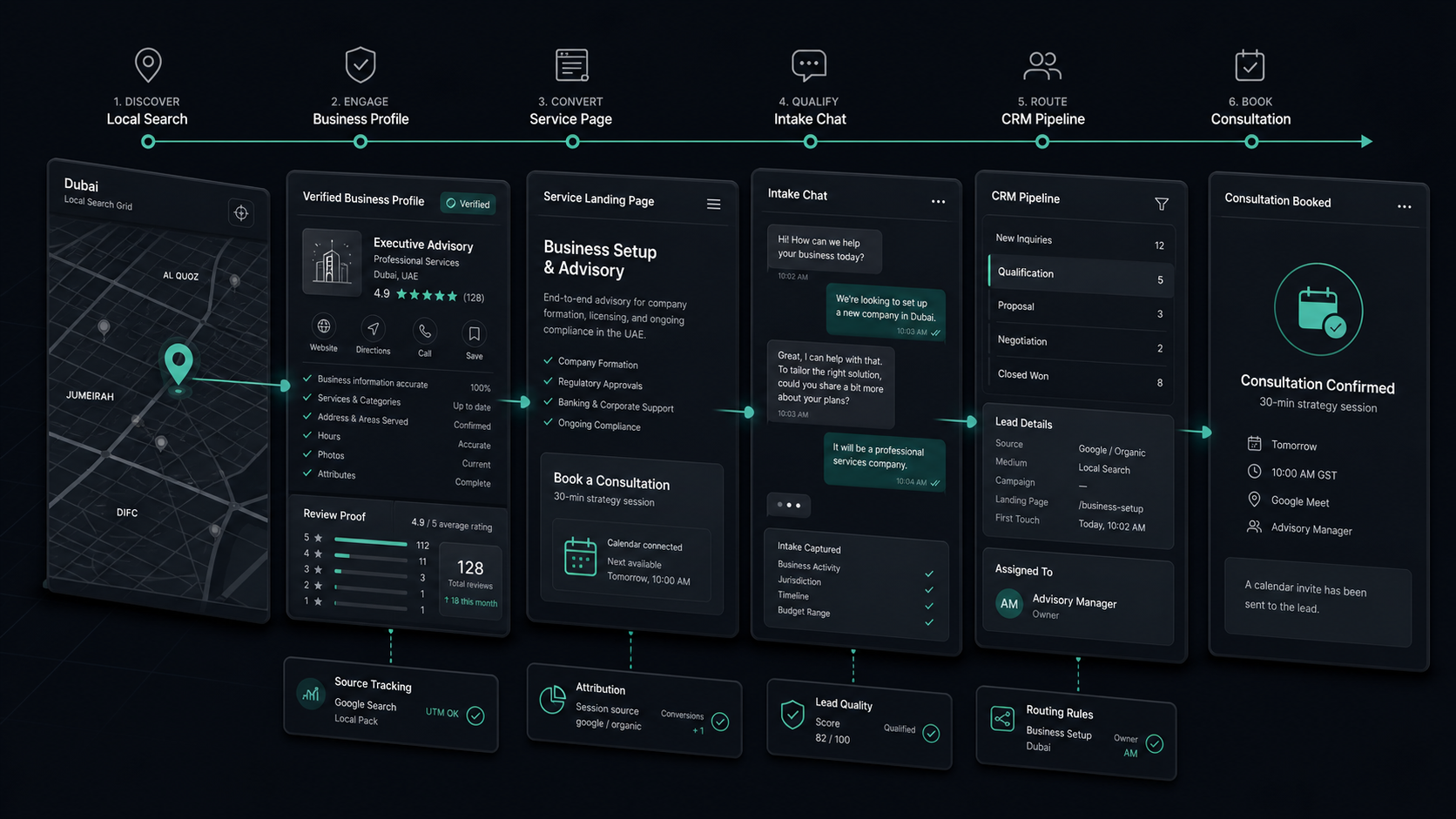
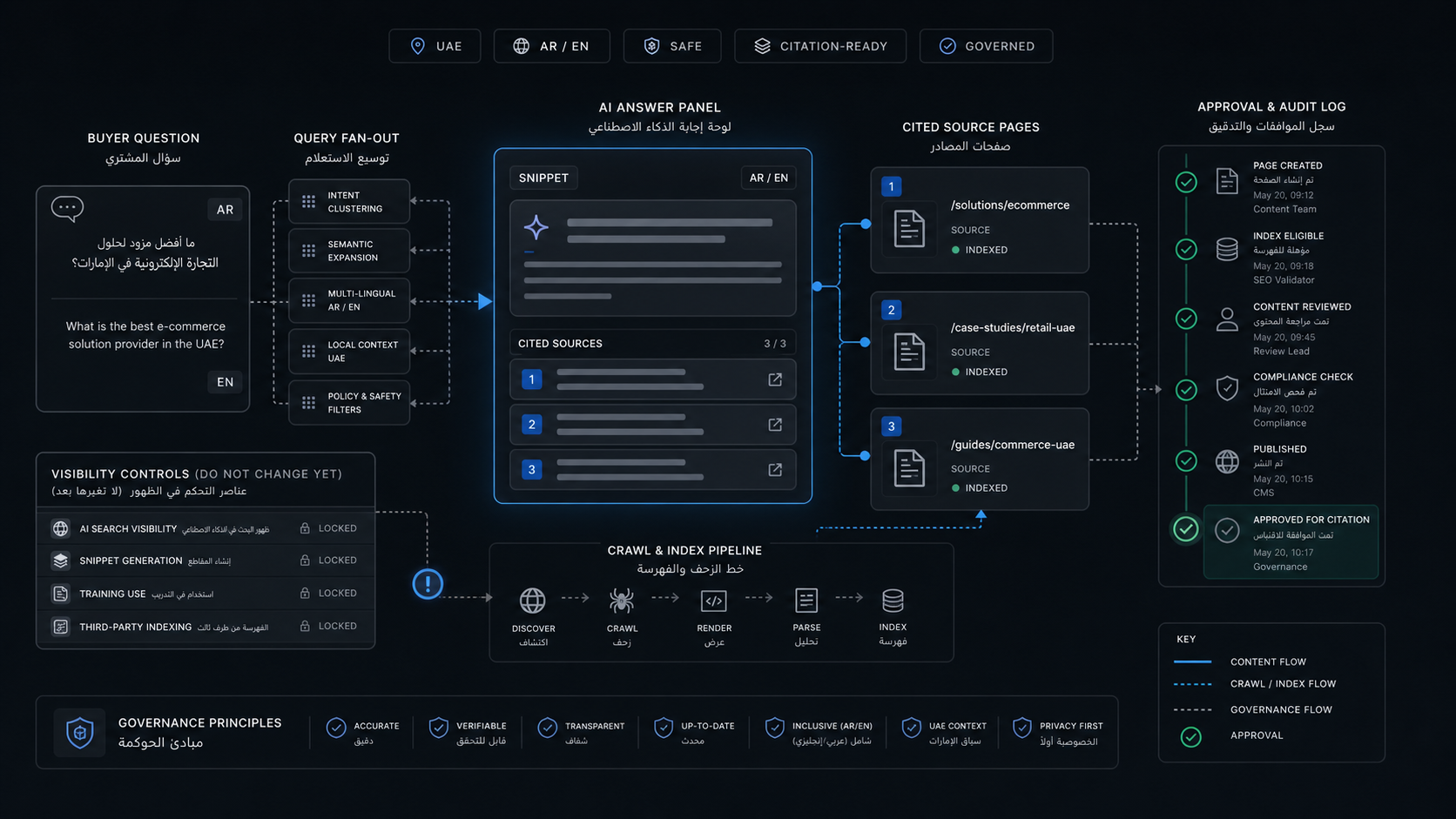
Real Estate Web Design Dubai: The Brokerage Conversion Brief
A Dubai brokerage website brief for turning listing traffic into WhatsApp and CRM enquiries, with compliance checks, page structure, and measurement.

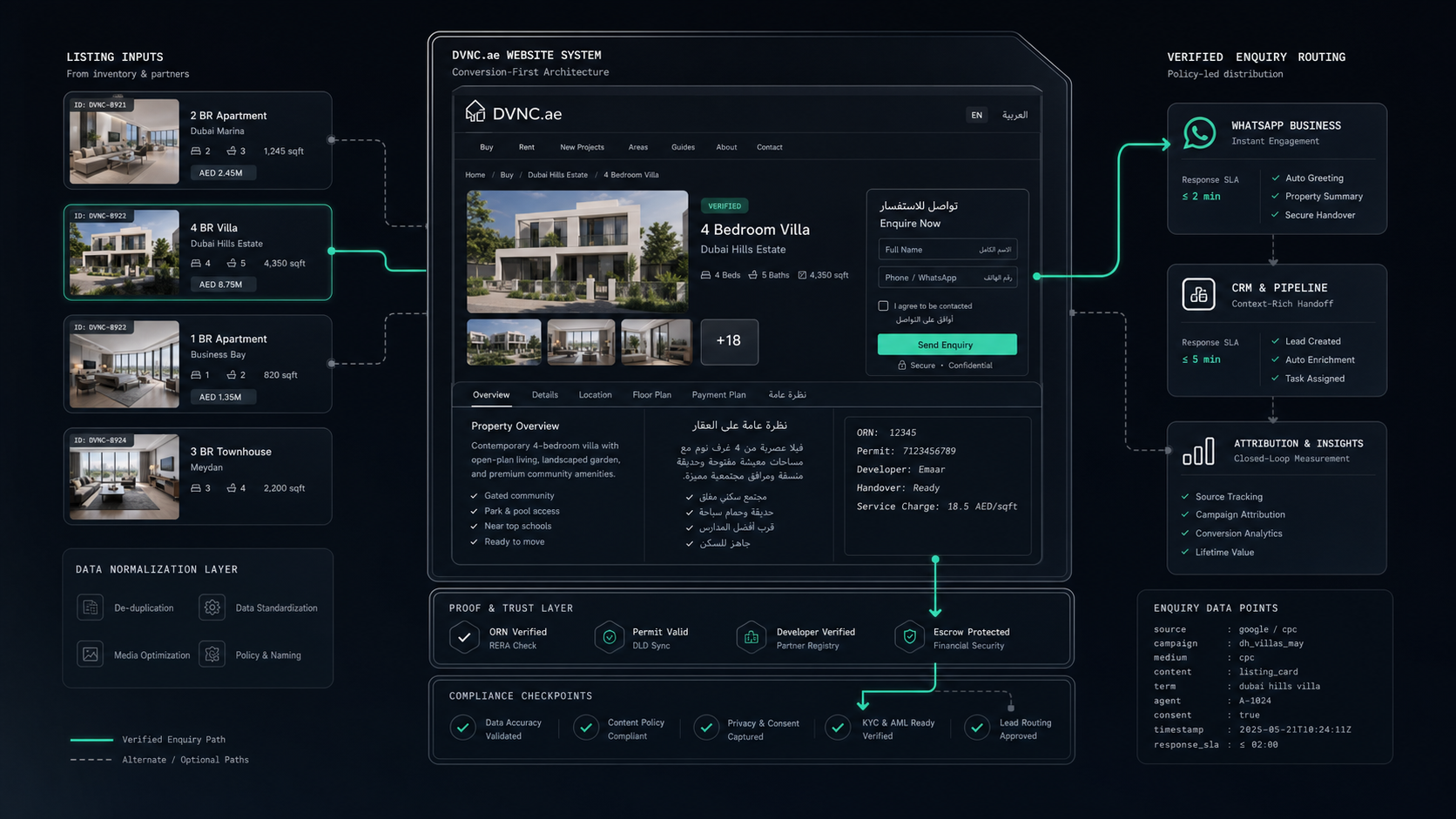
A Dubai real estate website should not be a portfolio with a WhatsApp button pasted on top. It should be the controlled middle of the brokerage pipeline: listing pages that earn trust, route enquiries to the right agent, record consent, and prove which channel produced the lead.
The right website brief starts with the enquiry, not the homepage
The first decision is not the visual style. The first decision is what counts as a qualified enquiry and where that enquiry should go.
For a Dubai brokerage, a useful website brief starts with five fields:
If the website cannot capture those fields, the redesign is cosmetic. A faster page and better photography will still drop leads into the same unclear handoff.
Scope the enquiry before the design system:
Define the lead object
Create one lead record shape before building pages: name, phone, email if needed, listing URL, area, budget, intent, language, source channel, preferred contact method, agent owner, consent state, and first response deadline.
Map every CTA to that object
A listing page WhatsApp click, a valuation form, an off-plan brochure request, and a community-page enquiry should all pass different context into the same CRM logic.
Write the routing rule
Decide the rule in plain language: "Arabic Palm Jumeirah buyer enquiries over AED 5M route to the luxury team, leasing enquiries route to the leasing desk, stale portal leads route to nurture." Then build the form and WhatsApp flow around that rule.
This is also where the website scope connects to the brokerage's sales discipline. A website can create a clean enquiry, but it cannot compensate for agents who do not answer, duplicate owners in the CRM, or a WhatsApp inbox that no one audits. The brief should name the operational owner, the response SLA, and the weekly report before any page is designed.
The pages a Dubai brokerage website actually needs
A brokerage website needs fewer page types than most proposals include, but each page type has to do real work.
The useful page map is:
Google's own search guidance is a useful baseline here: it says Google primarily finds pages through links, recommends descriptive URLs, and says its crawler should ideally see the page the same way an average user does. For a brokerage, that means listings and community pages should not live only behind filters, scripts, or a search box that produces no indexable page.
The practical rule is simple: if a buyer can ask for it, create a stable page for it.
A Dubai Marina apartment buyer should be able to land on a clear page, understand the property, see nearby context, contact the correct agent, and move into WhatsApp or a form without losing the listing context. A landlord in JVC should be able to reach a valuation page that speaks to owner goals, not a generic "contact us" form. A relocation buyer should be able to find area guidance that feels current, not a thin paragraph copied across every community.
Use this URL pattern as a working model:
The page map also supports AI search visibility. A model or search engine needs clean, crawlable, specific pages to understand what the brokerage does. A website that only says "award-winning real estate company in Dubai" gives search systems very little to cite. A page that explains Dubai Marina buying options, shows available inventory, names the enquiry path, and links to the right next step is easier for both people and machines to trust.
For the broader search layer, use the same discipline we described in our piece on AI search engine optimization for UAE brands: publish pages that answer real buyer questions, keep claims verifiable, and make the business easy to understand without forcing the reader through a sales call.
The compliance layer belongs in the CMS, not in a spreadsheet
Compliance should be designed into the publishing workflow, because retrofitting it after launch creates slow approvals and risky shortcuts.
Dubai brokerage websites usually fail here in a quiet way. The design agency builds a polished listing template, the marketing team uploads properties, agents send updates by WhatsApp, and compliance evidence sits somewhere else: a spreadsheet, a portal, a PDF, or a manager's phone. That is not a website system. That is a visual front end attached to an unmanaged publishing process.
DLD gives operators public verification surfaces that should shape the website brief. Its official site links to a Licensed Real Estate Brokers search and a Trade License Search. The licensed broker page lets users search by brokers, offices, mobile number, area, and ORN, and it displays broker numbers. The trade-license search asks for a license number and returns company name, license number, issue date, expiry date, phone, and fax fields.
That does not mean every website should display every internal compliance field to the public. It means the CMS should hold the evidence close to the page being published.
Set up the listing workflow like this:
A good web design company can make the site look credible. A good brokerage growth partner makes the publishing workflow credible. The difference matters because the website will not be judged only on launch day. It will be judged every week when new listings, community pages, and campaign pages are added by people under pressure.
WhatsApp should be routed like a sales channel, not a floating icon
WhatsApp is not the strategy. The strategy is passing the right context into the right conversation and logging what happened next.
Meta's WhatsApp Business Platform overview, updated Jun 2, 2026, says the platform enables businesses to communicate with customers at scale. Its Cloud API supports programmatic messaging and calling, text, rich media, interactive messages, business phone numbers, message templates, and webhooks. Webhooks can deliver message status updates, incoming messages, error handling, and other notification payloads to a server.
For a brokerage website, that changes the brief. You are not asking for "a WhatsApp button." You are asking for a controlled handoff.
The button should know:
- Which listing or page the visitor came from.
- Which agent or team should answer.
- Which language the page used.
- Whether the visitor asked to buy, rent, sell, or value a property.
- Which campaign, portal, social post, or search page produced the click.
- Whether the lead gave consent for follow-up templates.
The CRM should know the same thing. If the website sends WhatsApp enquiries without a lead record, the firm gets a conversation but loses attribution. If the website creates a lead record but the agent replies from a personal phone with no update, the firm gets attribution but loses control. The right model is both: conversation speed for the buyer, evidence and ownership for the brokerage.
Use a routing matrix before launch:
This is where many brokerages should review the handoff before redesigning the site. If leads already disappear between portal, WhatsApp, and CRM, the website must fix that routing problem first. Our separate guide to lead routing software for UAE WhatsApp and CRM workflows covers that decision in more depth.
One more point matters: templates and follow-up need consent. Meta's documentation says message templates are generally approved in advance, are used for messaging at scale, and are the only message type sent outside the customer service window. It also says businesses must obtain opt-in before sending message templates, and the opt-in must clarify the business name and intent. For a brokerage website, that means the consent text is not a decorative footer. It is part of the lead system.
Search and AI visibility need structured, indexable brokerage pages
The best real estate website design in Dubai will not help much if the important pages cannot be crawled, understood, and cited.
For a brokerage, search visibility is not just "SEO keywords." It is the way the website makes the business, locations, listings, agents, and offers legible. Google Search Central recommends helpful, reliable, people-first content, good page titles, short unique meta descriptions, high-quality images near relevant text, and descriptive alt text. Those basics matter because a property site is image-heavy, location-heavy, and often duplicated across portals.
Build the search layer around real buyer and landlord questions:
The mistake is writing every page as a slogan. "We are a leading real estate company in Dubai" does not help a buyer choose, and it gives search systems no useful detail. A better Dubai Hills page explains who the area suits, what buyers compare it against, what listings are available, what questions agents get repeatedly, and how to enquire with the right context already attached.
This is also where bilingual content matters. Arabic content should not be a machine-translated afterthought hidden in a language toggle. For an EN/AR brokerage, the Arabic page should carry the same decision value: area context, buyer intent, enquiry route, and brand tone. The English and Arabic versions can share structure, but they should not feel like one is the real page and the other is a compliance copy.
Use this publishing rule:
Make every important page linkable
If a buyer, seller, landlord, or search engine needs the page, it needs a stable URL. Do not hide important inventory, community guidance, or campaign offers behind unshareable filters.
Write one useful answer per page
The page should answer one commercial question clearly. A community page answers area fit. A listing page answers property fit. A seller page answers why the brokerage deserves the mandate.
Attach the enquiry path to the answer
The CTA should preserve context. A visitor asking from a Palm Jumeirah villa page should not arrive in the same inbox state as a visitor asking from a Dubai Marina rental page.
The search layer and the sales layer should support each other. A page built for search but disconnected from the CRM is a content asset, not a growth asset. A page built for conversion but not crawlable depends too heavily on paid traffic and portals.
Measure the site by enquiry quality, speed, and handoff
The launch report should not stop at page views. It should show whether the website produced better enquiries and cleaner handoff.
Use three measurement layers:
Web performance has a clear baseline. The Core Web Vitals current set measures loading, interactivity, and visual stability. A good Largest Contentful Paint should occur within 2.5 seconds of the page starting to load, Interaction to Next Paint should be 200 milliseconds or less, and Cumulative Layout Shift should be 0.1 or less. The recommended threshold is the 75th percentile across mobile and desktop page loads.
For a Dubai brokerage, the useful dashboard is more commercial:
- Listing page views by area and source.
- WhatsApp clicks by listing, area, language, and agent.
- Form enquiries by buyer, renter, seller, landlord, and campaign.
- First response time by team.
- Enquiry-to-qualified-lead rate.
- Qualified lead to viewing, valuation, or consultation.
- Listings with traffic but no enquiries.
- Pages with enquiries but poor agent follow-up.
That last pair is where the real insight lives. A page with traffic and no enquiries may need better media, stronger proof, cleaner pricing, or a more specific CTA. A page with enquiries and poor follow-up is not a web-design problem. It is a sales-operations problem exposed by the website.
This is why a cheap website can become expensive. If it cannot tell the owner which pages produced qualified enquiries, which agents answered, and which campaign created the lead, the firm will keep spending on traffic without knowing where the pipeline breaks.
The 14-day brokerage website scope
A serious website partner should be able to turn the redesign into a decision-ready scope before asking for a full build commitment.
Use a 14-day scope like this:
This scope is intentionally practical. It tells the brokerage whether the real job is a design refresh, a CMS rebuild, a lead-routing repair, a bilingual content operation, or all four.
The buying rule is direct: do not choose the real estate web design company in Dubai that only shows the prettiest mockup. Choose the partner that can explain how an enquiry moves from page view to WhatsApp conversation to CRM record to agent action, with compliance evidence and weekly reporting attached.
What to avoid when buying real estate web design in Dubai
Avoid any scope that treats the brokerage website as a brochure.
The common traps are:
- A conversion brief gives the design team a real operating target.
- A structured CMS reduces messy listing updates and compliance drift.
- WhatsApp routing keeps speed without losing attribution.
- Search-ready pages support organic, local, and AI discovery.
- Weekly reporting shows whether the website is producing qualified enquiries.
- A proper scope takes more work before visual design starts.
- Agents must follow the routing and CRM process for the system to work.
- Thin listing data and weak photography cannot be fixed by layout alone.
- A bilingual content model needs ongoing ownership, not a one-time translation pass.
Be especially careful with four promises.
First, "unlimited pages" usually means no page strategy. A brokerage does not need unlimited weak pages. It needs the right page types, maintained properly.
Second, "SEO included" often means titles and plugins, not a real area, listing, and content architecture.
Third, "CRM integration" can mean a form email, not a clean lead object with source, listing, owner, consent, and status.
Fourth, "WhatsApp integration" can mean a floating icon, not a routed and measured sales channel.
The best brief is less glamorous and more useful: pages that buyers can trust, a CMS that marketers can operate, evidence fields that managers can audit, WhatsApp flows that agents can answer, and reporting that an owner can use.
How much does real estate web design Dubai cost?
The useful answer depends on scope. A cheap brochure site, a listing CMS, and a brokerage conversion system with CRM, WhatsApp routing, bilingual content, compliance fields, and reporting are different products. Ask for the lead object, page map, CMS fields, routing matrix, and launch dashboard before comparing price.
Should a Dubai brokerage use a free or cheap website builder?
Use one only for a temporary validation page or a very small firm with no active listing operation. A brokerage that depends on listing updates, agent routing, portal traffic, WhatsApp follow-up, and search visibility needs more control than a generic builder usually provides.
What should the best real estate web design company in Dubai include?
They should include listing and community page architecture, mobile performance, CRM and WhatsApp handoff, bilingual EN/AR publishing, DLD evidence fields where relevant, conversion tracking, and a weekly owner report. The visual layer matters, but it is only one part of the growth system.
Does a brokerage website still matter if most leads come from Bayut, Property Finder, Instagram, and WhatsApp?
Yes, because the website is the controlled destination where the brokerage can own proof, content, routing, and attribution. Portals and social channels create attention, but the website should turn that attention into a managed enquiry the firm can measure.
Apply for a Partnership
Build a brokerage website, bilingual content engine, and WhatsApp lead system that turn listing attention into managed enquiries.
Jun 24, 2026