Interior Design Company Dubai: Build the Project Shortlist System
A Dubai fit-out playbook for portfolio pages, Google visibility, WhatsApp qualification, and CRM follow-up that wins better project enquiries.

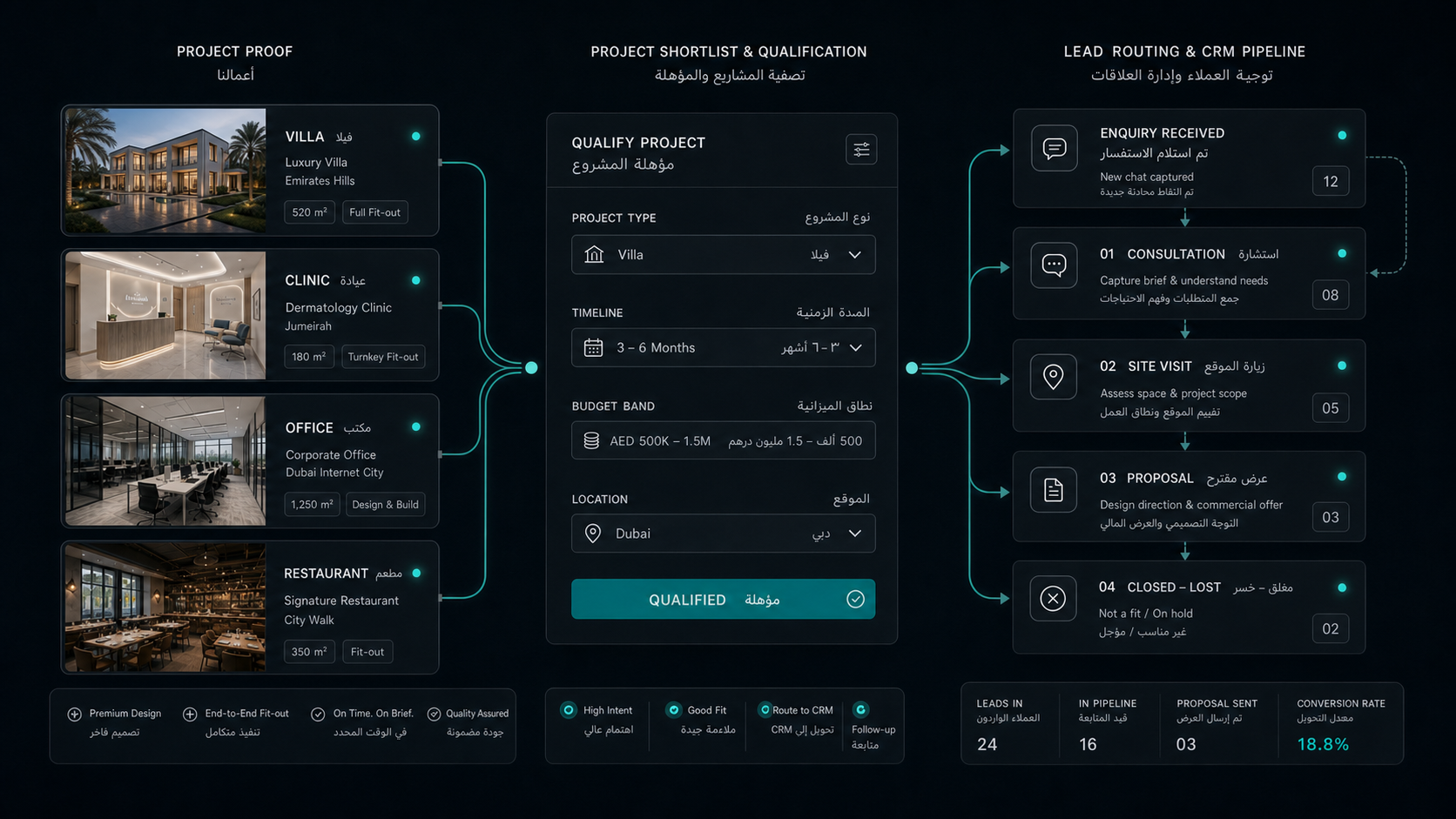
Dubai interior design and fit-out firms do not need a prettier gallery first. They need a project shortlist system: a Google profile that reflects the real studio, portfolio pages grouped by project type, WhatsApp qualification, and CRM follow-up before paid ads scale.
Build for the shortlist, not the gallery
The job is to make a serious buyer feel, within one visit, that your studio has already solved a project like theirs. A villa owner in Jumeirah, a clinic expanding in Business Bay, and a restaurant group opening a second venue are not browsing interiors in the same way. They are checking whether you understand their category, whether the finished work is real, whether the scope matches their budget, and whether your team can respond with a clear next step.
For a Dubai interior design or fit-out firm, the project shortlist system has five parts:
- Google visibility: the studio can be found under its real name, real service categories, and local service context.
- Portfolio proof: projects are grouped by buyer use case, not only by image style.
- Qualification: the form and WhatsApp flow ask for project type, property or venue type, location, timeline, budget band, and fit-out scope.
- CRM routing: a CRM, meaning the database where enquiries, follow-ups, and deal stages are tracked, receives the enquiry before the team starts replying from personal phones.
- Follow-up: every serious enquiry gets a next action, a site-visit path, and an owner-visible status.
The weak version is a beautiful portfolio with a floating WhatsApp button and no memory. The stronger version is a project pipeline. If a buyer clicks from Google or Instagram, the system knows the source, captures the brief, routes the enquiry, and shows whether the lead became a consultation, a site visit, a proposal, or a dead conversation.
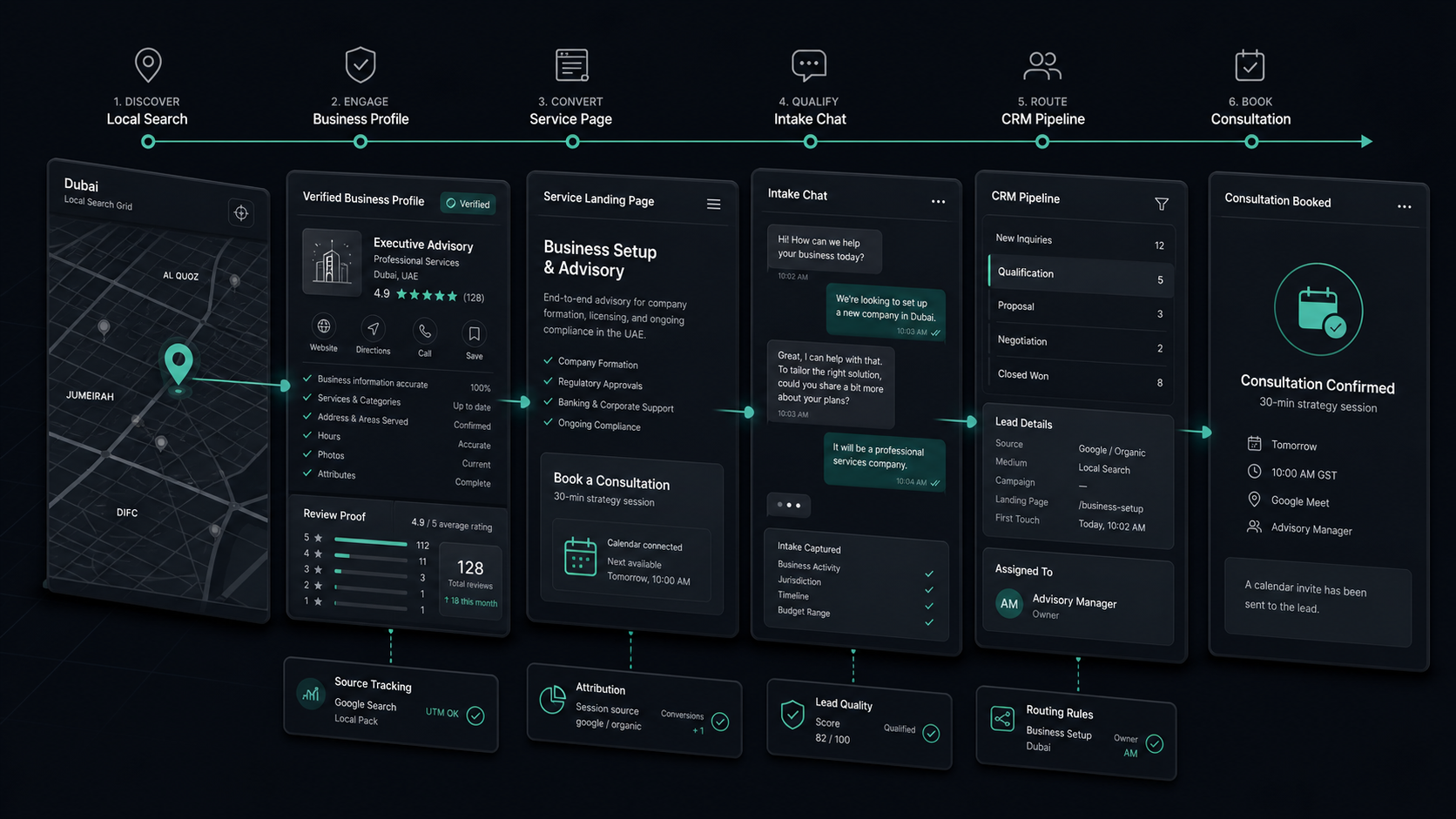
This is also why the work belongs near a local service search system, not only inside a design feed. A buyer who searches, compares, and then sends a WhatsApp message is already moving through a decision path. The studio should own that path.
Make Google trust the studio name
Your Google Business Profile should describe the real studio, not a keyword-stuffed version of the studio. Google's own Business Profile guidelines say a business with a physical location customers can visit, or a business that travels to customers, can create a profile. They also say the profile should reflect the business accurately, use an accurate address or service area, choose the fewest categories needed, and have only one profile per business.
For an interior design or fit-out firm, this means the profile should be boring in the places where Google expects discipline:
- The business name matches the real-world name used on signage, the website, stationery, and client documents.
- The service area reflects where the studio actually works.
- The primary category describes the core business without trying to cover every possible buyer phrase.
- The description explains services, products, mission, and history without links or irrelevant claims.
- The profile is not split into duplicate listings for every service line.
The fastest way to damage the profile is to turn the name field into an SEO sentence. Google says the business name should not include marketing taglines, business hours, phone numbers, website URLs, service or product information, or location information unless those are part of the real-world business name. "Studio Name" is safer than "Studio Name Best Luxury Villa Interior Design and Fit Out Dubai WhatsApp."
Clean the profile name
Use the exact studio name customers see on your website, invoices, office signage, and project documents. Do not add "Dubai," "luxury," "fit out," or "best" unless that wording is part of the real business name.
Choose fewer categories
Pick the category that best represents the main revenue line. Add secondary categories only when they describe real services the team delivers, not every search term you want to rank for.
Add services deliberately
Google's product editor page points service businesses to the services editor, so list services in buyer language: villa interior design, apartment renovation, office fit-out, restaurant interior design, clinic interior design, joinery coordination, or turnkey fit-out where true.
Post proof with a shelf life
Google says Business Profile posts can share announcements, offers, updates, and event details on Search and Maps with text, photos, videos, and action buttons. Posts older than 6 months are archived unless a date range is set, so keep a light monthly cadence around completed work and consultation availability.
The point is not to make the profile busy. The point is to make it trustworthy enough that a buyer who finds you on Search or Maps can move to a relevant project page without second-guessing whether the studio is real.
Turn portfolio pages into qualification pages
A portfolio page should answer the buyer's commercial question before it shows the next image. "We designed this villa" is weaker than "this was a full villa interior design and fit-out coordination project in Dubai, with custom joinery, furniture procurement, lighting coordination, and handover photography." The second version helps the buyer compare scope.
Use a repeatable page structure for every serious project:
For a villa studio, this might mean separate pages for luxury villa renovation, apartment interior design, and custom joinery. For a commercial fit-out firm, it might mean pages for office fit-out, clinic fit-out, retail fit-out, and restaurant interior design. The page should not force every buyer into one generic "contact us" path.
The form should be short but not empty. Ask for:
- Name and contact details.
- Project type.
- Property or venue type.
- Dubai location or community.
- Timeline.
- Budget band in AED.
- Scope needed: design, fit-out, furniture, joinery, permits coordination, or handover support.
- Preferred next step: consultation call, WhatsApp, or site visit discussion.
Budget band matters because interior design and fit-out teams lose time when every enquiry gets treated as equal. If a buyer refuses to select a range, they can still submit. The CRM can mark the enquiry as "needs qualification" rather than sending it straight to a senior designer.
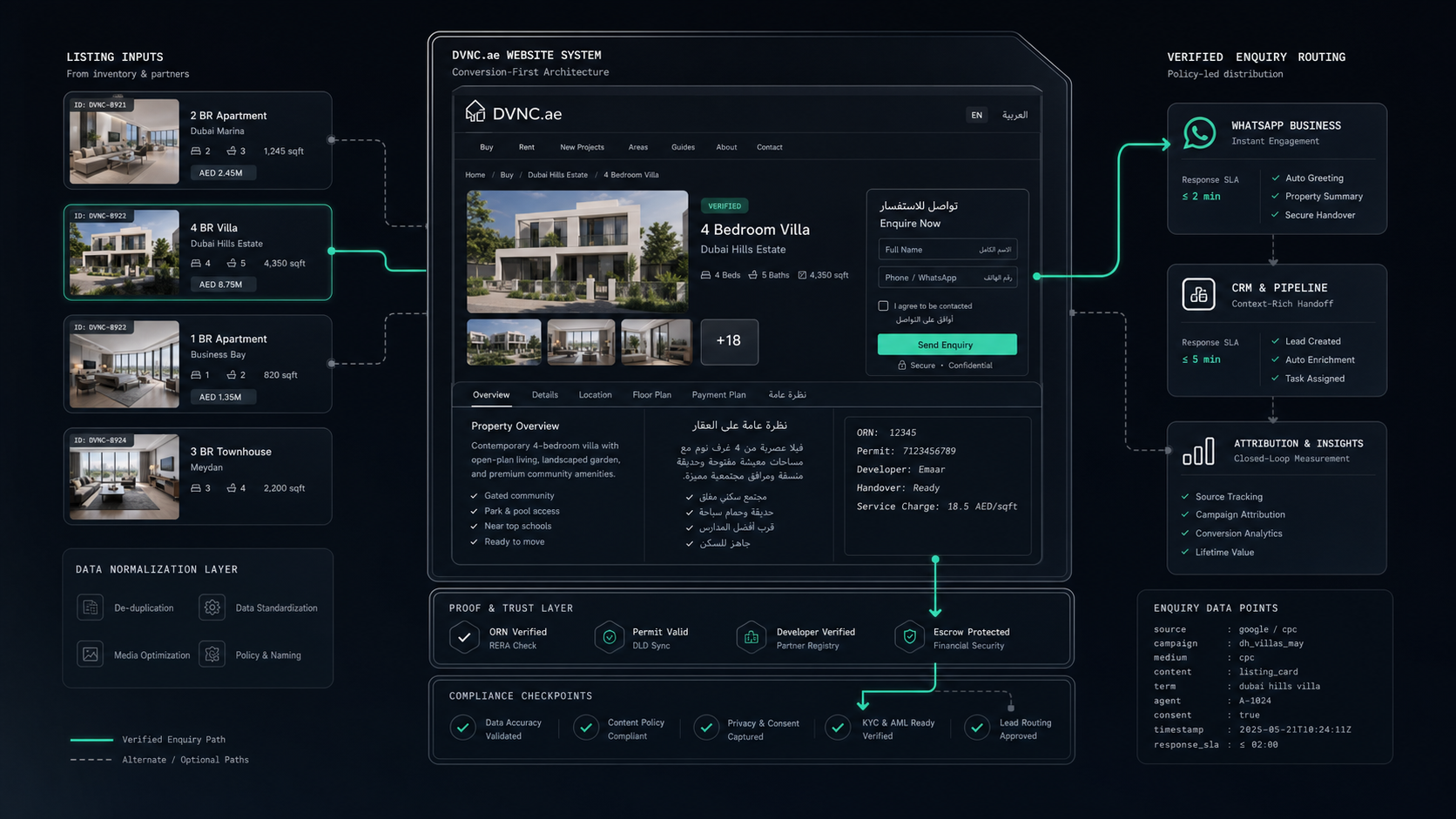
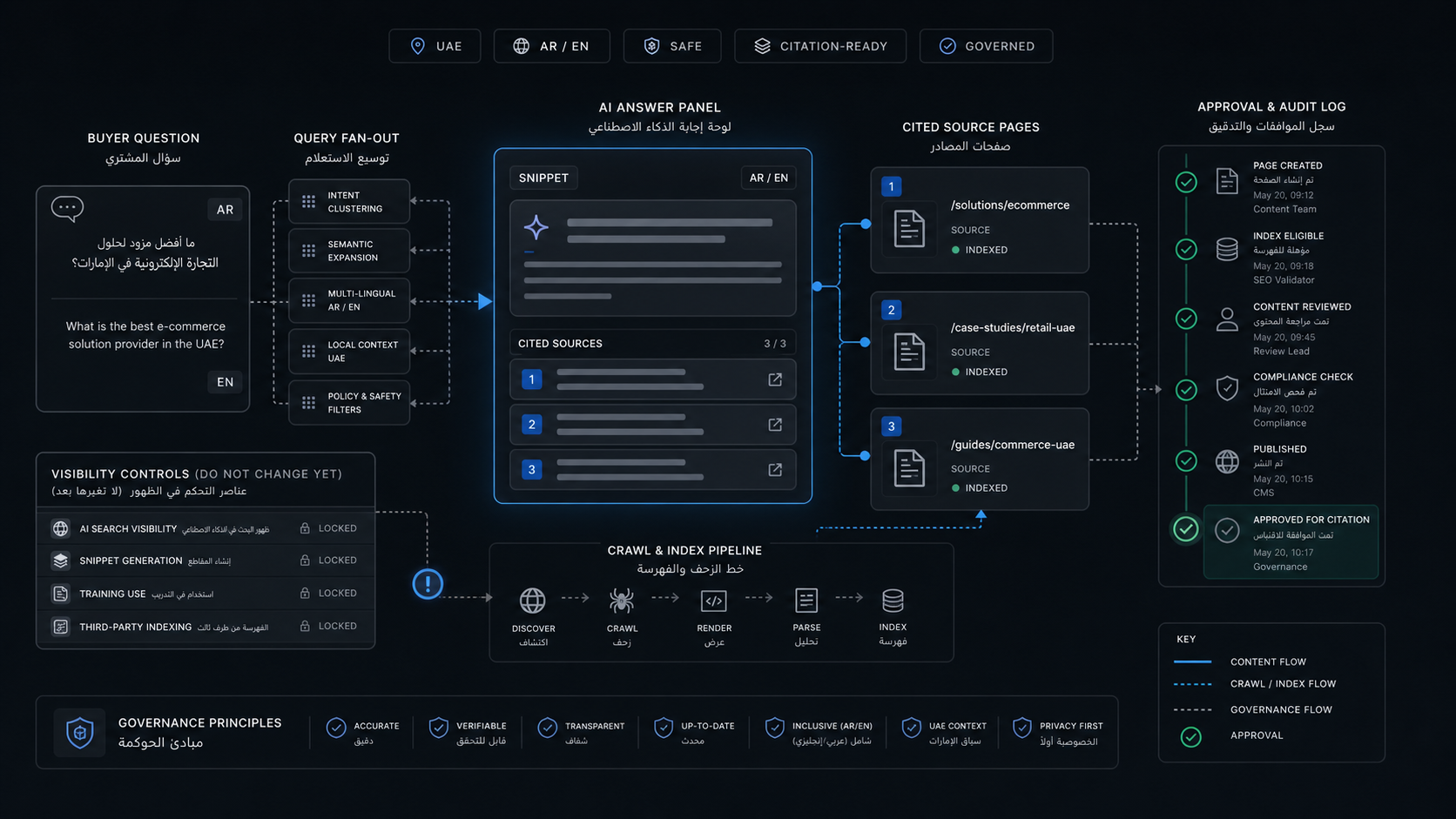
The same page can also support citation-ready service pages. Clear service pages, real project examples, and consistent entity information make it easier for search engines and AI answer systems to understand what the firm does, where it works, and which buyer situations it serves.
Route WhatsApp into CRM before speed becomes waste
WhatsApp should be the response channel, not the entire operating system. The WhatsApp Business Platform Cloud API enables businesses to communicate with customers at scale, and Meta says Cloud API can send text messages, rich media, and interactive messages. It also supports webhooks, which deliver JSON payloads for incoming messages, message status updates, asynchronous error handling, and other notifications.
That matters because serious project enquiries need a record. A senior partner cannot manage a high-ticket pipeline from scattered chats, screenshots, and memory. The first WhatsApp reply should be fast, but the lead should already be in the CRM with source, project type, scope, timeline, and owner.
The clean intake flow looks like this:
Capture the source
Tag whether the enquiry came from Google Business Profile, a portfolio page, Instagram, referral, paid search, or a directory. Without source, the studio cannot tell which channel produces qualified projects.
Ask the qualification questions
Use a short WhatsApp or form sequence: project type, location, timeline, budget band, and whether the buyer needs design, fit-out, or both. Keep it human, but structured.
Assign ownership
Route villa projects, commercial fit-outs, and small styling enquiries differently. A senior person should see the high-value enquiries quickly; smaller or unclear enquiries can be qualified before they consume design time.
Set the next action
Every serious enquiry gets one next action: consultation call, site visit discussion, requirements request, proposal, or close lost. No lead should sit as "WhatsApp replied" with no pipeline stage.
Template messages need extra care. Meta's template documentation says template messages are the only type that can be sent outside the customer service window. Each template must be categorized as authentication, marketing, or utility. Meta also says template strings and variables are not translated by Meta, so the business is responsible for supplying wording and example parameters in the right language.
For a bilingual Dubai studio, that means English and Arabic follow-up wording should be written intentionally. Do not create an English message and hope the system handles Arabic tone. Write separate EN/AR versions for site visit reminders, missing-brief follow-ups, project-scope clarification, and consultation confirmations.
PDPL matters here. The UAE's Personal Data Protection Law, Federal Decree Law No. 45 of 2021, applies to processing personal data in full or part through electronic systems, inside or outside the country. The UAE Official Portal says the law defines controls for processing personal data and general obligations of companies that have personal data to secure it and maintain confidentiality and privacy. It also states that the law prohibits processing personal data without owner consent except certain cases, and gives the data owner rights to request correction and restrict or stop processing.
For a design firm, the practical rule is simple: collect the brief information needed to qualify the project, explain why you are collecting it, protect it inside the CRM, and do not let personal project details live forever in unmanaged phones and spreadsheets.
Use Instagram as proof, not a parallel inbox
Instagram should make the buyer trust the taste, process, and current activity of the studio, then send serious enquiries into the same qualification path. If Instagram becomes a second inbox with its own unmanaged replies, the studio duplicates the WhatsApp problem in another app.
Use Instagram around proof, not noise:
- Finished projects: one post for the final result, one carousel for material and layout decisions, one short video for handover details.
- Process credibility: mood boards, site progress, joinery details, lighting tests, and before/after context where the client has approved use.
- Buyer education: "what to prepare before a villa consultation," "how to brief an office fit-out," or "what affects a restaurant interior timeline."
- Conversion route: the profile link should send serious buyers to a project brief page or WhatsApp path that captures source and scope.
For a clinic interior project, the post should not only show a reception desk. It should explain patient flow, privacy, consultation-room layout, material durability, and how the space supports appointment experience. For a restaurant project, show seating, lighting, circulation, service flow, and the moments people actually photograph. These are commercial proof points, not decorative captions.
The best content calendar for this vertical is usually not daily posting. It is a tight proof loop: completed project, project-detail explainer, buyer education, founder or design-director point of view, then a clear consultation path. That gives the sales team something useful to send when a prospect asks, "have you done something like this?"
Measure project quality, not enquiry count
The metric is qualified project movement, not the raw number of WhatsApp messages. A studio can get more messages and still have a weaker month if the team is spending senior time on small, unclear, or wrong-fit enquiries.
Track these fields in the CRM:
This is where a managed digital department earns its place. The website, Google profile, social proof, WhatsApp flow, and CRM are not separate tasks. They are one operating system for project demand. The owner should be able to ask: which proof pages brought the best enquiries, which sources booked consultations, where the team responded too slowly, and which enquiries should never have reached a senior designer.
The stronger move is to fix the shortlist system first. Then paid search, Instagram promotion, directory listings, and referral campaigns have somewhere useful to send demand.
What is the best interior design company in Dubai?
The best fit depends on project type, budget, scope, and proof in similar properties. A Dubai studio that wants to win those shortlist searches should make relevant project evidence, service scope, and consultation steps obvious before the buyer sends a WhatsApp message.
How do buyers choose an interior fit-out company in Dubai?
They compare relevant finished projects, scope clarity, availability, trust signals, and whether the team can handle the property or venue type. A fit-out firm should publish those signals on service and portfolio pages instead of hiding them inside a generic image gallery.
Should a Dubai interior design firm send every enquiry straight to WhatsApp?
No. WhatsApp is useful for response, but the enquiry should carry source, project type, location, timeline, budget band, and scope into a CRM. Otherwise the team gets speed without memory.
Do interior design firms in Dubai need Arabic content?
Yes, when the buyer base includes Arabic-speaking owners, family offices, landlords, or local operators. The important point is not translation volume; it is clear EN/AR consultation language, service pages, and WhatsApp follow-up that sound natural in both languages.
Apply for a Partnership
Build the website, content, WhatsApp, and CRM system that turns project attention into qualified enquiries.
Jul 4, 2026