Google AI Mode for UAE Brands: Build Citation Pages Before the Toggle
Google is testing AI Search controls. UAE brands should stay indexable, build citation pages, and govern public claims before opting out.

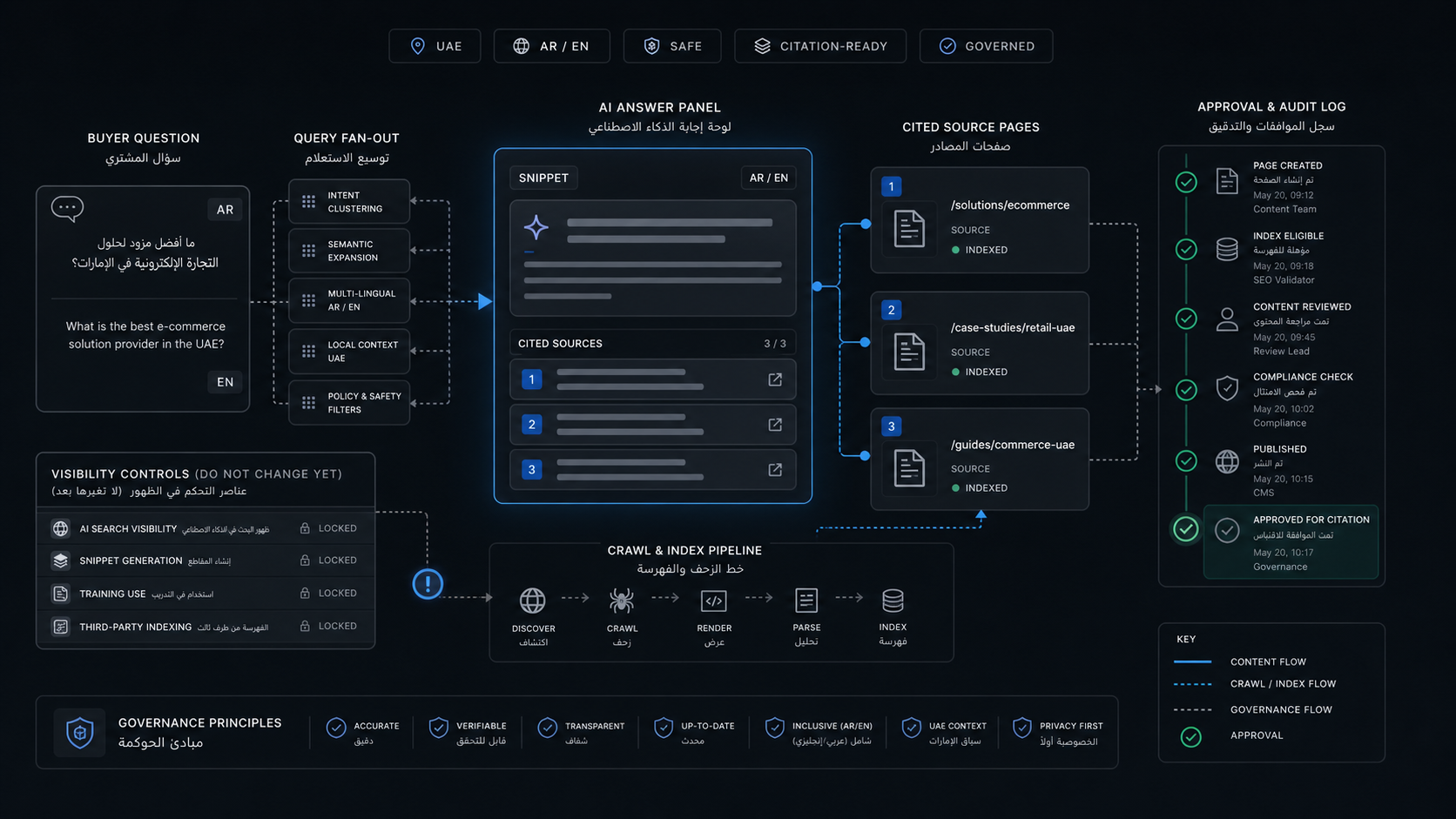
Do not opt out of Google AI Mode or AI Overviews by default. For a UAE brand, the better first move is to stay eligible for AI-search citations, build pages that answer real buyer questions with local proof, and govern every public claim before it becomes an AI source.
The Verdict: Stay Eligible, Then Govern What AI Can Cite
The wrong reaction to Google's new AI Search controls is to hide the site before you have built anything worth citing. A UAE brand that sells property, clinics, legal services, financial services, consulting, hospitality, or B2B software should treat AI Mode as a distribution surface with risk controls, not as a traffic threat to panic about.
Google announced on June 3, 2026 that it is testing a new Search Console control for generative AI Search features. The important tradeoff is blunt: Google says sites that opt out will not receive traffic or impressions from generative AI features, and the control is not used as a ranking signal outside those features. Google is starting that rollout with a subset of website owners in the UK before a broader rollout.
That matters for UAE operators because the decision is not available everywhere at once, and because the business question comes before the setting. If AI Mode can cite a page that explains your regulated service, pricing logic, area expertise, warranty, compliance boundary, or appointment process, opting out removes a route to qualified discovery.
The safer rule is:
- Stay indexable while you build the source pages.
- Use Search Console and rank checks to see where AI features already surface you.
- Remove or limit snippets only for pages that expose sensitive, stale, or legally risky claims.
- Put every public claim through an owner, date, source, and approval log.
What Changed In Google AI Search
Google AI Search is no longer a lab curiosity for UAE planning. Google's AI Mode support page lists the United Arab Emirates among supported countries and territories, and it lists Arabic and English among supported languages. That means UAE teams should assume AI-search behavior can affect discovery across both English and Arabic buyer journeys.
Google describes AI Mode as an AI search experience where a user can ask a question, ask follow-ups, and receive links to the web. It also says AI Mode divides a question into subtopics and searches for each one at the same time. Google Search Central says AI Overviews and AI Mode may use query fan-out, issuing multiple related searches across subtopics and data sources.
That changes the shape of content work. A normal SEO page can rank for one query and still fail AI search because it does not answer the adjacent questions the model fans out into.
A Dubai real-estate brokerage, for example, should not publish only "best villa broker in Dubai." AI Mode can break a buyer's question into subtopics:
- which communities fit a family moving from London,
- what service charge and handover risks matter,
- how RERA forms work,
- which documents a buyer should prepare,
- what happens after a WhatsApp inquiry,
- which listings are current and which are stale.
The page that wins citations is not always the loudest landing page. It is often the cleanest source page that explains the decision with a table, local context, current facts, and visible ownership.
Google's June 3 update also says AI Overviews has over 2.5 billion monthly active users and AI Mode has surpassed one billion monthly users. Treat those numbers as the strategic signal: AI answers are now a mainstream discovery surface, not a side channel.
The UAE Citation Page Standard
A citation page is a public evidence page built so a human buyer and an AI answer can both understand, verify, and reuse the same facts. It is not a thin blog post. It is a source asset.
Google Search Central says a page must be indexed and eligible to be shown in Google Search with a snippet to appear as a supporting link in AI Overviews or AI Mode. It also says there are no additional technical requirements beyond Google's Search technical requirements. That means UAE brands should stop looking for a hidden AI markup trick and fix the basics that make the page usable as a source.
Use this standard before asking whether to buy another AI visibility tool.
For UAE brands, the page should answer in the market's real language. English-only pages miss Arabic-search and mixed-language behavior. Arabic-only pages can miss expat and investor searches. The practical pattern is not machine-translated clutter. It is a bilingual evidence model:
- one English page with UAE terminology, area names, regulator names, and buyer language,
- one Arabic page or Arabic answer section where Arabic search demand is real,
- consistent entity data across the website, Google Business Profile, LinkedIn, directories, and media mentions,
- visible dates for facts that change, such as fees, availability, eligibility, or product limits.
The governance issue is just as important as visibility. AI answers can lift your public claims out of their original context. If the site says "DHA-approved" or "guaranteed ROI" or "instant mortgage approval," that sentence can travel. The claim needs an owner before it needs schema.
The 10-Day Build Plan
Build the source system before the dashboard. The first ten days should create enough visible evidence for AI systems to understand what the brand does, who it serves, and what claims are safe to cite.
Day 1: Choose five citation questions
Pick five questions that a buyer would ask before speaking to sales. For a UAE clinic group, that might be appointment availability, insurance pre-checks, Arabic-speaking staff, privacy during intake, and how rescheduling works. Do not start with "rank for clinic Dubai." Start with the decision questions that affect trust.
Day 2: Assign claim owners
Create a simple table with four columns: claim, owner, source, review date. A marketing claim has a marketing owner. A compliance claim has a compliance or operations owner. A price claim has a finance or commercial owner. No owner means the claim is not ready for a citation page.
Day 3: Make crawlability boring
Google Search Central names crawlability through robots.txt and hosting infrastructure as a continuing SEO fundamental for AI features. Check that public citation pages are not blocked by robots.txt, CDN rules, login walls, heavy client-only rendering, or accidental noindex tags.
Day 4: Write answer-first sections
Each page should open with the answer, then the conditions. For example: "Yes, UAE clinics can automate appointment reminders, but cancellation, insurance, and clinical questions still need human handoff rules." AI search needs extractable answers. Human buyers need the same thing.
Day 5: Add a local proof block
For a Dubai brokerage, proof might be community pages, RERA process notes, portal lead handling, WhatsApp response rules, and listing freshness checks. For a family office, proof might be DIFC or ADGM operating context, investment memo workflow, committee approval steps, and document retention rules. Keep it factual and dated.
Day 6: Add structured data only where it matches the page
Google Search Central says structured data should match visible text. Add Organization, LocalBusiness, FAQ, Product, Service, or Article markup only when the same facts are visible to users. Do not mark up claims that are not on the page.
Day 7: Link the evidence together
Internal links help discovery. Link the service page to the FAQ, the FAQ to the process page, the process page to the evidence page, and the evidence page back to the service page. The model should not have to infer your structure from isolated pages.
Day 8: Add media where it proves the claim
Google's guidance keeps high-quality images and videos in the fundamentals. For a UAE operator, use media as proof, not decoration: interface screenshots, process diagrams, area maps, form examples, clinic booking states, or before-and-after workflow diagrams with private data removed.
Day 9: Test the buyer question
Search the exact question in Google, AI Mode where available, ChatGPT search, Perplexity, and Gemini. Record whether your brand appears, what sources are cited, and whether any wrong claim appears. This is a visibility and risk check, not only a ranking check.
Day 10: Decide what should not be citable
Google Search Central says site owners can limit information shown from pages using controls such as nosnippet, data-nosnippet, max-snippet, or noindex. Use those controls for private, stale, risky, or context-dependent information. Do not use them on the pages you want AI answers to cite.
This is the work that should happen before a tool purchase. The tool can show where you appear. It cannot create the proof that deserves to appear.
For the broader foundation, pair this build plan with the existing DVNC.ae guide to AI search engine optimization for UAE brands. After the pages exist, use the AI search visibility tools guide to choose monitoring software without buying blind.
What To Measure Before You Buy Another Tool
Measure three things before you buy a specialist AI-search tracker: eligibility, citation appearance, and claim quality.
Google Search Central says appearances in AI features such as AI Overviews and AI Mode are included in Search Console's Performance report under the Web search type. Google's June 3 update says it is starting to roll out new Search Console insights that include impressions metrics and information about which pages appear in AI responses and in what countries.
That does not remove the need for third-party tracking, but it changes the order. Use native evidence first:
- Which citation pages are indexed?
- Which pages have impressions for buyer-intent queries?
- Which country data appears when Google exposes it?
- Which snippets and page titles are being used?
- Which pages attract qualified inquiries after AI-search exposure?
Then add external AI-search monitoring for cross-platform coverage, competitor comparisons, and repeatable question sets. A UAE brand should track at least three query groups:
- brand questions, such as "is [brand] good for Dubai property management,"
- category questions, such as "best clinic appointment booking system UAE,"
- decision questions, such as "should a UAE company use an AI agency or build in-house."
The reporting should produce an action list, not just a visibility score. If a competitor appears because it has a clear comparison page and you do not, the fix is content architecture. If nobody appears because the question is too new, the fix is original source material. If the AI answer cites a stale claim, the fix is governance.
The Governance Layer: Make Every Public Claim Audit-Ready
AI search visibility is a claim-control problem. OpenAI says ChatGPT search gives timely answers with links to relevant web sources, includes source links in chats, and lets users open a references sidebar. Google AI Mode and AI Overviews also use web links. The same public claims can travel through several answer engines.
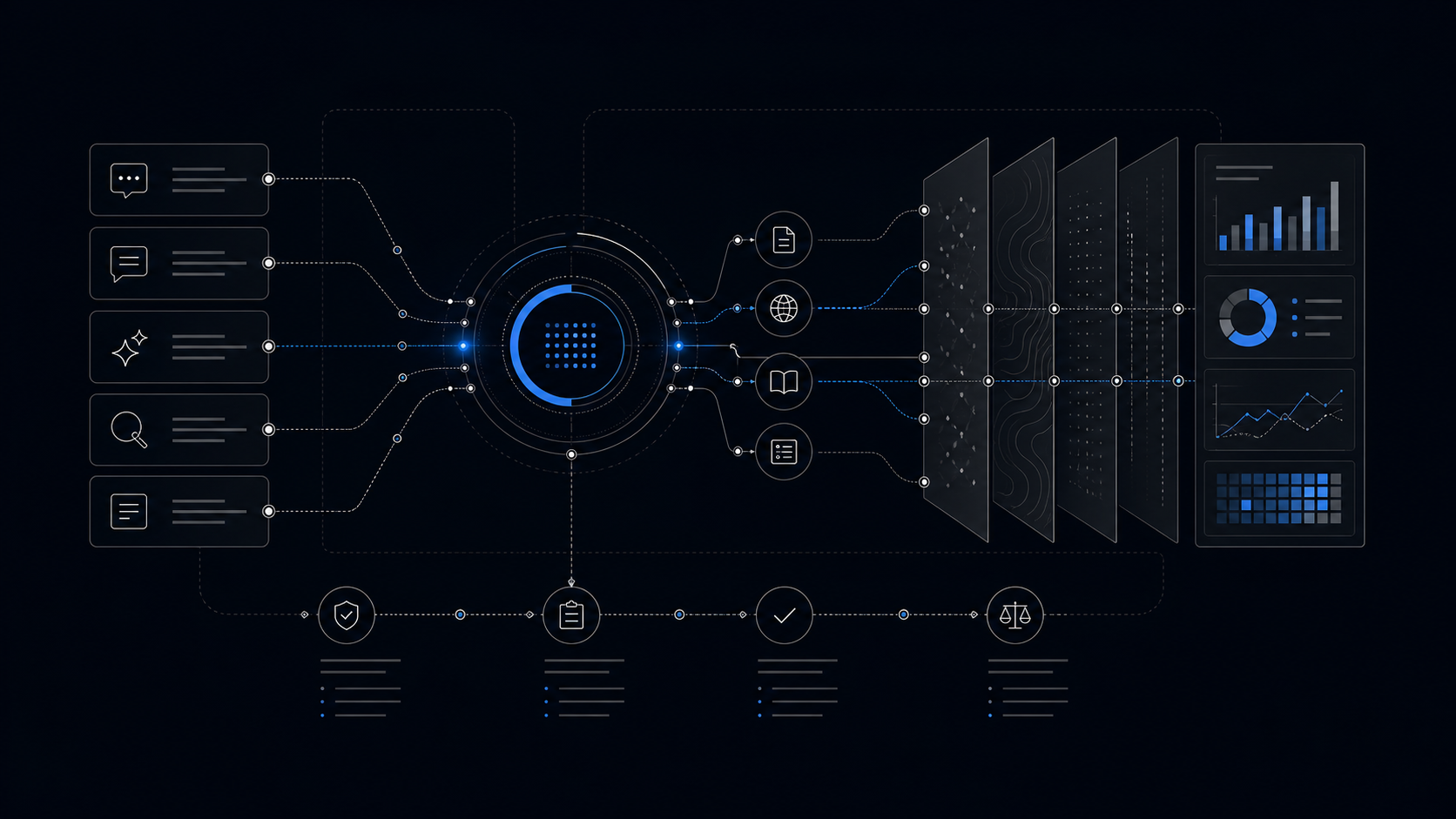
That is why the citation system needs an approval layer:
Do not publish private customer records, patient details, investor data, internal CRM screenshots, or named client outcomes as citation bait. If you need proof, use anonymized reference workflows, dated methodology, screenshots with private fields removed, or original research that can be defended.
The operator standard is simple: if the claim would make the board, regulator, customer, or partner ask "who approved this," the page should already answer that question internally.
FAQ
How do I turn on AI Mode in Google Search?
Google says AI Mode can be accessed at google.com/ai, through the AI Mode tab in Google Search, or through the Google app where available. For a UAE brand, the more important question is whether your public pages are eligible and useful enough to be cited once buyers use AI Mode.
Why is AI Mode not coming in Google for every user?
Availability can depend on country, language, account settings, plan, age, device, and feature status. Google's support page lists the United Arab Emirates among supported countries and Arabic and English among supported languages, but individual features and experiences can still vary.
Can a UAE brand turn off AI citations from Google?
Google is testing a new Search Console control for generative AI Search features, starting with a subset of UK website owners. Google says sites that opt out will not receive traffic or impressions from generative AI features, so the default UAE move should be to fix risky pages and keep useful citation pages eligible.
Do AI Overviews and AI Mode need special schema?
Google Search Central says there are no additional technical requirements for appearing in AI Overviews or AI Mode beyond Search technical requirements. Structured data still matters when it matches visible page content, but it is not a magic AI citation switch.
Should UAE brands publish Arabic pages for AI search visibility?
Yes when Arabic buyers, patients, tenants, investors, or employees actually search in Arabic. Google lists Arabic and English among AI Mode supported languages, so bilingual evidence pages are a practical UAE advantage when the claims are accurate and maintained.
Scope Your AI Search Visibility
Build the citation pages, source architecture, and governance checks your UAE brand needs before AI answers define the buyer journey.
Jun 10, 2026