AI Search Engine Optimization for UAE Brands: SEO vs GEO vs AEO
A practical UAE playbook for SEO, GEO and AEO: what to publish, what to mark up, what to log, and how to earn citations in AI search.

AI search optimization is not a replacement for SEO. For a UAE brand, the first move is to make your strongest service claims crawlable, locally specific, source-backed, and approved, so Google AI Overviews, ChatGPT Search, and other answer engines can cite the same facts your sales team is allowed to say.
The Verdict: Keep SEO, Add Citation Assets, Govern The Claims
The winning UAE approach is SEO plus a governed citation layer. Classic SEO still decides whether your pages are crawlable, useful, fast, and locally relevant. AI search optimization decides whether an answer engine can extract the right claim, connect it to your brand, and show a source a buyer can trust.
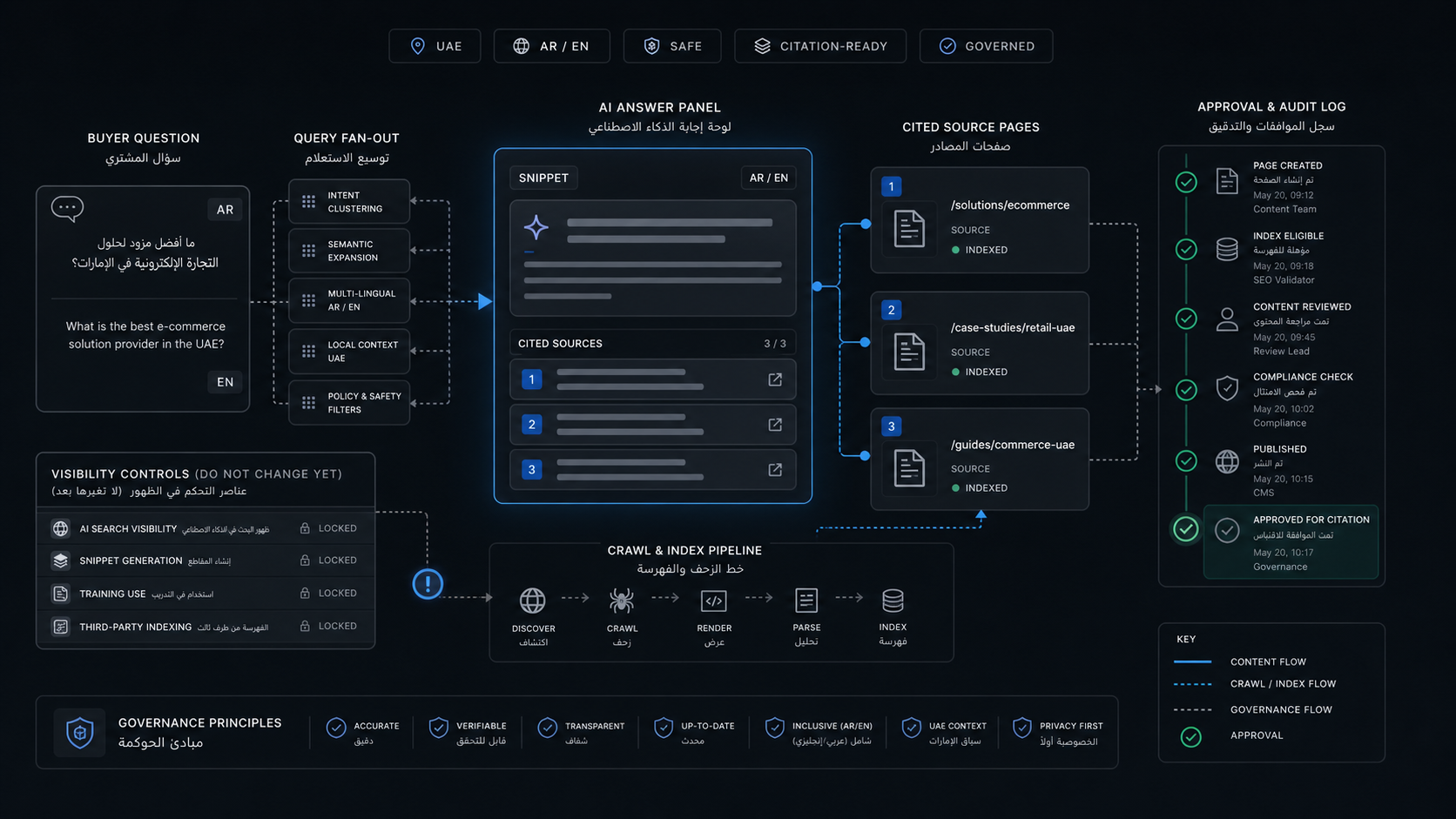
Google's own generative AI Search guidance says its generative AI features in Search are rooted in core Search ranking and quality systems. It also describes retrieval-augmented generation, or RAG, as a way to ground AI responses in relevant, up-to-date pages from Google's Search index, and query fan-out as a way to run related queries around the user's question. The practical implication is simple: a thin "AI SEO" page will not save a weak site. A UAE brand needs pages that answer the main question and the related questions around it.
ChatGPT Search has the same hard lesson from a different angle. OpenAI says ChatGPT Search can provide timely answers with links to relevant web sources, may show inline citations, and has no guaranteed top placement. OpenAI also says inclusion depends in part on allowing OAI-SearchBot to crawl the site and allowing traffic from its published IP ranges.
For a UAE operator, this changes the build order:
- Keep technical SEO healthy.
- Publish answer pages for the questions a buyer actually asks.
- Attach claims to sources, locations, author ownership, and update dates.
- Make crawler access deliberate.
- Log approvals before claims go live.
- Measure citations, answer accuracy, and referral traffic separately from rankings.
That is the difference between visibility work and AI-content noise. Visibility work creates a fact base that search systems can retrieve and your board can defend.
SEO Vs GEO Vs AEO: What Each One Is Actually For
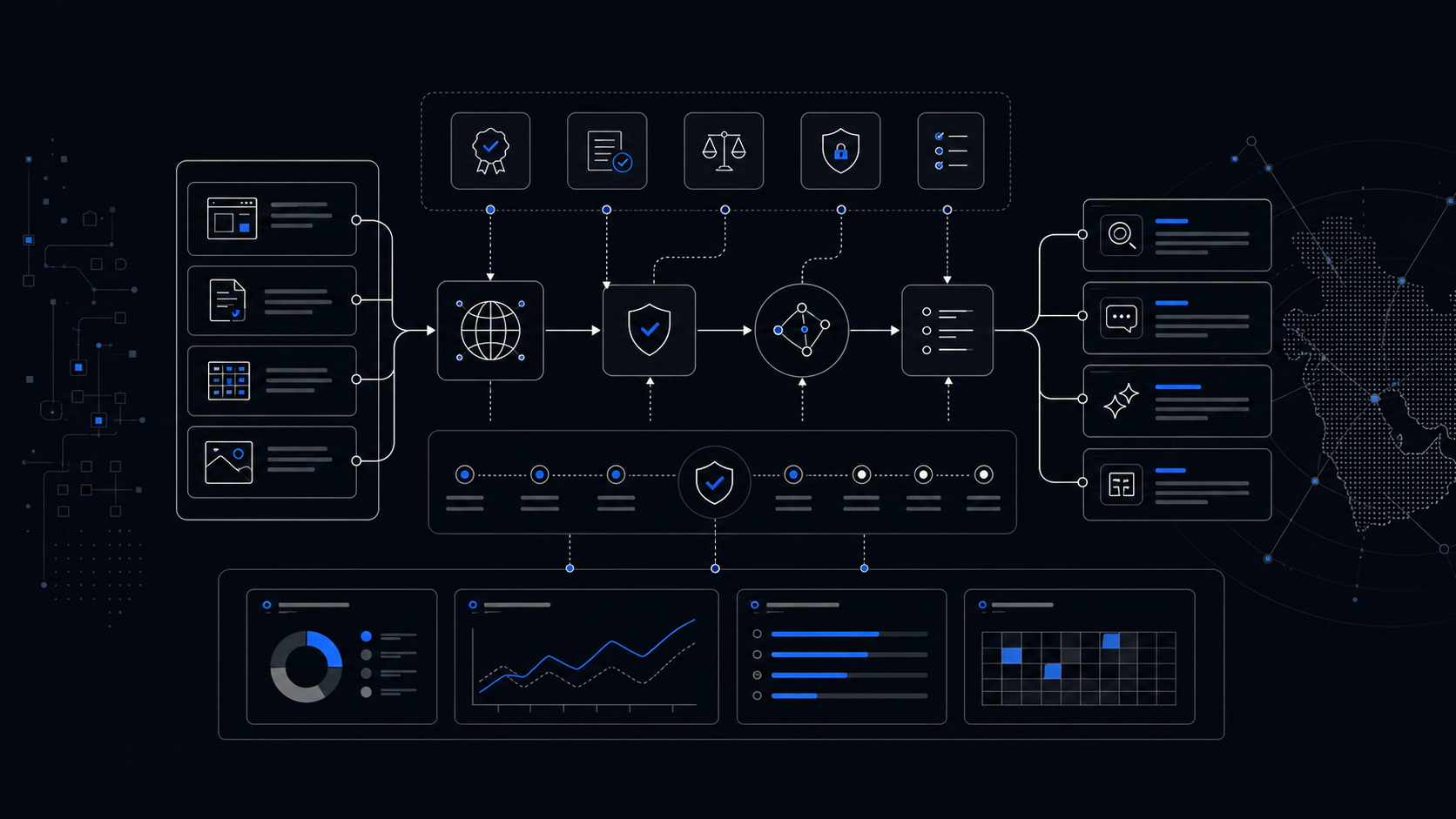
SEO, GEO, and AEO solve different jobs. Treat them as one operating system, not three disconnected campaigns.
The mistake is starting with GEO as a content label. AEO without SEO is a page that answers well but cannot be found. SEO without GEO is a site that ranks but may not be cited. GEO without governance is a citation risk, because the model may repeat a claim that was never approved for public use.
For a UAE clinic group, the right answer is not "publish 50 AI-written FAQs." The right answer is five approved source pages:
- "What admin AI can a UAE clinic safely automate first?"
- "How appointment reminders work across WhatsApp, phone, and clinic software."
- "What patient data is never used in public demos or AI-search examples."
- "How human approval works before any message goes to a patient."
- "How the clinic measures time saved without claiming diagnosis automation."
That set helps classic search, gives answer engines extractable facts, and protects the operator from hype claims that should never be repeated.
The 30-Day UAE Build Plan
The first month should produce a small citation system, not a content calendar. The output is a set of pages, markup, crawl settings, and approval records that make your brand easier to retrieve and safer to cite.
Day 1-3: Build The Claim Register
List the 20 claims your website, sales deck, listings, and founder profiles already make. Mark each one as approved, needs source, needs rewrite, or remove. A UAE real-estate brand might include "Dubai off-plan advisory," "RERA-aware buyer process," "Arabic and English support," "WhatsApp lead response," and "handover support." Keep the claim short enough that it can be copied into a search answer without changing meaning.
Day 4-7: Create Five Citation Pages
Create five pages that answer buyer questions directly. Each page should open with the answer, include a local scenario, cite official or first-party sources where relevant, and show the updated date. For a hospitality operator, the pages might cover guest WhatsApp automation, booking-policy questions, Arabic-English guest support, escalation rules, and what is never automated.
Day 8-12: Fix Crawl Access
Check
/robots.txt, canonical tags, XML sitemap, server rendering, blocked scripts, and CDN bot rules. Google says a robots.txt file belongs at the top level of the site and controls which crawlers may access which parts of that host. OpenAI says OAI-SearchBot is used for ChatGPT Search, while GPTBot is used for training, and the controls are independent. That means a brand can allow search discovery while making a separate training-data decision.Day 13-17: Add Entity And Answer Markup
Use JSON-LD for Organization, LocalBusiness, Service, Product where relevant, and FAQPage only where the visible page actually contains those questions and answers. Google says structured data gives explicit clues about page meaning, but it is not required for generative AI features. Treat schema as an explanation layer, not a shortcut.
Day 18-24: Run The Answer Audit
Test the same prompt set across Google AI Search surfaces, ChatGPT Search, Perplexity, and Gemini where relevant. Use English and Arabic phrasing for UAE buyers. Record whether your brand appears, which page is cited, whether the answer is accurate, what competitor is cited, and what missing fact caused the gap.
Day 25-30: Approve, Update, And Measure
Create a monthly update routine. Every source page needs an owner, last-reviewed date, source list, and approval record. Every AI-search answer audit should produce either a page update, a claim correction, a crawl fix, or a decision to ignore the query because it is not commercially useful.
The build is deliberately small. Ten clean source pages beat one hundred generic posts because answer engines need reliable retrieval targets, not a pile of interchangeable copy.
The Crawler And Schema Checks That Matter
The crawl check is not a developer detail. It decides whether your best answer is available to the systems your buyers use.
Use this simple rule for UAE brand sites:
User-agent: OAI-SearchBot
Allow: /

User-agent: GPTBot
Disallow: /

Sitemap: https://www.example.ae/sitemap.xml
That example allows OpenAI's search crawler and blocks OpenAI's training crawler. It is not universal policy advice, but it shows the separation OpenAI documents in its crawler overview: OAI-SearchBot is for ChatGPT Search, GPTBot is for training. Your legal and leadership team should decide the training position. Your search-visibility team should know when that decision accidentally blocks citation discovery.
For Google, the crawl basics are still the basics:
- The public page must load without requiring login.
- The main answer must be in HTML, not only inside an image or hidden script.
- The canonical URL must point to the page you want cited.
- The page must be in the sitemap.
- The page title, H1, opening answer, and internal links must match the same topic.
- The Arabic and English versions should use clear language alternates if both exist.
Structured data comes next. Use it to clarify what the page already says:
{
  "@context": "https://schema.org",
  "@type": "Service",
  "name": "AI Search Visibility for UAE Brands",
  "areaServed": "United Arab Emirates",
  "provider": {
    "@type": "Organization",
    "name": "Example Company"
  }
}
Do not add structured data for claims the page does not visibly support. Google says structured data should describe the content of the page. A hidden markup claim is not a visibility strategy. It is a future correction.
What To Measure, And What Not To Promise
AI search visibility is measurable, but it is not controllable in the way paid search is controllable. The right promise is a governed monitoring system and a better citation base, not guaranteed placement.
Measure these fields monthly:
The most useful dashboard is not a vanity mention tracker. It is a decision board:
- Which source pages are earning citations?
- Which high-intent questions cite competitors?
- Which answers mention your brand but get the service wrong?
- Which pages are blocked, stale, or too generic?
- Which claims need a compliance or leadership review?
If a tool is needed, buy it after the baseline audit. DVNC.ae already has a separate buyer's guide to AI search visibility tools for UAE brands. The first month should prove which questions and pages matter before the team commits to a monitoring stack.
UAE Governance: The Approval Layer Is The Advantage
For UAE brands, trust is part of the visibility system. The goal is not to make an AI answer say more. The goal is to make it repeat the correct public claim with the right source.
Dubai's AI market is already moving toward verification language. The Dubai AI Seal is a government verification system for AI service providers, with six tiers from E to S, serial-number verification, and a free application process. That matters even for brands outside the AI-provider category because it shows the direction of the market: trust signals, supplier verification, and anti-AI-washing proof are becoming part of how UAE buyers assess claims.
Apply the same logic to AI-search assets:
- Every public claim has an owner.
- Every high-risk claim has a source.
- Every service page has a last-reviewed date.
- Every AI-generated draft is human-approved before publication.
- Every answer audit records wrong, missing, and outdated claims.
- Every Arabic translation is reviewed for meaning, not only wording.
For a DIFC advisory firm, this might mean a partner approves pages about fund operations before publication. For a clinic admin provider, it might mean no page suggests diagnosis automation when the actual service is intake, scheduling, billing, and approvals. For a property brokerage, it might mean every investment-yield claim links to a current source or gets removed.
That approval layer is not bureaucracy. It is what makes the brand safer to cite.
How do you optimize for AI search engines?
Start with useful, crawlable pages that answer real buyer questions directly, then add source links, entity clarity, structured data, and monthly answer monitoring. For a UAE brand, the high-value work is not publishing more generic posts, it is building approved source pages that AI systems can retrieve and cite accurately.
Is AI SEO different from SEO?
AI SEO is an extension of SEO, not a replacement. Google's generative AI Search guidance says these features are rooted in core Search ranking and quality systems, so crawlability, page quality, internal links, and local relevance still matter.
Is ChatGPT good for SEO?
ChatGPT is useful for testing buyer questions and checking whether your brand is cited correctly, but it is not a ranking guarantee. OpenAI says ChatGPT Search has no guaranteed top placement, so use it as a monitoring surface and make sure OAI-SearchBot can access the pages you want considered for search.
What are the four pillars of AI search visibility?
Use four practical pillars: crawlability, local authority, extractable answers, and approved claims. If one pillar is weak, the brand can either disappear from AI answers or appear with a claim the team cannot defend.
Scope Your AI Search Visibility
Map the questions UAE buyers ask, build the source pages they can cite, and monitor how AI search systems describe your brand.
Jun 5, 2026