AI Receptionist Pricing for Dubai Clinics: Subscription vs Owned Agent
Compare subscription and owned AI receptionist costs for a Dubai clinic, with DHA data gates, EN/AR testing, WhatsApp handoff and booking scope.

For a Dubai clinic, the cheapest AI receptionist is often the most expensive mistake. Use a managed subscription for a narrow booking workflow; build an owned agent only when Arabic and English quality, phone and WhatsApp continuity, clinic-system integration, patient-data control, and auditability must work as one system.
The verdict: price the clinic workflow, not the bot
The right buying model depends on how deeply the receptionist must enter your operation. A subscription is a vendor-hosted product with a recurring fee. An owned agent is a custom system built around your accounts, rules, and integrations.
A single-location dental or aesthetic clinic with a contained job should start with a managed subscription. The contained job is administrative: answer approved questions, find an appointment slot, book it, send the confirmation, and transfer anything clinical or exceptional to staff.
An owned build earns its cost when the receptionist must preserve context across phone and WhatsApp, work in Arabic and English, write safely into a clinic system, route across locations or specialties, expose an audit trail, and leave the clinic with control of its accounts and data. If those requirements are absent, do not buy a custom build.
The price table is not an apples-to-apples comparison
The public prices below buy three different levels of responsibility. They are useful price anchors, not endorsements and not equivalent quotes.
My AI Front Desk: the sticker price buys usage, not clinic readiness
The $99 per month Business plan publishes a concrete allowance: 200 voice minutes per month, 100 chatbot conversations, 400 SMS messages, 1,000 monthly overage credits, Zapier, and a verified outbound number. That makes it possible to test a real workload rather than compare adjectives.
Its pricing page says the product supports 20+ languages and setup in 5 minutes. The same captured plan details list voice, chat, SMS and CRM, but do not list WhatsApp or name Arabic. A Dubai clinic should therefore treat both as unverified requirements until a recorded Arabic test and a written channel scope prove them. The advertised 7-day free trial is useful for that test; it is not evidence of patient-data readiness.

TalkRight: a managed UAE deployment includes more of the operating layer
TalkRight publishes focused EVA deployments from AED 1,200 per month. Its stated scope includes phone, WhatsApp and email, one core booking or enquiry workflow, 70+ languages and dialects, human handoff, and conversation visibility. That is closer to what a Dubai clinic is actually buying than a bare software seat.
The provider also publishes a managed landline, telephony and EVA package from AED 2,000 per month, with final pricing dependent on minutes, number configuration and workflow scope. Advanced deployments can add branch routing, EMR integration, analytics, transcripts, workflow tuning, security and data-residency review, and SLA planning.
Do not read “70+ languages and dialects” as proof that your Arabic experience is acceptable. Test the exact Gulf Arabic, English, code-switching, clinic vocabulary, names, and booking corrections your patients use.

DVNC.ae owned build: the higher upfront price buys control and integration
An owned build from AED 90,000 with a delivery window of 4 to 10 weeks is the wrong purchase for a clinic that only needs after-hours FAQs. It becomes rational when the clinic needs one governed receptionist across EN/AR voice, WhatsApp, calendars, CRM or clinic systems, with the accounts and audit trail under its control.
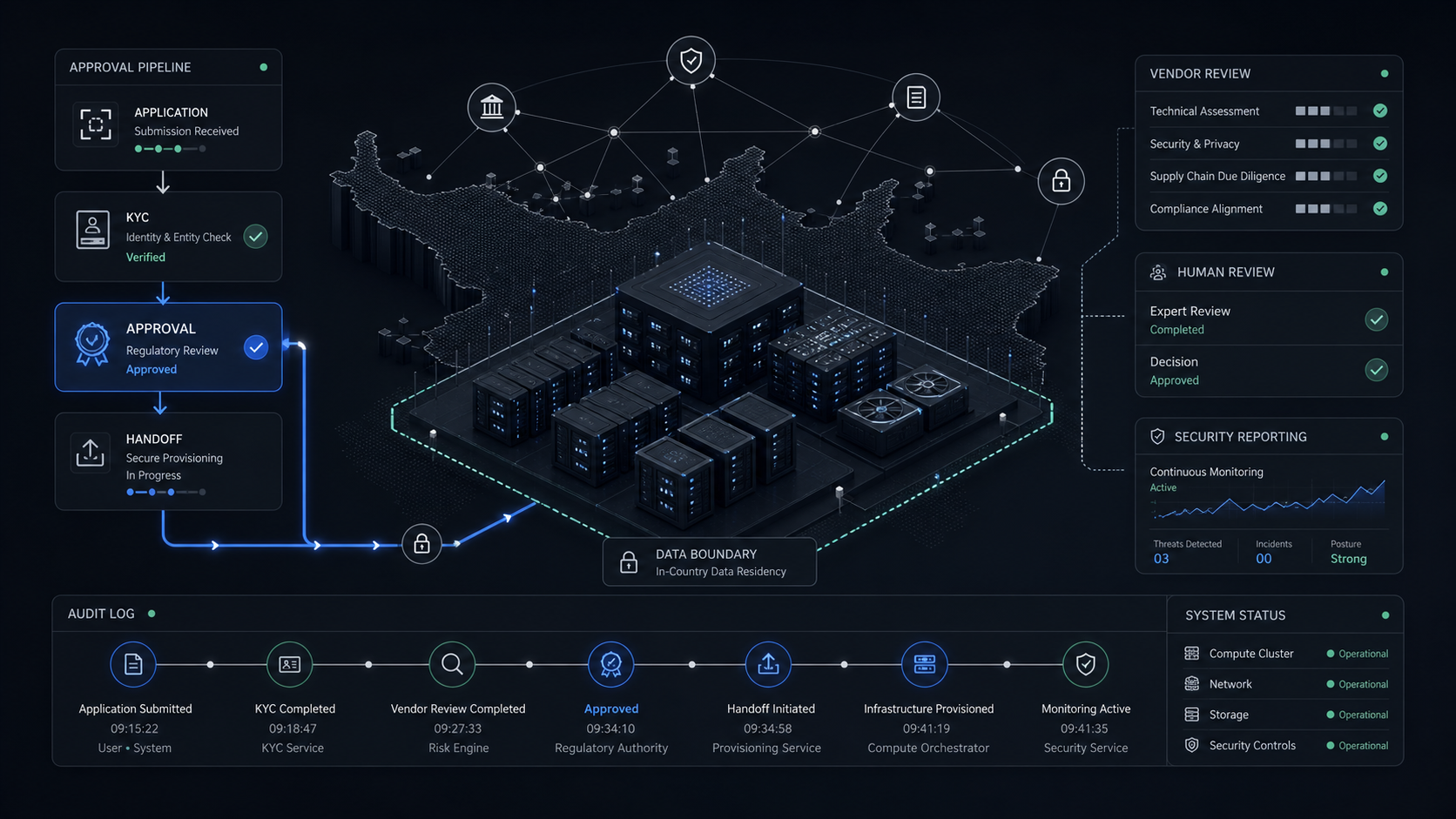
DVNC.ae publishes the ownership model plainly: the production agent belongs to the client, while WhatsApp Business API, telephony and CRM accounts sit in the client's name and platform running costs pass through at cost. The value is not cheaper call answering. It is a system the clinic can change, inspect and move without rebuilding its front desk around another vendor's product.

Pass the clinic gates before discussing price
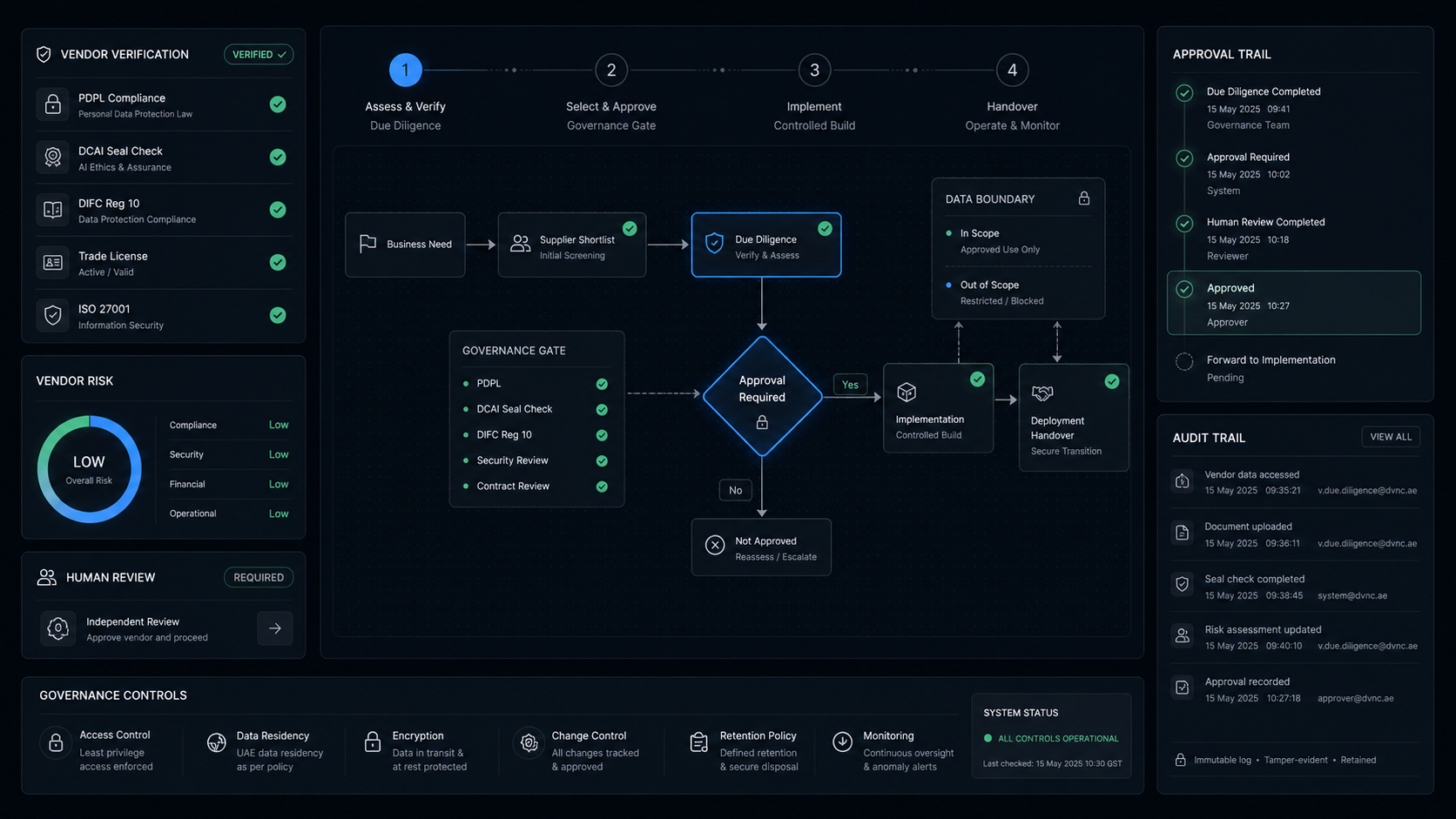
Price becomes meaningful only after data scope and human control are written into the proposal. A phone call is not low-risk merely because it begins with an appointment question.
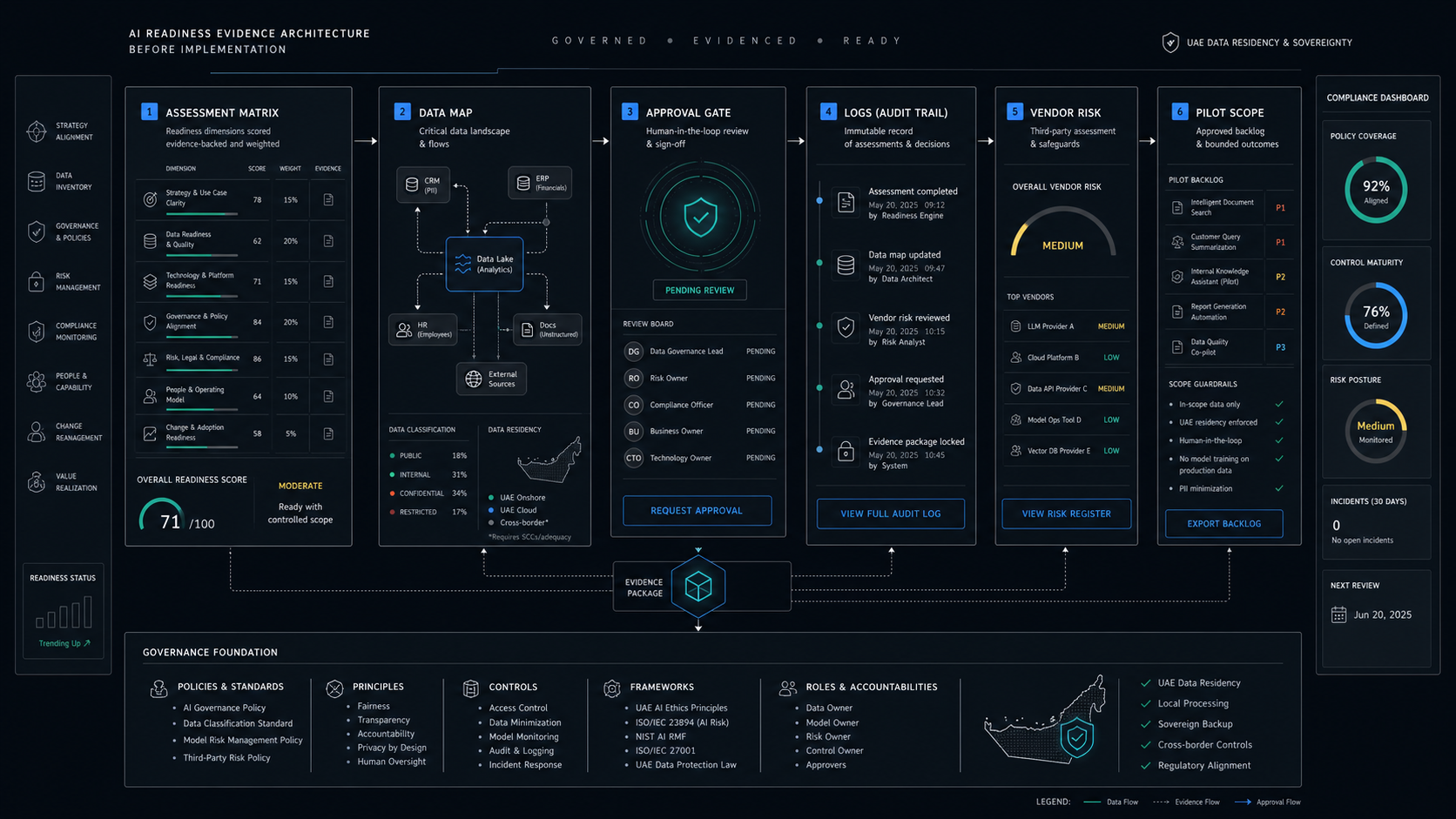
The DHA consent and access-control standard identifies telephone numbers and biometric identifiers including voice prints as protected or personal health information. It applies to contractors, consultants, suppliers, vendors and partners that access PHI, and it requires lawful access, access control and least privilege.
The UAE Personal Data Protection Law summary says the law applies to electronic processing inside or outside the country, restricts processing without consent except in specified cases, and sets requirements for security, data-subject rights and cross-border transfers.
DHA's published healthcare AI policy adds an operational test: failures must be traceable, diagnosable and controllable. It also calls for disclosure of AI-enabled functions, validation, integration and limitations, and for designated users to be able to override or reverse significant decisions.
Scope those requirements as build gates:
Map the data
List every field the agent hears, creates, stores and sends. For a booking flow, start with the minimum contact and appointment fields. Do not collect a medical narrative simply because the model can understand it.
Limit access
Give the agent only the calendar, fields and actions required for its administrative job. A receptionist that can read an entire record to book a slot has been granted the wrong access.
Disclose the automation
Write the opening disclosure, recording or transcript notice, consent path and privacy route in both languages. The patient should know when they are dealing with automation and how their information will be used.
Design the override
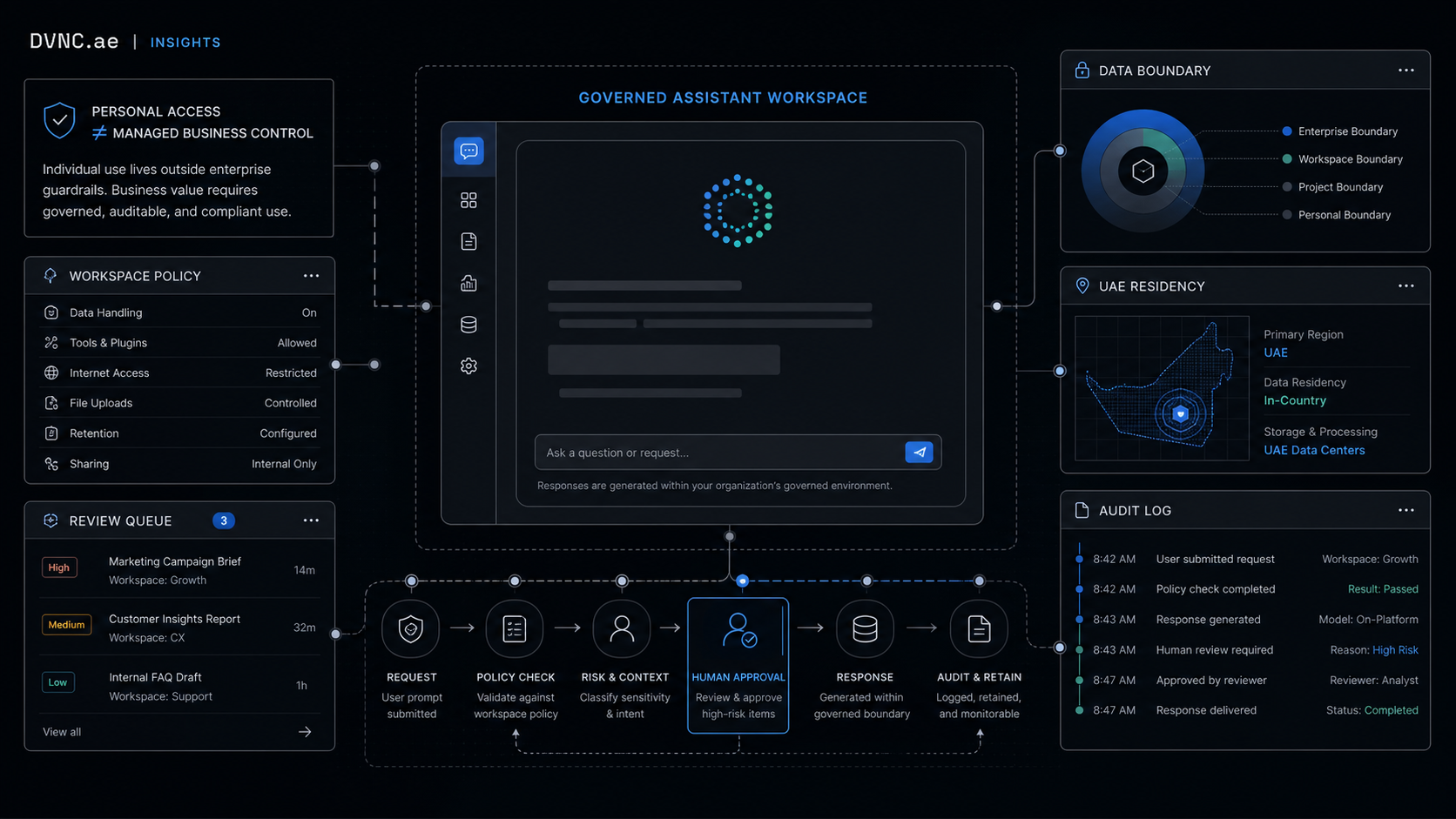
Define the words, intents, failed actions and staff decisions that trigger a human handoff. The person receiving the transfer needs the conversation context, not a cold call with no history.
Secure the exit
Put number portability, transcript export, deletion, retention, subprocessors, model-training use and account ownership in the contract. A cheap pilot becomes expensive when the clinic cannot leave cleanly.

Test the real bilingual booking path
A polished demo is not a purchase test. Run the candidate against the calls your clinic receives, on your channels, with your staff watching the handoff.
Use real call shapes
Prepare English, Arabic and code-switched enquiries using your service names, doctor names, locations, hours, deposits and rescheduling rules. Include interruptions, corrections, background noise and callers who change language mid-sentence.
Write into a safe test calendar
Ask the agent to find, create, reschedule and cancel appointments. Confirm that it repeats the doctor, location, date and time before committing the action and that failed writes do not produce false confirmations.
Force the human handoff
Introduce a symptom, an urgent concern, a request for treatment suitability and a complaint. The pass condition is a prompt transfer with context, not a confident answer from the model.
Inspect the record
Review the transcript, summary, fields written, user identity, access trail and retention behavior. Remove any medical detail the administrative workflow does not need.
An illustrative dental-clinic test makes the boundary clear. A caller asking whether the clinic offers implants and requesting the next consultation can stay in the approved booking flow. If the caller asks whether a medication makes them suitable for treatment, the agent stops and transfers the conversation to staff. No diagnosis is attempted, and the receiving person sees why the handoff happened.
The ownership logic resembles the AI receptionist buy-or-build decision for Dubai law firms, but a clinic adds PHI, clinical boundaries and health-system access to the test.

Build the cost sheet that exposes hidden spend
The usable monthly number is a ledger, not the subscription price. Ask every provider to price the same operating scenario so the totals become comparable.
Use the public prices only as anchors. The My AI Front Desk Business plan is $99 per month with 200 voice minutes per month, while TalkRight starts a managed deployment from AED 1,200 per month and scopes advanced work around volume, channels and integrations. The DVNC.ae owned build starts from AED 90,000 and places the agent on client-controlled accounts. Each price can be honest while buying a different thing.
The cost decision therefore has a simple shape:
- Choose self-serve software when the workflow is narrow, the clinic can configure and govern it, and missing channels or integrations do not matter.
- Choose a managed deployment when the clinic wants a provider to configure the channels, booking flow and handoff while the workflow remains bounded.
- Choose an owned build when integration depth, EN/AR behavior, account control, traceability and an exit path are part of the asset you are buying.
Keep medical judgment outside the agent
The safest scope is also the easiest to evaluate: automate administrative certainty and escalate clinical ambiguity.
The agent can handle:
- Approved clinic hours, locations, services and administrative policies
- Appointment discovery, booking, rescheduling and cancellation
- Minimum contact details and appointment preferences
- Approved reminders and directions
- A context-rich transfer to the correct staff member
A person should handle:
- Symptoms, urgency and clinical advice
- Diagnosis, treatment suitability and expected outcomes
- Exceptions that require professional judgment
- Complaints, distress or any conversation where the caller asks for a clinician
- Decisions that affect care or cannot be reversed safely
Frequently asked questions
How much does AI reception cost?
Public prices vary because the scope varies. My AI Front Desk publishes $20 per month for Basic and $99 per month for Business-in-a-Box; TalkRight publishes managed UAE deployments from AED 1,200 per month; DVNC.ae publishes an owned agent build from AED 90,000. Compare channels, usage, integration, governance and ownership before comparing the numbers.
Is an AI receptionist worth it?
It is worth testing when missed or repetitive administrative calls can be converted into correctly booked appointments with a reliable staff handoff. It is not worth buying when the clinic expects the agent to make clinical decisions, tolerate weak Arabic, or operate without access controls and an audit trail.
Is there a free AI receptionist?
Free trials exist. My AI Front Desk advertises a 7-day free trial, but a trial proves only what you test. It does not prove patient-data controls, production support, WhatsApp continuity, Arabic quality or clinic-system integration.
What changes the AI receptionist cost per month?
The main cost drivers are voice usage, concurrent calls, phone numbers, WhatsApp, languages, locations, calendar or EMR integration, data retention, security review, evaluation work, support and human-handoff design. Ask providers to quote the same call flow and workload.
Apply for a Build
Scope an owned EN/AR voice and WhatsApp agent around your clinic systems, data controls, evaluation set and human handoff.
Jul 18, 2026