Nvidia AI Chips in the UAE: The Operator Readiness Rule
What UAE Nvidia chip approvals mean for operators: workload readiness, data controls, vendor review, approvals, logs, and board evidence.

The Nvidia chip approval is not a shopping notice for ordinary UAE companies. It is a signal that serious UAE AI buyers need workload governance, data controls, vendor readiness, and board evidence before local or regional compute becomes easier to access.
What Actually Changed
The confirmed change is narrower, and more useful, than the headline suggests: advanced AI infrastructure in the UAE is moving from announcement to controlled deployment.
On November 19, 2025, the US Department of Commerce said it had authorized the export of advanced American semiconductors to G42 in the UAE and Humain in Saudi Arabia. Commerce said both companies are receiving approvals to purchase the equivalent of up to 35,000 Nvidia Blackwell chips, specifically GB300s, and that the approvals are conditioned on rigorous security and reporting requirements. The Bureau of Industry and Security is engaging with the companies and will monitor compliance on an ongoing basis.
That matters because it sits inside a larger UAE-US infrastructure program. The US-UAE AI Acceleration Partnership includes a 1GW AI data center as part of a planned 5GW UAE-US artificial intelligence technology cluster in Abu Dhabi. A separate Commerce statement says the campus will include 5GW of AI data-center capacity, span 10 square miles, and serve as a regional platform for US hyperscalers and large enterprises within 3,200 km, or 2,000 miles, of the UAE.
OpenAI then announced Stargate UAE as the first international deployment of Stargate and the first OpenAI for Countries partnership. OpenAI says the partnership includes G42, Oracle, NVIDIA, Cisco, and SoftBank, and includes a 1GW Abu Dhabi cluster with 200MW expected to go live in 2026. Cisco says it will provide networking, security, and observability solutions for OpenAI workloads in the initiative.
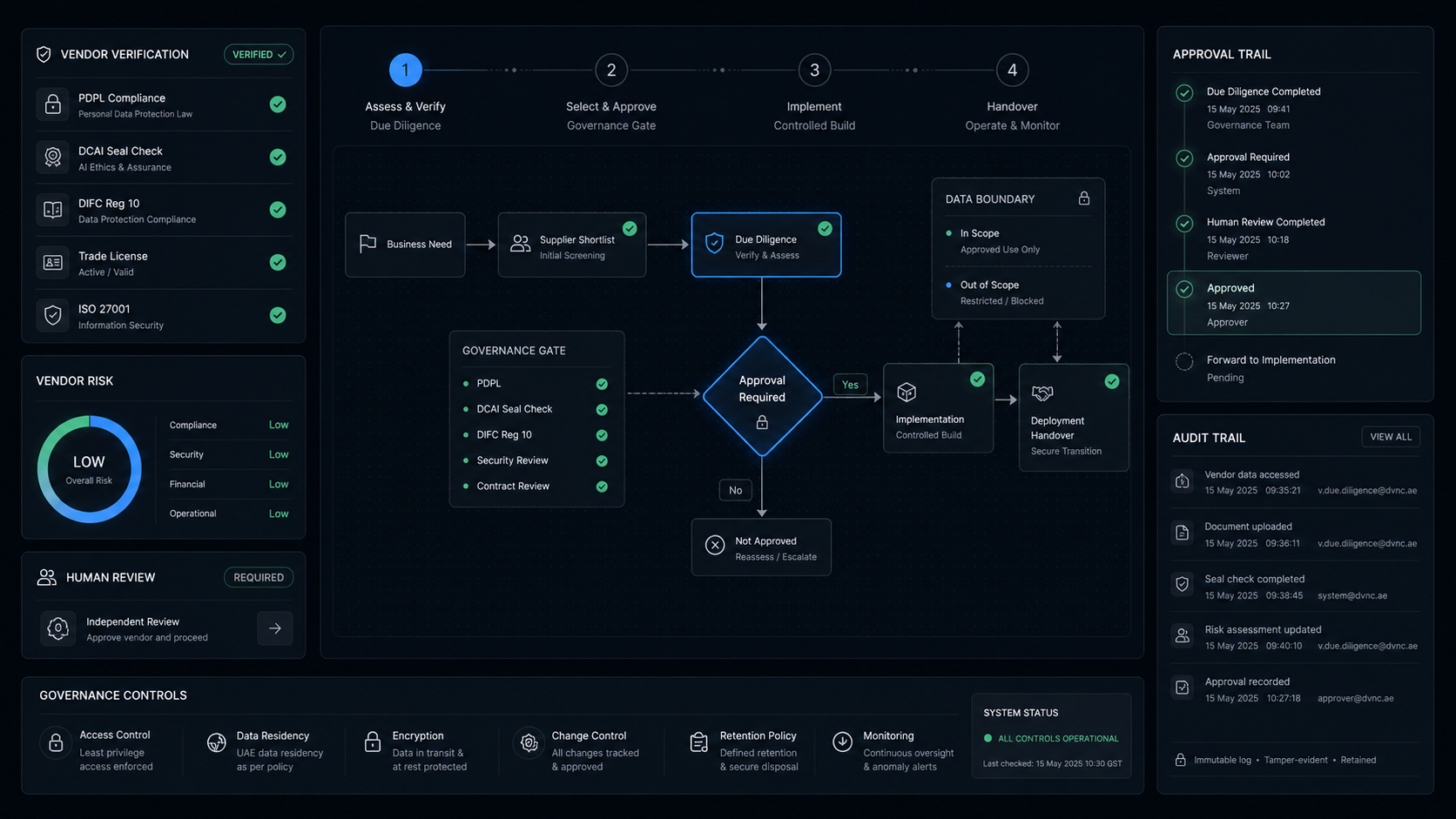
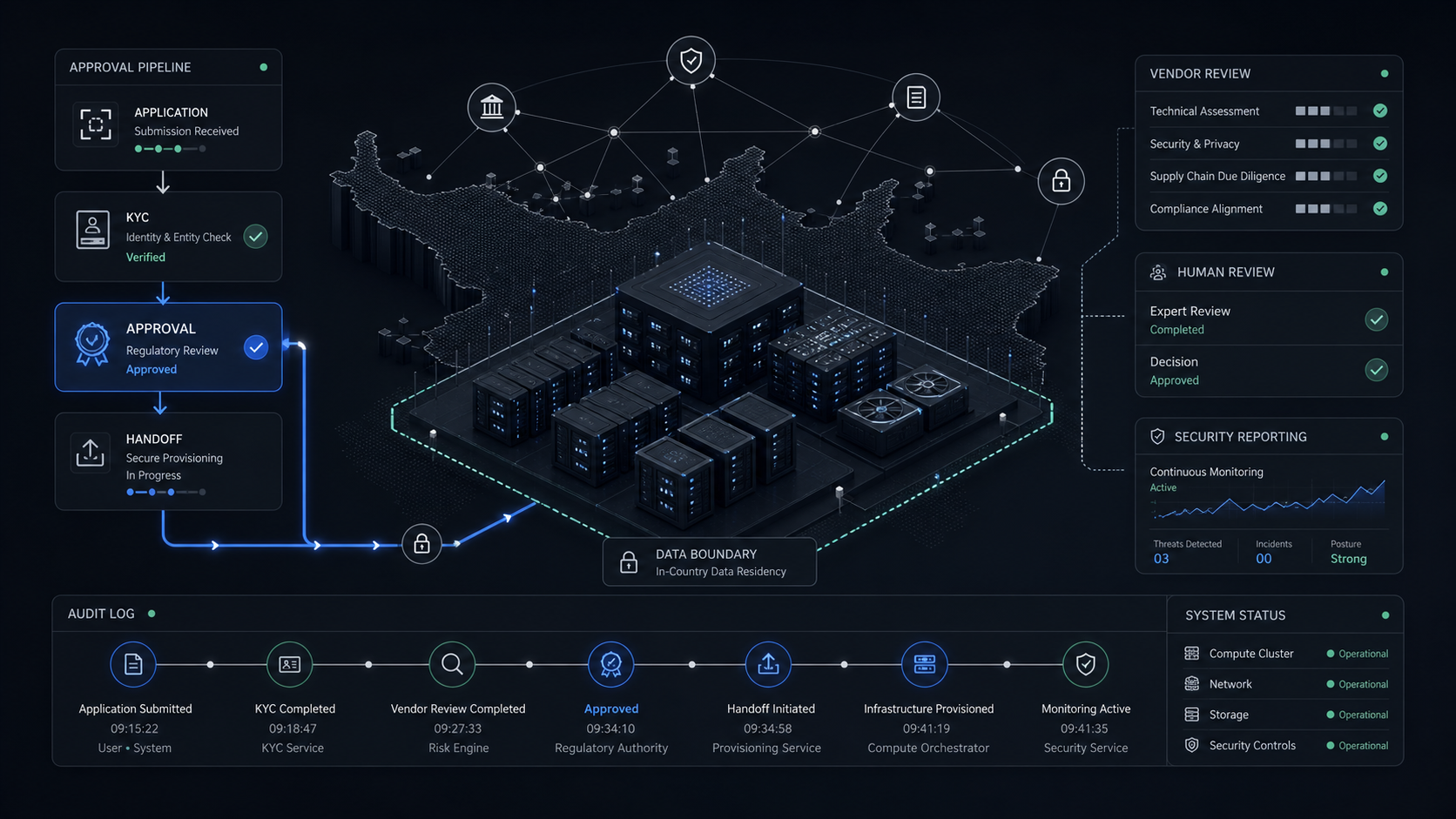
The important operator detail is access control. Commerce says the UAE and US will enhance Know-Your-Customer protocols to regulate access to compute resources, and that those resources are reserved for US hyperscalers and approved cloud service providers. G42 says deployment of advanced chips will be governed by its Regulated Technology Environment, described as a technology and compliance framework approved under US Department of Commerce and BIS guidelines.
The Operator Rule: Do Not Start With GPUs
The right first question is not "which chip can we access?" The right first question is "which UAE workflow has enough value, data quality, risk control, and volume to justify stronger compute?"
Most UAE companies do not need to train their own frontier model. They need a governed AI system that answers from approved company knowledge, triages customer requests, drafts operational documents, routes exceptions to a human, and leaves an audit trail. Better compute can help those systems run faster, support larger context, or serve more users, but it does not fix messy data, unclear approval rights, weak vendor terms, or missing privacy controls.
Use this decision rule before asking a cloud provider, vendor, or board for an AI budget:
For a UAE operator, this turns infrastructure news into a practical buying gate. If the workload cannot pass this table, better compute only helps you make poor decisions faster.
If staff are already experimenting with consumer or team AI tools, start with a governed rollout path before chasing infrastructure. The business rule in ChatGPT Plus Free in the UAE: The Business Rollout Rule applies here too: access is not readiness.
Which UAE Workloads Deserve Better Compute First
The first workloads to benefit are high-volume, evidence-heavy workflows where better AI infrastructure improves latency, retrieval, throughput, or model quality without removing human accountability.
A Dubai brokerage does not need a custom model to answer every WhatsApp lead. It needs a governed lead-intake system that classifies buyer intent, checks inventory rules, drafts a response in the right tone, and routes pricing or legal exceptions to a manager. Stronger inference can help when the system handles many chats, bilingual context, and larger property-policy documents. The control point is still the same: logs, source links, human approval for sensitive claims, and clear retention.
A clinic admin team does not need diagnostic AI as the starting point. It needs intake, scheduling, insurance-document routing, and patient-message drafting that keeps medical and personal data inside approved systems. If the workflow touches health information, the board will care less about chip type and more about data minimization, access rights, vendor processing terms, and whether staff can explain what the system did.
A DIFC or ADGM fund team should treat better compute as useful only after the document boundary is clean. Investment memos, capital-call support, compliance Q&A, and policy search can benefit from larger context and stronger retrieval. They also need source citation, role-based access, conflict checks, and a review trail before output leaves the firm.
A UAE logistics, hospitality, or construction operator can use better AI capacity for exception-heavy operations: supplier emails, purchase orders, site reports, customer complaints, and internal SOP search. The workload becomes a candidate when it has repeated volume, clear source data, measurable delay, and a human decision point.
The pattern is simple:
The wrong workload is the one with vague ownership: no data owner, no approver, no system of record, no audit trail, and no measurable business pain. That project should be scoped as an AI readiness audit before any vendor demo.
The Governance Layer To Build Before Capacity Arrives
The governance layer is not paperwork after the build. It is the system design that lets a UAE company use stronger AI without losing control of data, approvals, and accountability.
PDPL is the UAE Personal Data Protection Law, formally Federal Decree by Law No. (45) of 2021 Concerning the Protection of Personal Data. Article 5 says personal data processing must be fair, transparent, and lawful. It also says personal data must be collected for a specific and clear purpose, limited to what is necessary, and kept securely against violation, penetration, illegal processing, or unauthorized processing through appropriate technical and organizational measures.
Article 7 requires controllers to maintain a special record for personal data, including the categories of personal data, authorized access, processing times, scope, erasure or modification mechanisms, purpose, cross-border movement, and technical and organizational security measures. Article 20 requires technical and regulatory security measures suitable to processing risk, including encryption of personal data and pseudonymisation.
For an AI system, those requirements translate into practical controls:
This is where many AI projects fail procurement. A vendor demo can look polished while the underlying system cannot answer basic board questions: who accessed the data, which sources were retrieved, whether personal data left the UAE, what output was approved, and how the company can stop or correct processing.
The infrastructure news raises the bar because it normalizes more serious AI deployment in the UAE. If a provider says it can use regional compute, advanced chips, or a trusted AI corridor, your question should be precise: which legal entity processes the data, which cloud service is approved, what is logged, what is retained, where are prompts stored, who can inspect the audit trail, and which outputs require human approval?
That is also the difference between choosing a development partner and choosing a risky vendor. The buying rule in AI Development Company Dubai: The UAE Buying Rule still holds: proof beats pitch. Ask for the controls, not just the model.
The Board Brief For A 2026 UAE AI Build
A board-ready AI proposal should make the infrastructure news useful without turning it into a hardware wish list.
Name the business workflow
Write the workflow in operator language: "reduce tender-response preparation time," "route clinic appointment requests," "answer broker-policy questions," or "review investor-document packs." Avoid generic AI-program names.
Map the data boundary
List the systems the AI will read from, the fields it must not touch, and the documents that are approved for retrieval. For bilingual UAE teams, state whether Arabic and English documents are in scope and who owns translation review.
Set the human approval point
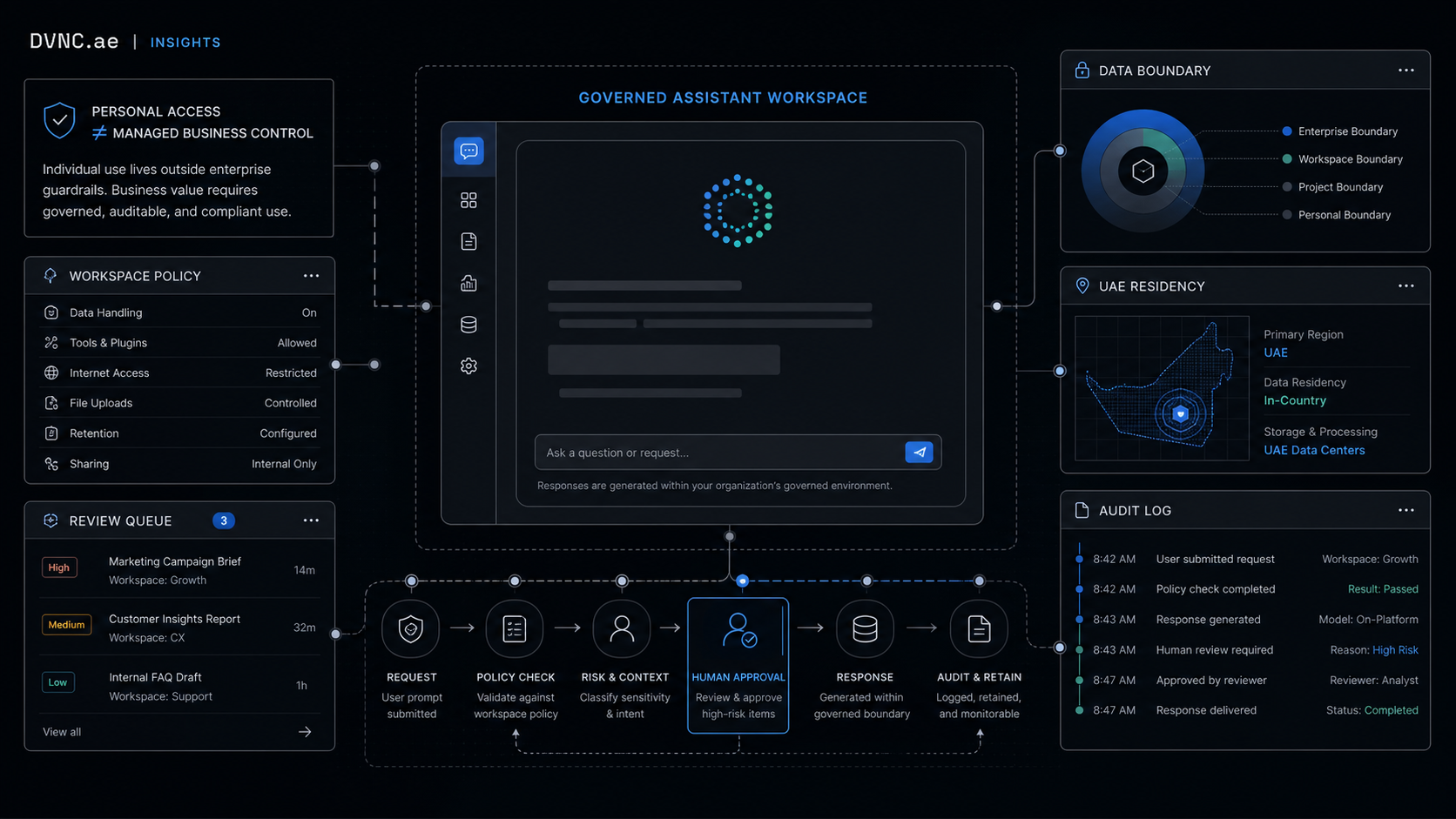
Define where the model stops. External customer messages, regulated advice, medical admin exceptions, finance outputs, legal wording, and procurement submissions should have a named human approver.
Specify the evidence trail
Require logs for user identity, prompt, retrieved sources, model output, approval status, exception reason, and final action. This is the difference between a useful system and an unprovable one.
Review the vendor path
Ask whether the system runs through a hyperscaler, approved cloud service provider, regional environment, or foreign endpoint. Then review data residency, retention, subprocessors, and audit access before deployment.
The final budget question is not "can we access better AI infrastructure?" It is "are we ready to use it in a way procurement, legal, operations, and the board will accept?"
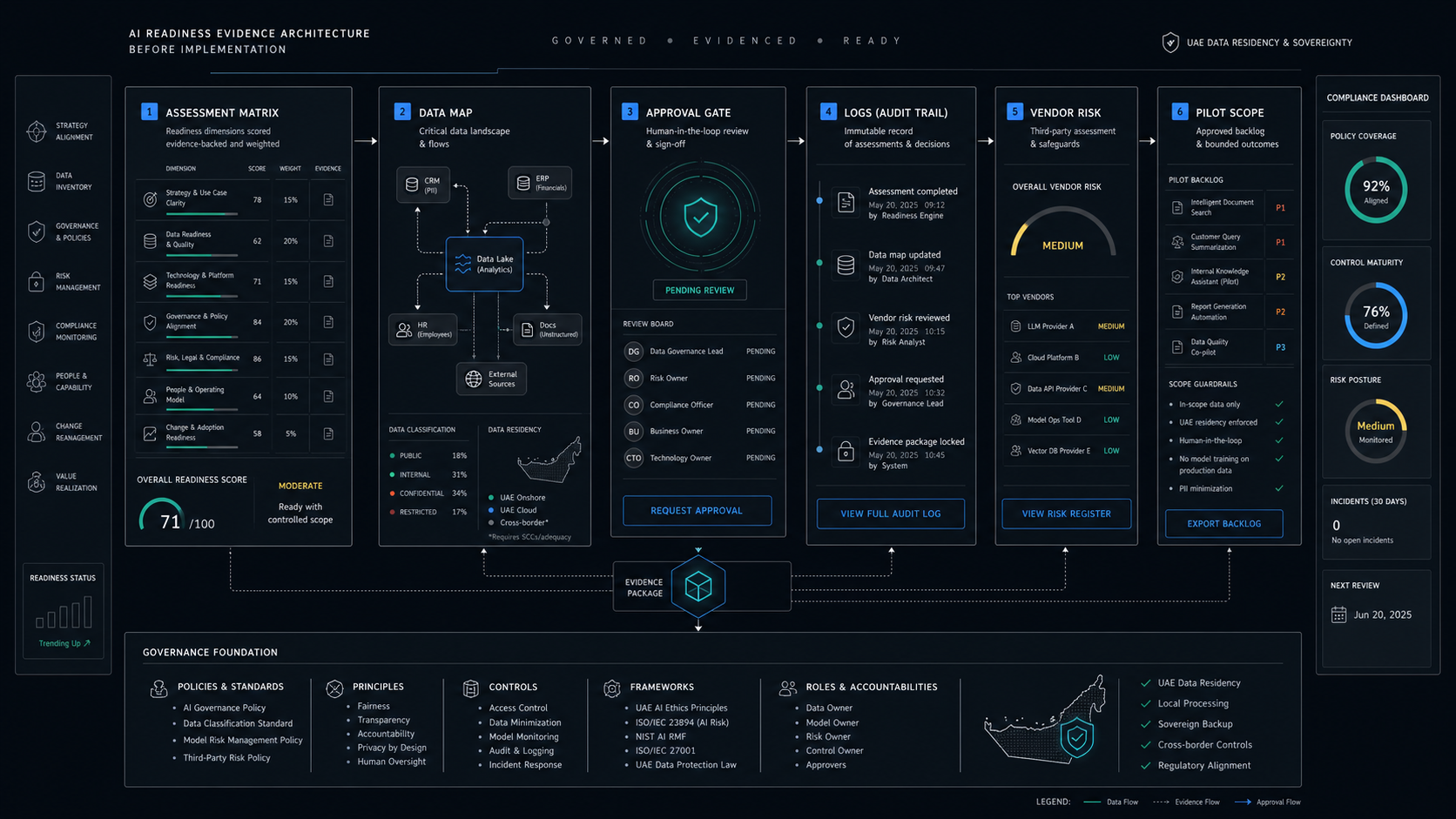
For most UAE companies, the first investment should be a readiness audit, not a model-training budget. The audit should identify which workflows are worth building, which data is usable, which risks need control, which vendor path is acceptable, and what monitoring must exist after launch.
FAQ
Is the UAE buying Nvidia chips?
The confirmed official statement is that the US Department of Commerce authorized exports of advanced American semiconductors to G42 in the UAE and Humain in Saudi Arabia, with approvals to purchase the equivalent of up to 35,000 Nvidia Blackwell GB300 chips.
Did the US approve Nvidia chips for the UAE?
Yes. Commerce announced the approvals on November 19, 2025 and said they are conditioned on rigorous security and reporting requirements, with BIS monitoring compliance.
Does this mean every UAE company can access the same chips?
No. The official campus statement says compute resources are reserved for US hyperscalers and approved cloud service providers. Ordinary UAE operators should prepare workloads, data controls, and vendor due diligence rather than assume direct chip access.
Should a UAE company train its own AI model now?
Usually no. A governed retrieval or workflow system is the better first build for most operators because it can use approved company data, keep humans in the decision path, and produce logs that procurement and the board can review.
What should a UAE company prepare before using regional AI infrastructure?
Prepare a workload brief, data map, source allowlist, vendor review, approval policy, logging design, retention rule, and monitoring plan. Those items matter more than the chip name in a real deployment.
Book AI Readiness Audit
Map the UAE workflows, data controls, vendor path, approval points, and monitoring evidence your AI system needs before you build.
Jun 9, 2026