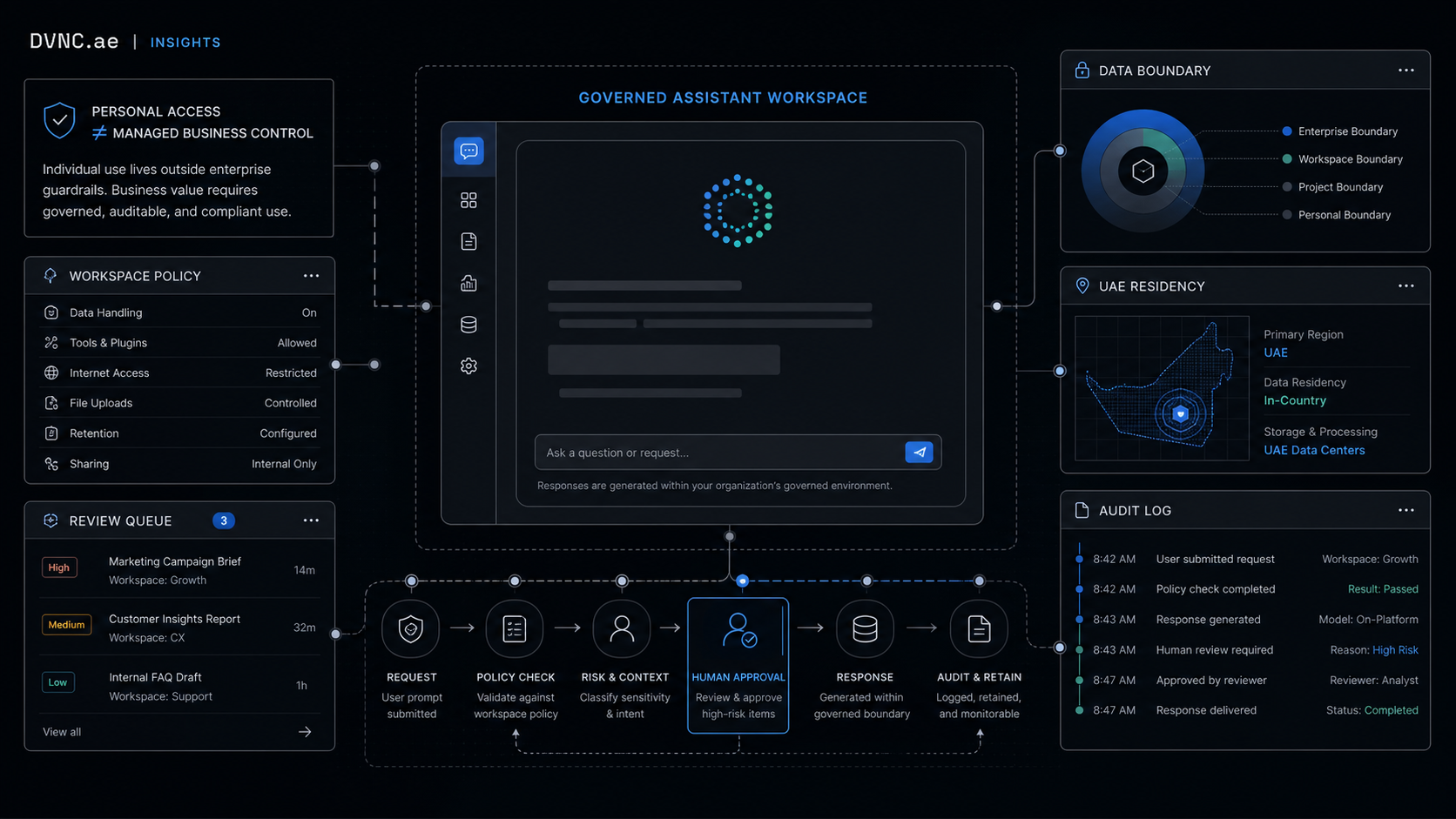
AI Readiness Assessment Services for UAE Companies: What to Check Before You Buy
Use this buyer rule before paying for AI readiness assessment services in the UAE: scope data, governance, vendors, evidence, and first builds.

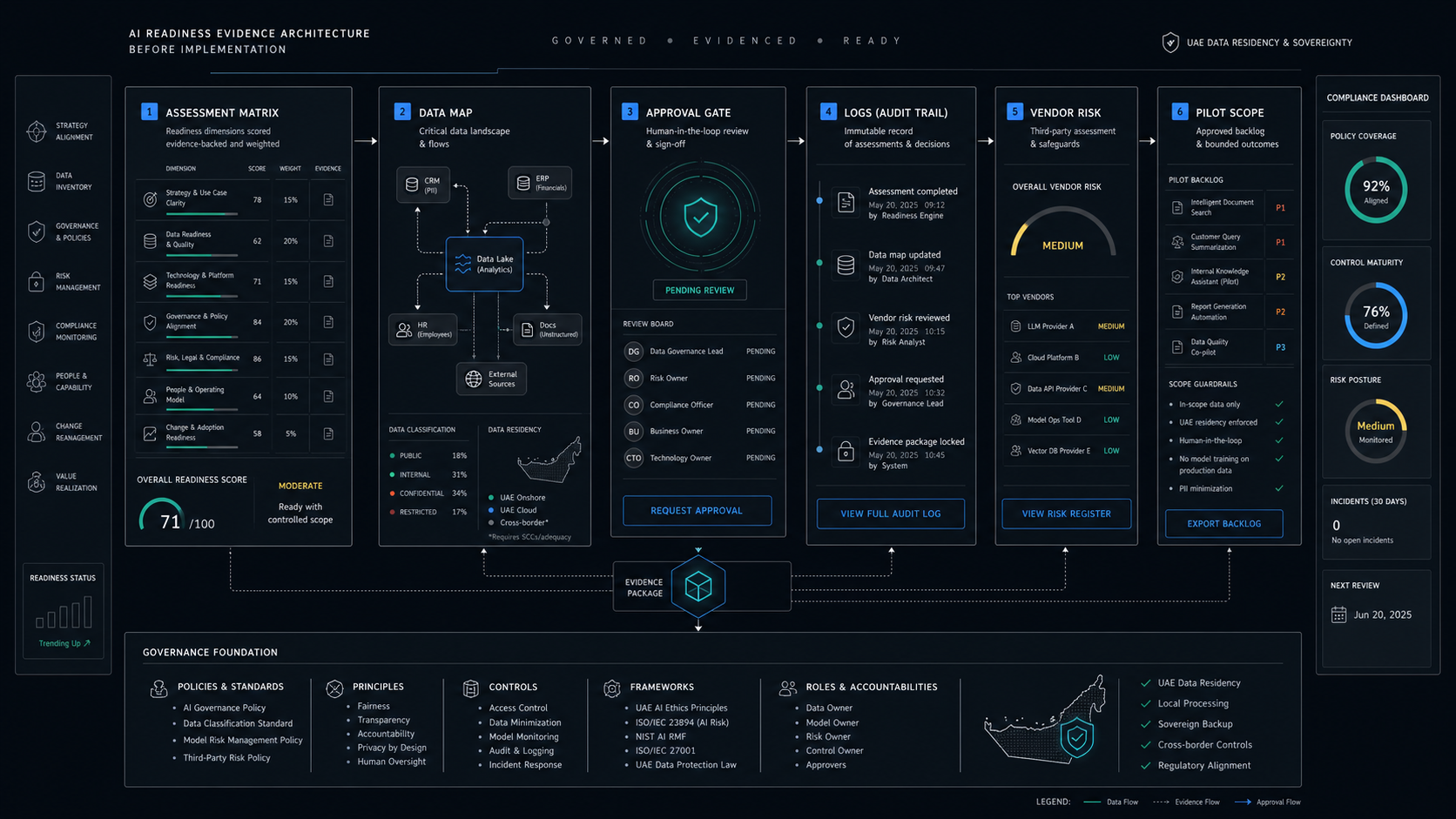
The right AI readiness assessment for a UAE company is not a maturity score. It is a governed build plan: which workflow to automate first, what data can be used, who approves model output, and what evidence will satisfy a board, regulator, or Dubai AI Seal procurement review.
The Verdict: Buy The Assessment That Produces Build Evidence
Buy the assessment that leaves you with an implementation decision, not only a dashboard. A UAE operator should finish the assessment knowing the first workflow to build, the data that can safely enter the system, the approval points that stay human, and the evidence folder a board or regulator can inspect later.
The weak version is a maturity score. It may tell you that your strategy, data, infrastructure, people, or governance are at an early stage. That can be useful for orientation, but it does not tell a brokerage which WhatsApp lead workflow to automate first, a clinic which intake step must stay under front-desk approval, or a DIFC firm whether an AI workflow touches personal data in a way that needs stronger control.
The strong version produces a build decision. It should answer five questions:
- What should we automate first? Pick one workflow with a measurable pain point, clean ownership, and low regulatory ambiguity.
- What data can the system use? Map documents, customer records, chat history, CRM fields, permissions, retention, and cross-border exposure.
- Who approves output? Define where a human reviews, edits, rejects, or signs off before anything reaches a client, patient, investor, tenant, supplier, or regulator.
- What gets logged? Record prompts, retrieved sources, tool actions, model output, approvals, overrides, and exceptions.
- What provider risk remains? Note the vendors, hosting locations, subcontractors, model policies, and support responsibilities.
That is why a generic AI readiness score is not enough for a UAE company. Readiness is only real when it can become a governed pilot.
The Three Assessment Types And When Each Fits
Most UAE companies should use a free self-assessment for orientation, then buy a local governance-first audit before paying for a build. A global advisory assessment can fit larger transformation programs, but it should not be the first paid step for every operator.
Microsoft's AI Readiness Assessment is useful as a structured first screen. The Microsoft page says the assessment measures preparedness across seven pillars: Business Strategy, AI Governance & Security, Data Foundations, AI Strategy & Experience, Organization & Culture, Infrastructure for AI, and Model Management. It also lists the assessment length as 45 and the format as multiple choice and multiple response questions, with curated and personalized guidance after completion.

RSM's public AI readiness assessment page is a useful example of the global advisory model. It says the assessment analyzes data readiness, infrastructure, talent, capabilities, and governance. It also describes a four-week engagement that delivers a comprehensive roadmap and implementation plan, with a detailed AI readiness report, strategic recommendations, and prioritized next steps.

The UAE-specific question is different. Your assessment has to translate readiness into a controlled system. If your issue is a Dubai property brokerage, the deliverable is not "AI maturity level 2." It is a decision such as: automate first-response classification for portal and WhatsApp leads, keep listing recommendations under broker approval, log every data source used for matching, and do not send buyer-facing messages without review.
That is the difference between knowing you are ready for AI and knowing which governed AI system to build first.
The UAE Governance Layer Changes The Brief
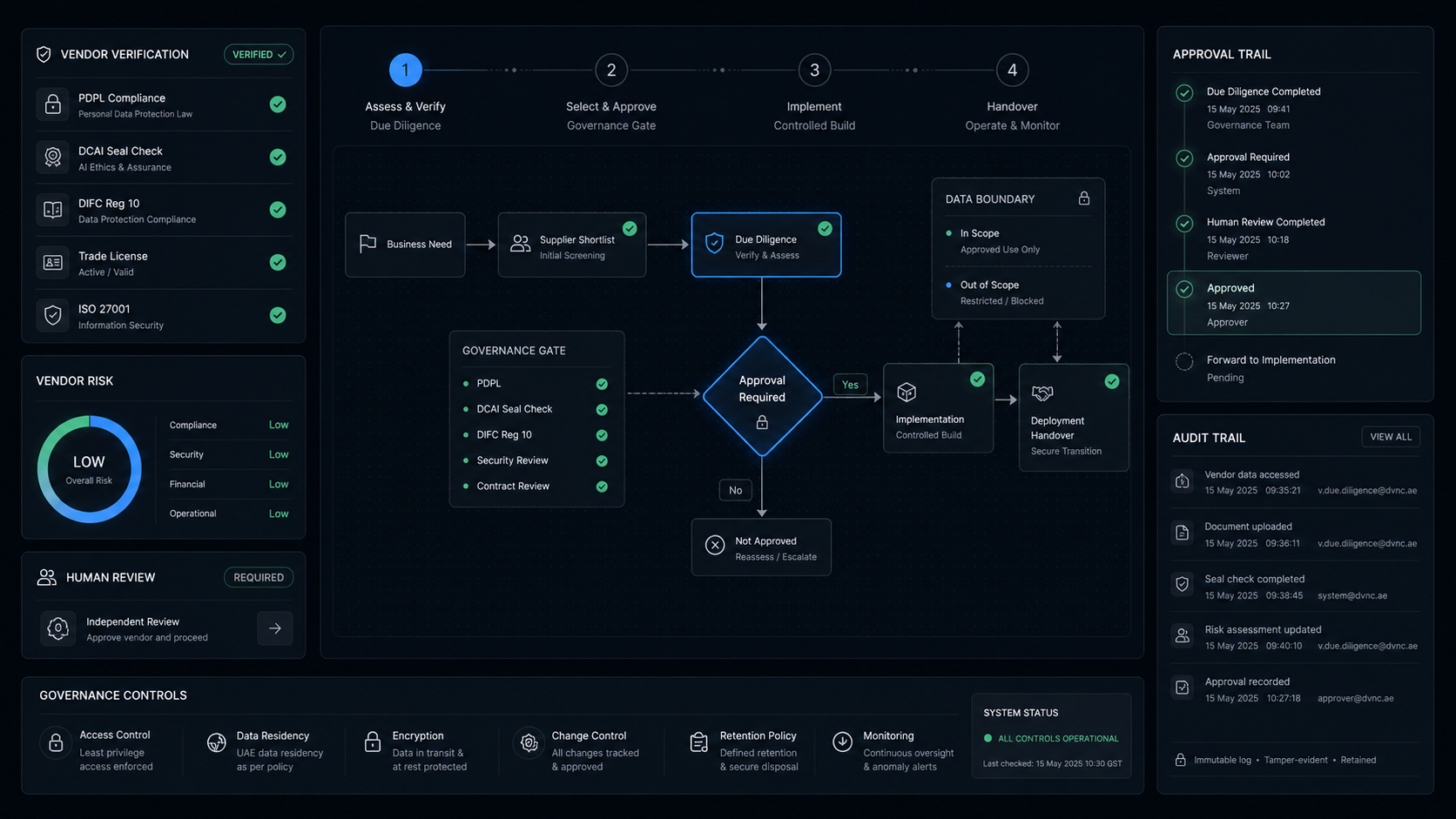
A UAE readiness assessment has to test the provider, the workflow, and the evidence trail together. This is where many generic assessments are too thin: they cover data and infrastructure, but they do not force the local procurement questions that matter in Dubai, DIFC, ADGM, clinics, real estate, and family-office operations.
Dubai's AI provider market now has an official trust signal. The Dubai AI Seal page says the Seal was developed by the Dubai Centre for Artificial Intelligence as a verification system for Dubai's AI industry. It provides an accessible source for businesses and government entities to verify AI service providers, has six tiers: E, D, C, B, A, and S, and gives each seal a unique serial number that can be checked on the Dubai AI Seal website. The same page says AI businesses of any size that operate legally in Dubai can apply online, and that the service is free of charge.
For a UAE buyer, that changes the supplier checklist. If a provider claims serious Dubai AI capability, ask whether it has a Dubai AI Seal, what tier and serial number it holds if approved, and whether the seal covers the entity actually contracting with you. The Seal is not a substitute for technical due diligence, but it is a useful anti-AI-washing screen.
DIFC exposure needs its own check. DIFC says the updated DIFC Data Protection Regulations enacted on September 1, 2023 include Regulation 10 on Processing Personal Data through Autonomous and Semi-autonomous systems, i.e. artificial intelligence (AI). The same official page says Regulation 10 addresses privacy and security issues around AI and other advanced IT while providing a platform for principles, ethics, and governance. It also lists approved documents and forms, including an Accreditation and Certification Framework and Regulation 10 Certification.
That does not mean every UAE company has a DIFC Regulation 10 issue. It does mean a DIFC or DIFC-adjacent operator should not buy an AI readiness assessment that ignores autonomous and semi-autonomous processing of personal data. A fund workflow that summarizes investor documents, a compliance assistant that drafts suitability notes, or a client-service agent that acts on account data needs a different evidence folder from a public marketing copy assistant.
Classify the workflow
Name the workflow in plain language: lead response, clinic intake, supplier triage, investment memo review, HR policy search, invoice routing, or customer support.
Mark the regulated data
List the personal, financial, medical, tenancy, employee, or confidential business data the workflow touches. Do not start with the model. Start with the records.
Set the human approval point
Decide where the system can suggest and where a person must approve. For UAE operators, the approval point is often the difference between an internal assistant and a customer-facing risk.
Define the audit trail
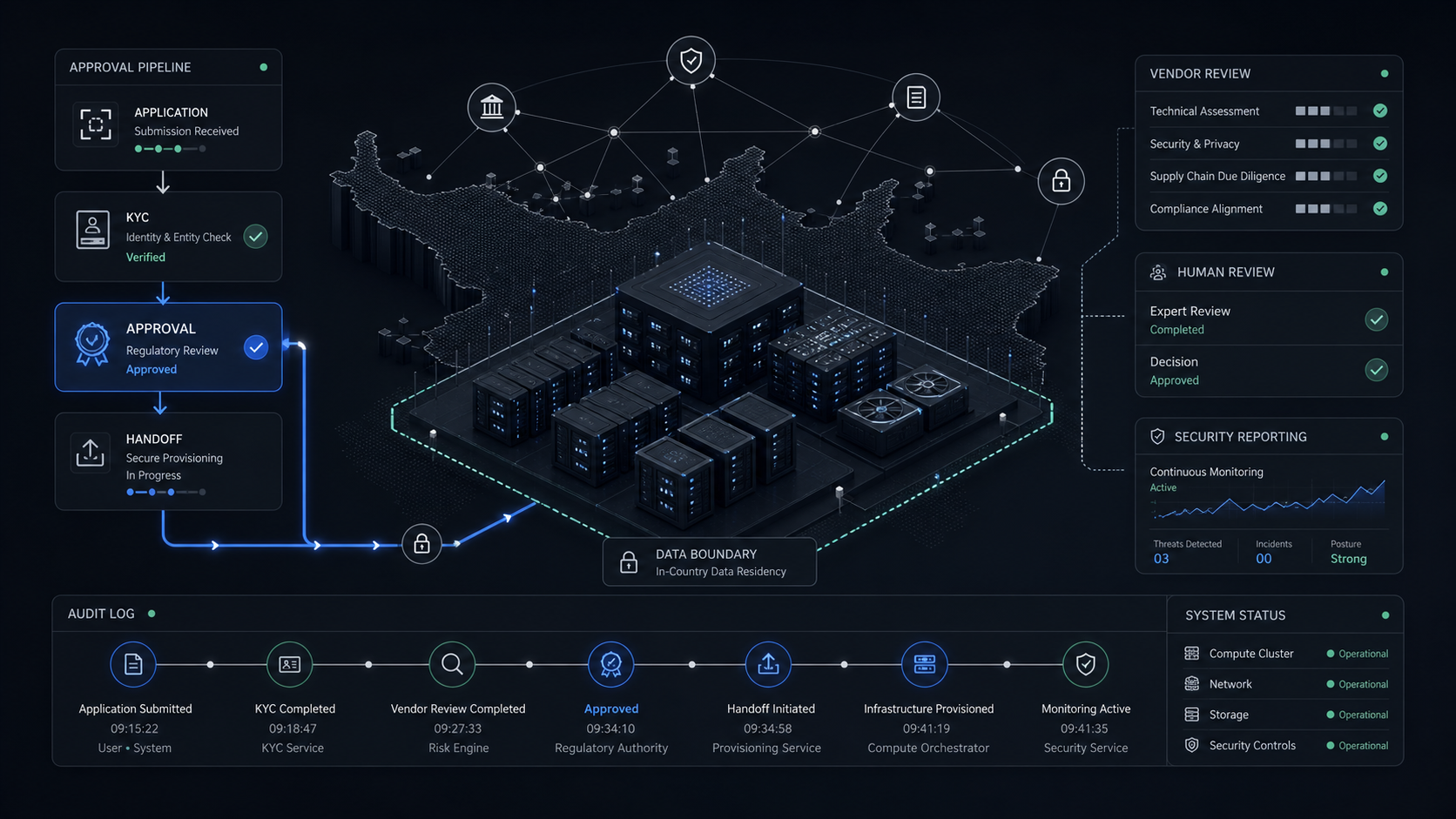
Record input source, retrieved document, model output, human decision, timestamp, and override reason. If the system cannot explain what happened, it is not ready for regulated use.
Review the supplier
Check the provider's legal entity, Dubai AI Seal status if relevant, data handling terms, hosting options, subcontractors, deletion process, and support obligations.
This is the part to solve before you sign an implementation agreement. The buying rule is simple: if the assessment does not tell you what gets logged, where humans approve, where data lives, and what the regulator or board can inspect, it has not done the UAE job.
The 10-Business-Day Scope A UAE Operator Can Use
A practical readiness audit can be scoped in 10 business days if the company already knows the area of the business it wants to improve. The aim is not to solve every AI question. The aim is to choose the first governed build with enough evidence to approve or stop.
Here is a clean scope for a UAE operator.
Days 1 And 2: Business Value And Workflow Selection
Pick three candidate workflows and score them by value, risk, and data quality. A real estate brokerage might compare portal lead response, landlord document collection, and listing description QA. A clinic might compare appointment scheduling, insurance pre-checks, and patient intake summaries. A family office might compare investment memo summarization, document search, and meeting-note action tracking.
Use a simple score:
The first build is usually the workflow with high pain, usable data, and a clear approval point. Do not start with the most impressive AI demo. Start with the workflow that can survive review.
Days 3 And 4: Data Map And Access Rules
Map the data sources before choosing tools. For each source, record owner, location, access method, sensitivity, update frequency, and deletion rule.
A brokerage might list CRM leads, WhatsApp exports, listing inventory, broker notes, call summaries, and email templates. A clinic might list appointment records, intake forms, insurance documents, front-desk notes, and patient communications. A fund might list pitch decks, capital statements, KYC files, investment memos, email attachments, and meeting notes.
The key is not volume. The key is permission. If the workflow needs a record the business cannot safely expose to a model or vendor, the pilot needs a different architecture.
Days 5 And 6: Governance And Approval Design
Define the system boundary in operational language. What can the AI draft, retrieve, classify, summarize, or route? What can it not do? Where does a human approve?
For a UAE clinic admin workflow, the safer first build might summarize intake notes for staff review, not diagnose or recommend treatment. For a brokerage, the safer first build might classify buyer urgency and suggest next actions for broker approval, not send unapproved promises to clients. For a family office, the safer first build might retrieve source-backed document answers, not make investment recommendations.
This is also where you decide the logs. A readiness assessment should specify prompt logs, retrieved-source logs, output logs, human approvals, rejected outputs, override reasons, and escalation events.
Days 7 And 8: Vendor And Architecture Review
Review the likely vendors and deployment model. The question is not "which model is best?" The question is "which stack can handle our data, controls, and support obligations?"
Ask for model-provider terms, data-retention settings, hosting region options, access control, admin logs, export options, deletion terms, incident support, and subcontractors. If the provider is an AI services company in Dubai, ask about Dubai AI Seal status and verify any serial number directly on the official Seal site.
If you are still choosing between build partners, read the buying-rule detail in /blog/ai-development-company-dubai-buying-rule before you let a demo drive the procurement.
Days 9 And 10: Pilot Backlog And Board Memo
End with a decision memo. It should name the selected workflow, the reason it was chosen, the expected business value, the blocked workflows, the risk controls, the implementation sequence, the owner, and the pilot acceptance criteria.
The memo should include:
- Workflow map.
- Data map.
- Approval model.
- Logging requirements.
- Vendor-risk notes.
- First-build backlog.
- Open legal or security questions.
- Go, hold, or stop recommendation.
If the memo says the first purchase should be infrastructure, challenge it. The UAE operator readiness rule is usually to prove workflow value and governance first, then scale capacity. The infrastructure-first version of that rule is covered in /blog/nvidia-ai-chips-uae-operator-readiness.
The Provider Questions That Prevent A Bad Buy
The safest way to buy AI readiness assessment services is to ask for deliverables before methodology. Framework names matter less than the evidence you will hold after the work.
Ask these questions in the first call:
- What evidence will we receive at the end?
- Which UAE or free-zone governance issues will you screen for?
- Will you review actual workflows, or only interview leadership?
- Will you map data sources, permissions, and retention?
- Will you review vendor terms and subcontractors?
- Will you define human approval points?
- Will you specify logs and audit trails?
- Will the output include a ranked pilot backlog?
- Will the memo say what not to build yet?
- Who owns implementation after the assessment?
The best providers are comfortable saying no. They will block a glamorous pilot if the data is messy, the approval path is unclear, or the vendor cannot support your evidence needs. That is not pessimism. It is how a UAE company avoids a failed AI project, a procurement mistake, or an unreviewable system.
FAQ
What is an AI readiness assessment tool?
An AI readiness assessment tool is a structured questionnaire or assessment workflow that checks how prepared a company is to adopt AI across strategy, governance, data, people, infrastructure, and model-management areas. Microsoft's assessment is a useful example because it covers seven pillars and gives personalized guidance after completion.
Is the Microsoft AI Readiness Assessment enough for a UAE company?
It is enough for a first screen, not for procurement approval. A UAE operator still needs a local evidence pack covering regulated data, vendor terms, human approvals, logs, and the first workflow to build.
What should an AI readiness assessment framework include?
It should include business value, data readiness, governance and security, people readiness, infrastructure, vendor risk, model management, and a build roadmap. In the UAE, it should also define what gets logged, where a human approves, and what evidence a board or regulator can review.
Should we download an AI readiness assessment PDF before hiring a provider?
Use a PDF or checklist to prepare internally, but do not treat it as the decision artifact. The paid assessment should convert checklist answers into a workflow map, data map, approval design, vendor notes, pilot backlog, and go or stop recommendation.
How do we know whether a Dubai AI provider is credible?
Ask for the provider's legal entity, relevant experience, references, data handling terms, and Dubai AI Seal status if it claims to provide AI services in Dubai. The official Dubai AI Seal page says each approved seal includes a unique serial number that can be verified.
Book AI Readiness Audit
Scope the first governed AI build for your UAE company: workflow, data, approvals, vendors, audit trail, and board-ready next steps.
Jun 16, 2026