AI Development Company Dubai: The UAE Buying Rule
How UAE companies should choose an AI development partner in Dubai: proof, PDPL controls, Dubai AI Seal checks, approvals, data movement, and scope.

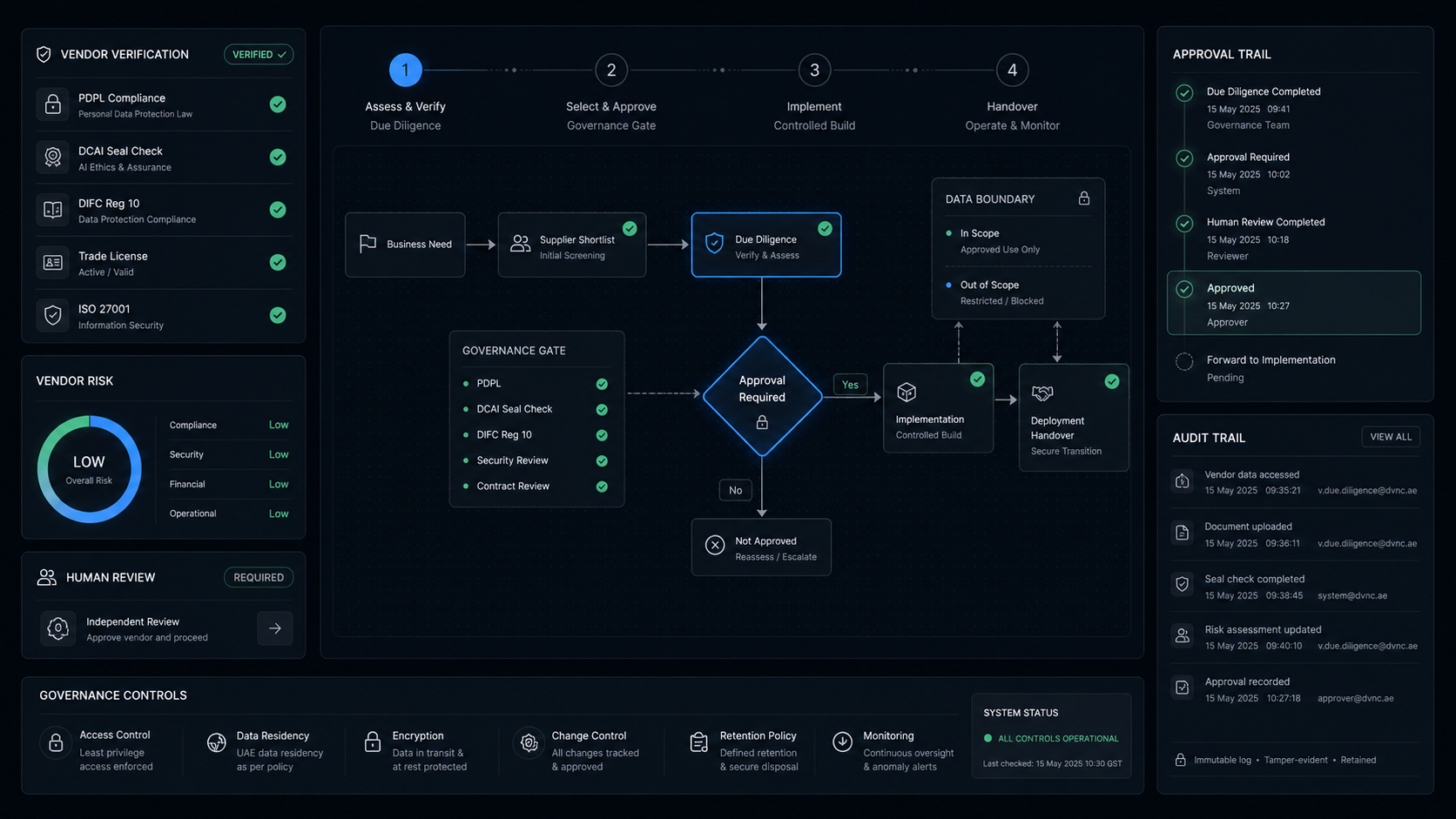
Choose the AI development company in Dubai that can prove the workflow, the data boundary, and the approval trail before it sells you the model. A polished demo is not enough for a UAE board: the right partner can show what gets logged, which humans approve, where personal data moves, and how the first use case survives PDPL, DIFC, and Dubai AI Seal scrutiny.
The Verdict: Hire For Governed Delivery, Not AI Theater
The right AI development company in Dubai is not the one with the broadest demo library. It is the one that can turn one real workflow into a governed production system, with scope, data controls, human approval, logs, and handover evidence clear enough for your board, legal counsel, and operations lead to inspect.
For a UAE company, the first buying mistake is asking, "Can you build an AI chatbot, agent, or automation?" The sharper question is, "Can you prove the exact workflow, the data it touches, the decision it influences, the person who approves it, and the record it leaves behind?"
That difference matters because AI work in the UAE is no longer a lab experiment. Staff may already be using ChatGPT. Brokers may be feeding WhatsApp leads into CRMs. Clinics may want intake summaries. Fund teams may want faster document review. Each case touches permissions, personal data, vendor access, and operational accountability.
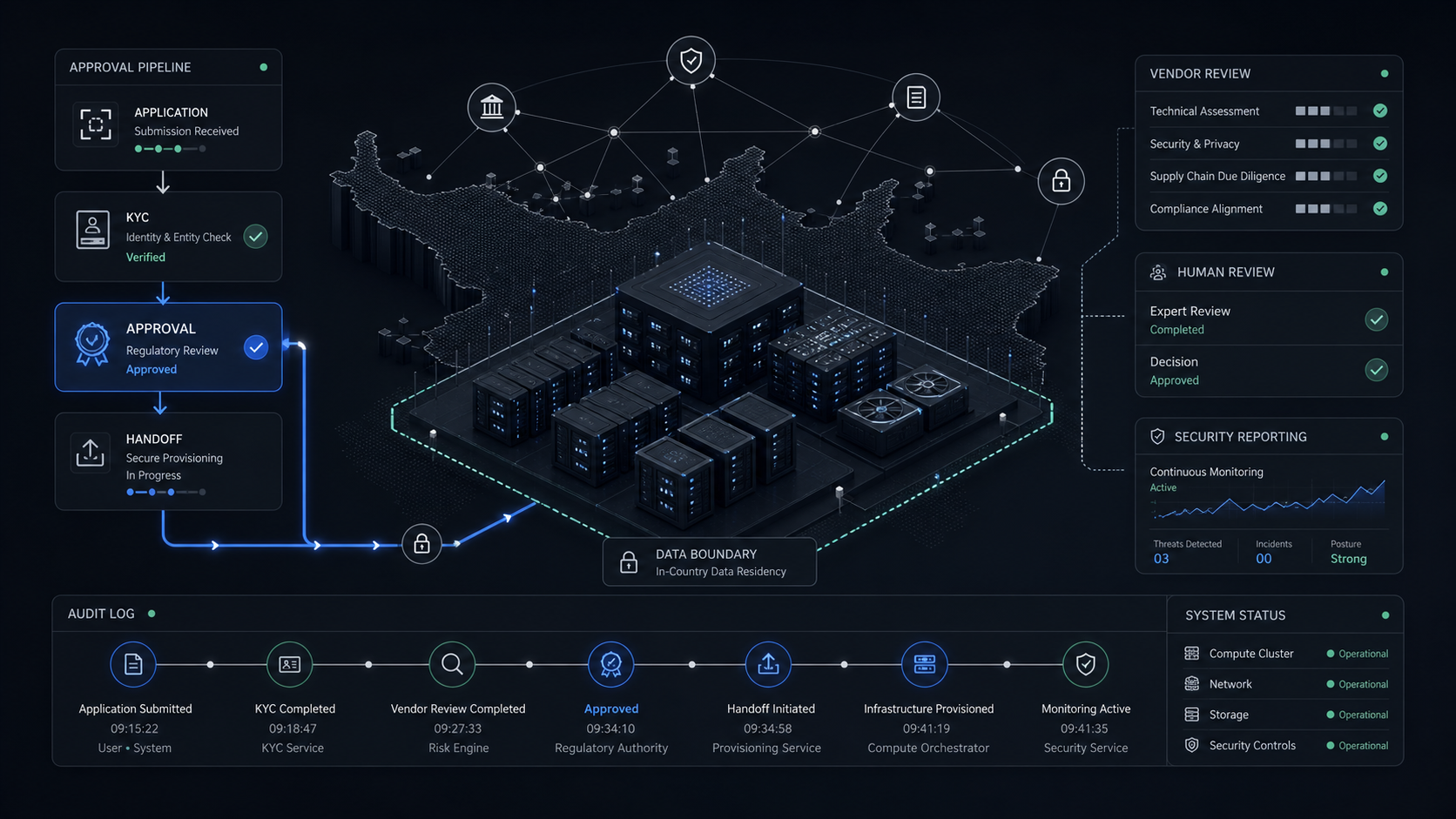
Use this buying rule: shortlist the provider only after it can produce a one-page control map for the first workflow. If it cannot explain the control map before the sales proposal, it will probably struggle to build the control layer after the invoice.
The Shortlist Test: Five Questions Before The First Demo
Your first vendor screen should be operational, not theatrical. Before you watch a demo, ask five questions that expose whether the company understands UAE delivery conditions.
Name the workflow
Ask: "Which exact workflow would you build first, and why?" A useful answer sounds like this: "For your brokerage, start with portal and WhatsApp lead triage into the CRM, then route hot leads to brokers with a manager-review log." A weak answer starts with model names and generic productivity claims.
Map the data classes
Ask which data the workflow reads, writes, stores, and sends outside your environment. In a clinic intake workflow, that may include patient contact details, appointment history, insurance notes, and staff comments. In a real-estate workflow, it may include buyer names, phone numbers, budgets, property preferences, and broker notes.
Define the legal roles
Ask whether your company is the controller and whether the AI provider is a processor for personal-data handling. Under the UAE Personal Data Protection Law, a controller determines the purpose and method of processing personal data, while a processor handles it on the controller's behalf under instructions. That split affects contracts, records, breach handling, and access.
Set the approval boundary
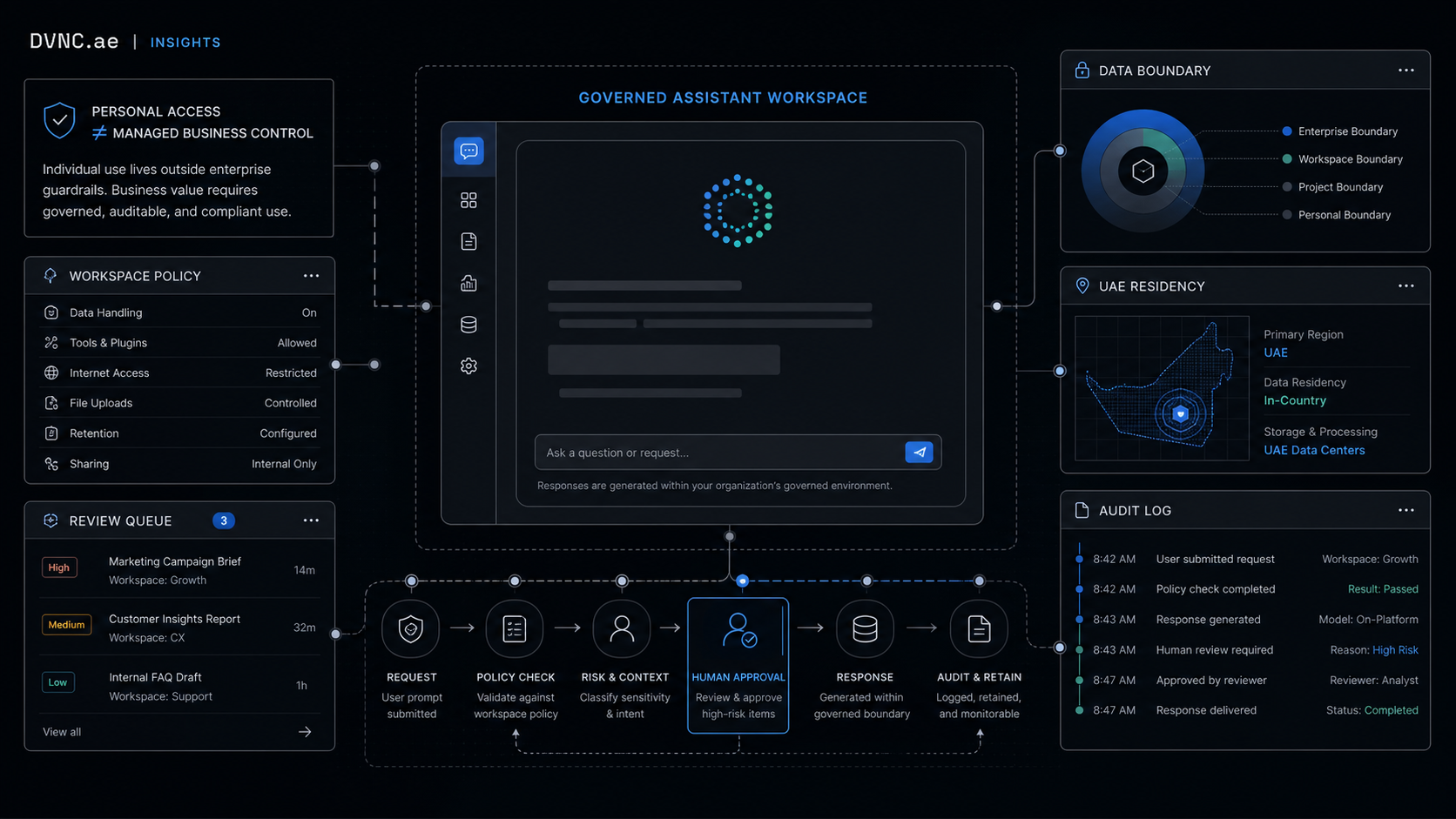
Ask what the system can do without approval. A safe first build usually starts at observe or advise: read-only retrieval, summaries, drafts, routing recommendations, or classification. If the system writes to a CRM, sends messages, changes records, or triggers a payment or booking, require explicit human approval and an audit trail.
Demand the handover evidence
Ask what you receive after the first sprint. You should expect a workflow map, data map, role matrix, test log, prompt or policy register where relevant, rollback plan, incident path, and admin handover. If the answer is only "source code" or "dashboard access," the implementation is under-specified.
A strong provider will not treat these questions as bureaucracy. They are the delivery spine. They show whether the company can work with WhatsApp, CRM records, bilingual Arabic/English content, approvals, and board-level risk without turning the project into a policy deck.
For staff adoption context, the same principle applies to general AI rollouts: a tool launch needs a control layer around who can use it, what data is allowed, and what gets reviewed. DVNC.ae covered that in the ChatGPT Plus UAE business rollout rule.
Dubai AI Seal Is A Filter, Not The Whole Due Diligence
Dubai AI Seal is a useful first filter for AI suppliers, but it is not a replacement for project-specific due diligence. Use it to verify that a company is part of Dubai's trusted AI supplier surface, then still test whether it can deliver your workflow safely.
The official Dubai AI Seal page says the Seal is developed by the Dubai Centre for Artificial Intelligence, or DCAI, as a verification system for AI enterprises. Its stated objectives include giving businesses and government entities an accessible way to verify AI service providers, expanding business opportunities for AI companies, and recognising AI companies' economic contribution to Dubai.
The Seal has six tiers: E, D, C, B, A, and S. The page says those tiers are based on the nature of a company's activities and services, current and future projects, and economic contribution to the AI sector. Each Seal has a unique serial number, and organisations can verify the supplier by checking that serial number on the Dubai AI Seal website.
That is valuable because the same page states a buyer benefit directly: protection from irrelevant suppliers and AI washing. AI washing is when a vendor markets ordinary software, dashboards, outsourced scripting, or generic automation as serious AI capability.
Here is the practical buying rule:
The Seal helps remove obvious weak suppliers. It does not answer whether your customer data should enter the model, whether a DIFC workflow needs a Regulation 10 clause, or whether a broker can send an AI-drafted WhatsApp message without manager review. Those answers come from project design.
The PDPL Layer To Ask For In Writing
PDPL is the UAE Personal Data Protection Law, formally Federal Decree by Law No. 45 of 2021 Concerning the Protection of Personal Data. The UAE legislation portal lists it as active, issued on 20 September 2021 and effective on 2 January 2022. For AI procurement, the important point is not the law's title. It is the evidence your provider can produce before personal data enters the system.
The UAE legislation portal defines personal data broadly and defines automated processing as processing carried out by an electronic program or system operating automatically, either fully without human intervention or partly with limited human supervision and intervention. That definition is directly relevant to AI workflows that classify, summarise, recommend, route, or act on customer, patient, staff, tenant, investor, or lead information.
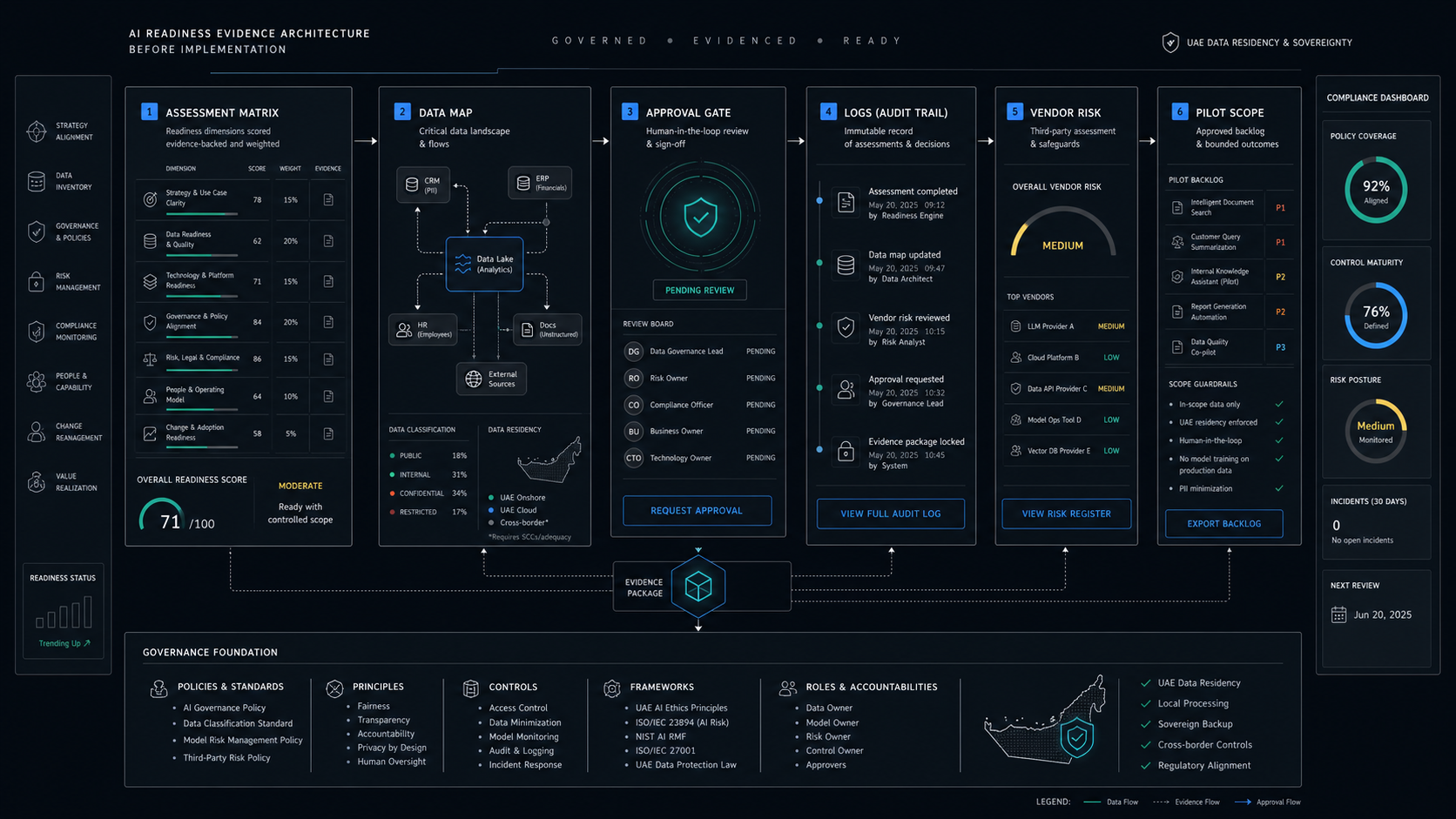
Ask your provider to give you this PDPL evidence pack before the pilot:
This is where many AI proposals become too vague. "We are secure" is not evidence. "Data is private" is not a control. For a UAE operator, the minimum useful answer is a mapped workflow: CRM lead arrives, AI classifies it, broker sees the draft, manager can review exceptions, system logs prompt, source, output, user, approval, and final action.
If the provider wants to train on your data, fine-tune a model, store conversation history, connect to WhatsApp, or read sensitive personal data, the evidence bar rises. Sensitive data includes health and biometric data under the PDPL definitions. A clinic intake workflow, facial-recognition access workflow, or staff-performance workflow needs stronger review than a public FAQ assistant.
This is also why a readiness audit should happen before a build contract. The audit separates simple, low-risk retrieval or drafting from workflows that need legal review, impact assessment, procurement controls, or a different architecture.
DIFC And Fund Workflows Need A Stronger AI Clause
DIFC workflows need a stronger AI clause when the system processes personal data through autonomous or semi-autonomous systems. DIFC Regulation 10 is not a generic AI slogan. DIFC says the updated Data Protection Regulations enacted on 1 September 2023 include Regulation 10 on processing personal data through autonomous and semi-autonomous systems, including AI.
For a fund, family office, wealth manager, fintech, or regulated financial operation, that changes the vendor conversation. The AI provider should not only show model capability. It should explain how the workflow fits personal-data processing, decision support, access boundaries, evidence retention, and escalation.
Use this clause pattern in the statement of work:
DIFC also lists a Regulation 10 Accreditation and Certification Framework and approved Accredited Certification Bodies. That does not mean every AI workflow needs external certification. It means the provider should know the surface exists and should not treat DIFC data work as a normal software feature.
A practical fund example: an AI assistant that summarises investor emails and drafts responses can stay in an advise pattern, with humans sending every message. A system that updates investor records, changes risk classifications, or triggers follow-up sequences needs stricter approval, logging, and rollback design. The more the system can act, the more specific the controls must become.
For broader board controls, see DVNC.ae's AI governance compliance UAE guide.
Scope The First Build Like A Risk-Controlled Sprint
The first AI build should be a controlled sprint with one workflow, one owner, one metric, and one governance boundary. Do not start with a multi-department platform unless your team already has clean data access, mapped approvals, and operational ownership.
Gartner's 26 May 2026 agent-governance note is useful here because it gives a practical autonomy model. Gartner says that by 2027, 40% of enterprises will demote or decommission autonomous AI agents due to governance gaps found only after production incidents. It recommends proportional governance across distinct autonomy levels.
Translate that into a UAE buying frame:
For most UAE companies, the first production sprint should land in observe, advise, or act with approval. That is not timid. It is how you protect value. A broker who gets ranked leads with source notes and approval history has a useful tool. A clinic admin team that gets drafted intake summaries with human review has a useful tool. A finance team that gets document retrieval with citations has a useful tool.
The sprint should produce four things:
- A working workflow in a real operating surface, not a standalone demo.
- A control pack covering data, access, approval, logs, testing, fallback, and owner.
- A metric tied to operations, such as response time, queue reduction, accuracy of routing, or manual review load.
- A next-step decision: expand, hold, redesign, or stop.
The provider should also show the support model. Who fixes broken retrieval? Who reviews bad outputs? Who owns prompts, model settings, and integration credentials? Who confirms that a CRM field change did not break routing? AI systems fail in dull places: stale permissions, bad source documents, missing approval records, and unclear ownership.
The Red Flags That Should End The Procurement
End the procurement if the provider cannot explain where your data goes. A Dubai company does not need a long architecture document on day one, but it does need a simple data path: source system, processing layer, model or tool, storage, logs, human reviewer, and any cross-border transfer.
End it if the provider sells broad automation before it understands approvals. In a UAE operating context, the question is not how much a system can do. It is which action it is allowed to take, who approves it, and what record remains.
End it if the provider treats governance as a PDF written after launch. Governance belongs in the workflow design: permissions, logs, review queues, rollback, data-retention rules, and breach escalation.
End it if the proposal cannot name a first metric. "Better productivity" is not a metric. "Reduce broker response time from four hours to one hour for portal leads during business hours" is a metric. "Cut manual intake classification from ten minutes to three minutes with 95% staff-reviewed accuracy" is a metric. Label those as project targets, not promised outcomes, until the sprint validates them.
End it if the provider skips handover. A real implementation leaves your team with an admin guide, runbook, test evidence, owner matrix, and a clear path for support. Otherwise you bought a dependency, not a system.
Who are the top AI companies in Dubai?
Do not start with a ranked list. Start with the company that can prove your workflow, data boundary, approval trail, and support model. Directory rankings are useful for discovery, but they do not replace due diligence.
Is a Dubai AI Seal enough to hire an AI company?
No. Dubai AI Seal is a useful verification filter because it gives buyers a way to verify AI suppliers and reduce AI washing risk, but you still need project-specific checks for PDPL handling, approvals, logs, integrations, and handover.
What should a UAE company ask before hiring an AI development company?
Ask for the first workflow, data map, controller and processor split, approval points, audit evidence, support owner, and success metric. If the provider cannot answer those before a demo, the project is not scoped tightly enough.
Should the first AI project be a chatbot?
Only if the chatbot is connected to a governed workflow. A public FAQ bot is different from a RAG knowledge assistant over internal documents, and both are different from a WhatsApp or CRM assistant that handles customer personal data.
Does a UAE AI project need a data impact assessment?
When the workflow uses modern technologies in a way that poses high risk to privacy and confidentiality, UAE PDPL Article 21 points to impact evaluation before processing. The practical move is to screen every first AI workflow for personal data, sensitive data, automated processing, and cross-border transfer before launch.
Book AI Readiness Audit
Assess the workflow, vendor risk, data controls, and rollout plan before you sign the AI build.
Jun 8, 2026